



What We’re Watching This Week
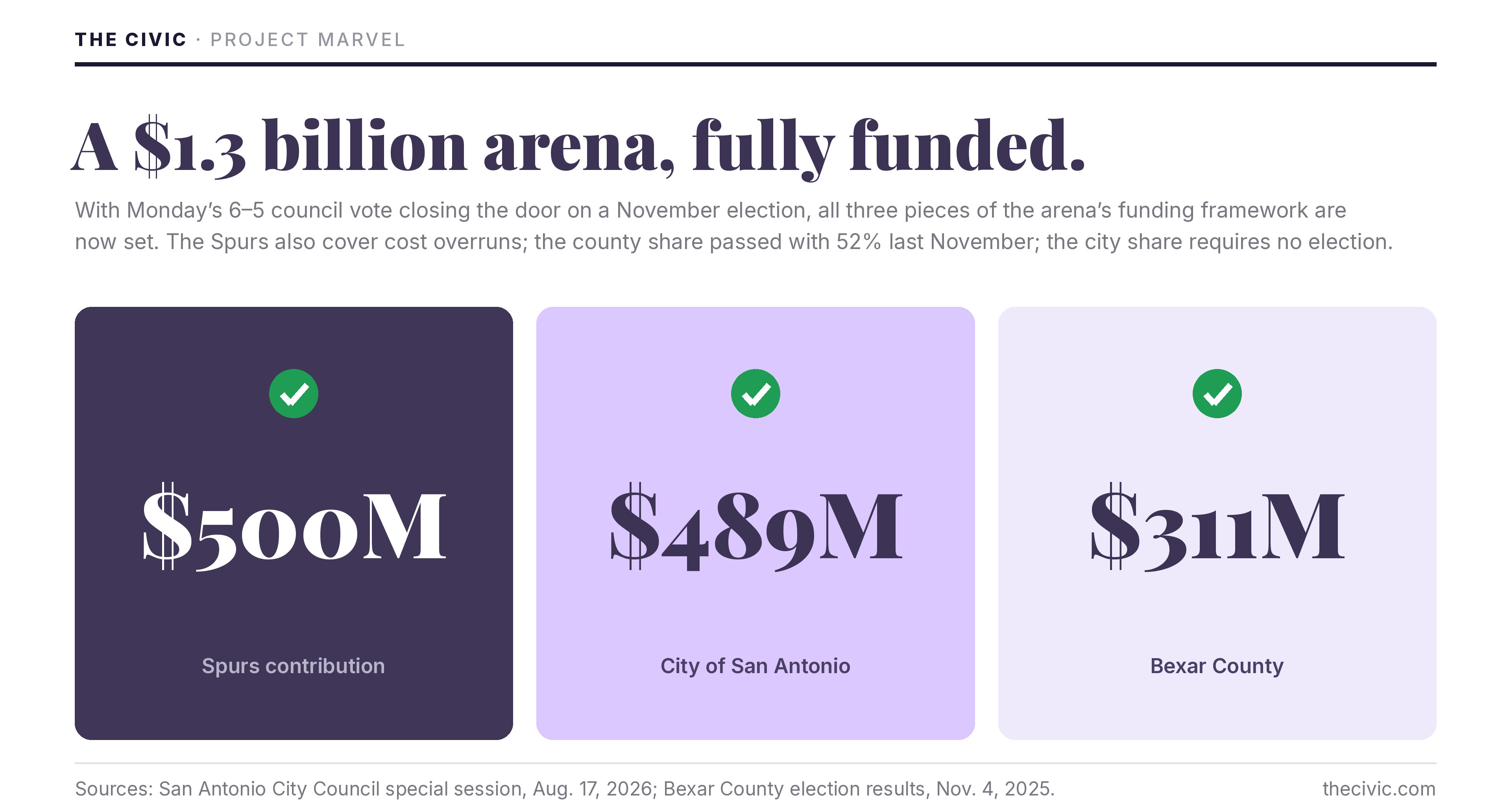
Project Marvel had its day in front of council, and Project Marvel won. At Mayor Jones’ urging, city council held a Monday special session to debate and ultimately vote on whether the $489 million city contribution for Project Marvel should be put before city voters. After three hours of public testimony, and extensive rehashing of old arguments on both sides, the motion to put this funding on the ballot failed six votes to five. A narrower vote than many expected, but a defeat for the anti-Marvel advocates nonetheless. Though Project Marvel was and remains a contentious issue, this is a very predictable outcome for a proposal which surfaced mere days before the ballot deadline and was championed mainly by Mayor Jones, whose popularity has been trending downward for her whole term. Can we please move on? We’re watching to see if, with the project basically guaranteed to proceed, the Mayor and likeminded councilmembers continue to grandstand when the term sheet returns to council for final approval and the bond debate resurfaces.
The budget fight is now in its substantive, final stretch. At Wednesday’s budget work session, staff put the alternative to the proposed tax increase on the table: hold the rate flat for two years by cutting roughly $75 million more, eliminating 171 additional positions on top of the 101 already proposed and reaching into police and fire overtime, library hours, and parks programming. Little unity emerged over what precisely should be cut. The “fiscal responsibility caucus” of Whyte, Gavito, and Spears have been adamant that a rate increase would be a mistake, while nearly every other councilmember took issue with specific cuts, with seemingly every program portrayed as an essential service. At Tuesday's work session, Councilwoman Viagran told her colleagues that "we cannot cut our way out of this deficit." As a matter of arithmetic, that is simply false and staff later presented the $75 million cuts required to do exactly that. “We cannot” and “we should not” are two different things, both wrong. But as no one can agree on precisely what to do, no one will get what they want. It is now almost certain that the tax rate will go up, programs will get cut anyway, the council will remain at odds, and the hard structural decisions will be deferred once more. We’re watching to see if there’s any genuine movement or compromise shown between now and September 17th.
Most taxing entities in the San Antonio area continue to pursue tax increases. On Tuesday, Alamo Colleges trustees voted unanimously to advance a 1.75-cent rate increase—larger than the 1.25 cents floated in June, and their first rate increase in over a decade. The very same day, Bexar County presented a budget that keeps its rate flat, as University Health did earlier this month. Add the city’s proposed increase and the November tax-rate elections coming from SAISD (alongside a $600 million bond package), Northside ISD, and South San ISD, and the pattern is clear: nearly every large taxing entity in Bexar County faces the same declining property values, and the easy choice is always to ask for more. The county’s explanation for keeping the rate where it’s at is that it banked money during the good years and stopped issuing new debt when revenue slowed down. Even so, when the choice is between cutting real programs and nudging a rate, the temptation is enormous—and most of our taxing entities are not resisting it. We’re watching to see precisely what the increased burden is on San Antonians when all of this is said and done: between taxes, utility rates, and over a hundred increased city fees.
The Civic is independent, nonprofit, and nonpartisan. We are supported entirely by our readers and our Charter members. Consider supporting our work.
The Reframe

VIA board mulls bus fare increase as costs escalate for planned rapid lines (Express News) → The bus line overruns have already started and the first line isn’t even finished. The Green and Silver lines, our impending rapid bus transit lines, were pitched at $803 million. The estimate is now $878.8 million (surprise!) with the Green Line barely into construction and the Silver Line revised upward twice even before breaking ground. Anyone familiar with projects like these knows those will not be the last revisions, and that’s assuming everything goes according to plan with regard to federal funding. The city has had a lot of open public debate recently: Ready to Work, Project Marvel, taxes… We need to talk about the buses. San Antonio will not become an urban policy analyst's ideal public transportation city no matter how many rapid bus lines we add, and right now we’re signing up for years of construction pain at significant fiscal cost for—let’s face it—little benefit. We should fund what works & what we need, and this isn’t going to be either.
Study finds passenger rail route between S.A., Austin could cost $13.5B (Express-News) → Passenger rail, without a serious push from Austin’s political leadership, will always be a pipe dream. It seems like every other month there is a story about a “viability assessment” or study for passenger rail, and they all say the same thing. Rail is technically possible, but at a cost of billions and billions of dollars. The $13.5 billion for this hypothetical project doesn't even connect the downtowns, it connects Austin-Bergstrom to a terminus outside of downtown San Antonio, like the Frost Bank Center. A line that reliably links the two city cores (probably the only version worth building) would undoubtedly cost even more. And the sticker price is never the full story: look no further than California's rail project, or even VIA here in town. It’s true that a working rail connection to Austin would be transformational—but it would require a capital commitment the state has never shown any serious interest in committing. This study will join its predecessors on the shelf.
Proposed Bexar County budget approaches $3B (Business Journal) → In 2016, the Bexar County budget was $1.8 billion. The county budget ballooned into nearly $3 billion in the pandemic years, juiced by federal relief which, as it always does, became a baseline. The $2.6 billion now proposed is the result of a $200 million cut from last year, but still $800 million above a decade ago. That roughly follows inflation and growth, which is a problem. "We kept up with inflation" defends the growth rate but ignores whether the original rapid spending increase was ever really justified, or even whether we got anything from it. Meanwhile the people paying for it saw their taxable values fall and are facing significant cost increases this year, and household budgets don't work the same way. So ask the only question that matters: what did an extra $800 million buy? Are the county's courts faster, its jail safer, its roads better than in 2016?
Report finds need for homeless shelters, assistance outpacing supply (Express News) → The continually underexplored truth: we have a full-service system in place to deal with the homeless who are willing to accept help. What about those who aren’t willing? We have written about San Antonio’s comprehensive homeless services economy. The logic is simple: keep as many people as possible from becoming homeless while helping the ones who do become homeless find housing and reenter society. The idea that we can “solve” the homeless problem is misguided, however, once you account for the population that refuses help. We have almost no plan for the population that refuses to cooperate with the system in place. Every report on shelter capacity and assistance dollars measures the willing. Until someone solves that fundamental disconnect, homelessness continues (and grows) no matter how much supply we add.
The Pick
Our weekly recommendation for what’s going on in San Antonio

Congo Falls Night at the Ballpark
This Saturday, August 22nd, at Nelson W. Wolff Municipal Stadium, 5757 W. US Highway 90. The Missions host the Northwest Arkansas Naturals at 7:05 p.m. for a night with the San Antonio Zoo (recently named one of the best zoos in the world by Condé Nast) celebrating Congo Falls, its new two-acre gorilla habitat. Postgame fireworks close the night. Tickets through the Missions' website.
Thanks for another week. Follow us on your platform of choice: X/Twitter, LinkedIn, Instagram, and Facebook. Story tips and reader notes go to our reporter Jarrett Whitener at jarrett@thecivic.com, and my inbox is always open.
A particular thanks to our Charter members, whose continued generosity allows us to operate.
Enjoy your weekend and see you Tuesday.
- Philip Reichert
Editor, The Civic
When it comes to Project Marvel and the urge to "move on", this is a major mistake despite the prickly personalities involved. There are legitimate major issues & questions left unaddressed, as reported; its wiser to deal with them now rather than later, or not at all. When it comes to "public policies", they do not exist. If they do exist, where are they?