


What We’re Watching This Week
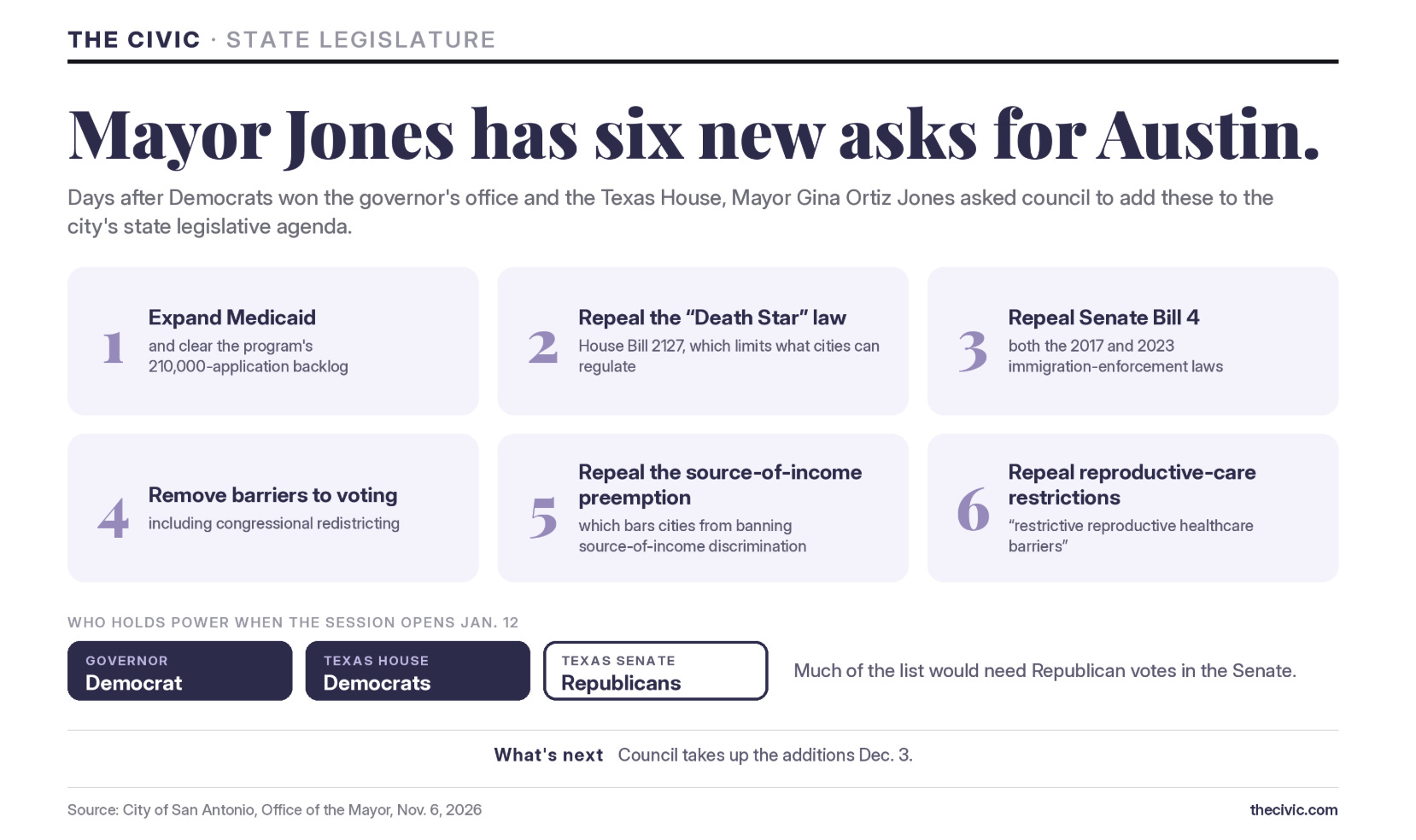
Mayor Jones wants San Antonio to ask Austin for a lot more now that Democrats will hold the governor’s office and the Texas House. Days after the election, Jones asked council to add to the city’s legislative agenda: expanding Medicaid, repealing the “Death Star” law that limits what cities can regulate, repealing the state’s immigration-enforcement laws and rolling back restrictions on reproductive healthcare. “Elections matter, and as we prepare for the 90th Legislative Session, we are going to ask for more,” she said. The agenda council approved less than two weeks earlier focused on protecting the city-owned utilities, funding infrastructure and preserving local control. Council takes up the additions on December 3, and the session opens January 12. Republicans still hold the Senate and many Democrat policies would likely struggle to pass both chambers. We’re watching because, as we wrote Tuesday, a friendlier Austin is a real advantage for City Hall, but we can’t expect Austin to fix our problems for us. Read our thoughts below:
The Blue Wave
·
The biggest story of the moment is the Democratic Party’s performance in the midterms. Here in Texas, Gina Hinojosa beat Greg Abbott, James Talarico beat Ken Paxton, Vikki Goodwin unseated Dan Patrick, Nathan Johnson is the next attorn…
McCombs Enterprises has put its $277 million development next to the San Antonio Museum of Art on hold after the city did not play ball with its funding request. McCombs had planned restaurants, shops and offices on a riverfront site between the museum and the Pearl. For part of the project’s funding, it asked for $13 million from the Midtown tax-increment zone toward a pedestrian bridge, walkways, parking and a park under I-35. City staff recommended a contribution of $7.5 million, the Express-News reported. McCombs said it could not get a deal “comparable to those supporting similarly ambitious projects in other Texas cities.” Councilwoman Sukh Kaur (D1) said staff saw no public benefit in some of the work, such as demolition and paid parking, and that a council that just raised property taxes has to be prudent. City Manager Erik Walsh said the city still wants to see the site developed. We’re watching because in September we said we’d see whether the city plays ball next door to the Pearl, and because the city’s own economic development plan lists a “stringent incentives policy” among its weaknesses.
Northside ISD is dropping this year’s raises and cutting its budget after voters rejected its tax increase. The 3-cent increase was meant to pay for a $35 million raise package, including a 2% raise for all staff. Trustees are scheduled to vote Tuesday on a budget amendment that goes back to the old tax rate, removes the raises and adds $10 million in cuts. Because the district had to adopt the higher rate in August, before the election, the county is now reissuing tax bills to about 200,000 property owners, and trustees want the Legislature to change that calendar. “There’s going to be some tough decisions we’re going to have to make,” Interim Superintendent Jessica Palomares said, adding that there have been no formal decisions on closing schools. We’re watching because the bigger decision is weeks away: consultants are due this month with recommendations from the district’s “optimization” study, which could include closing schools, and the board is scheduled to vote in January.

The Civic is independent, nonprofit, and nonpartisan. We are supported entirely by our readers and our Charter members. Consider supporting our work.
The Reframe
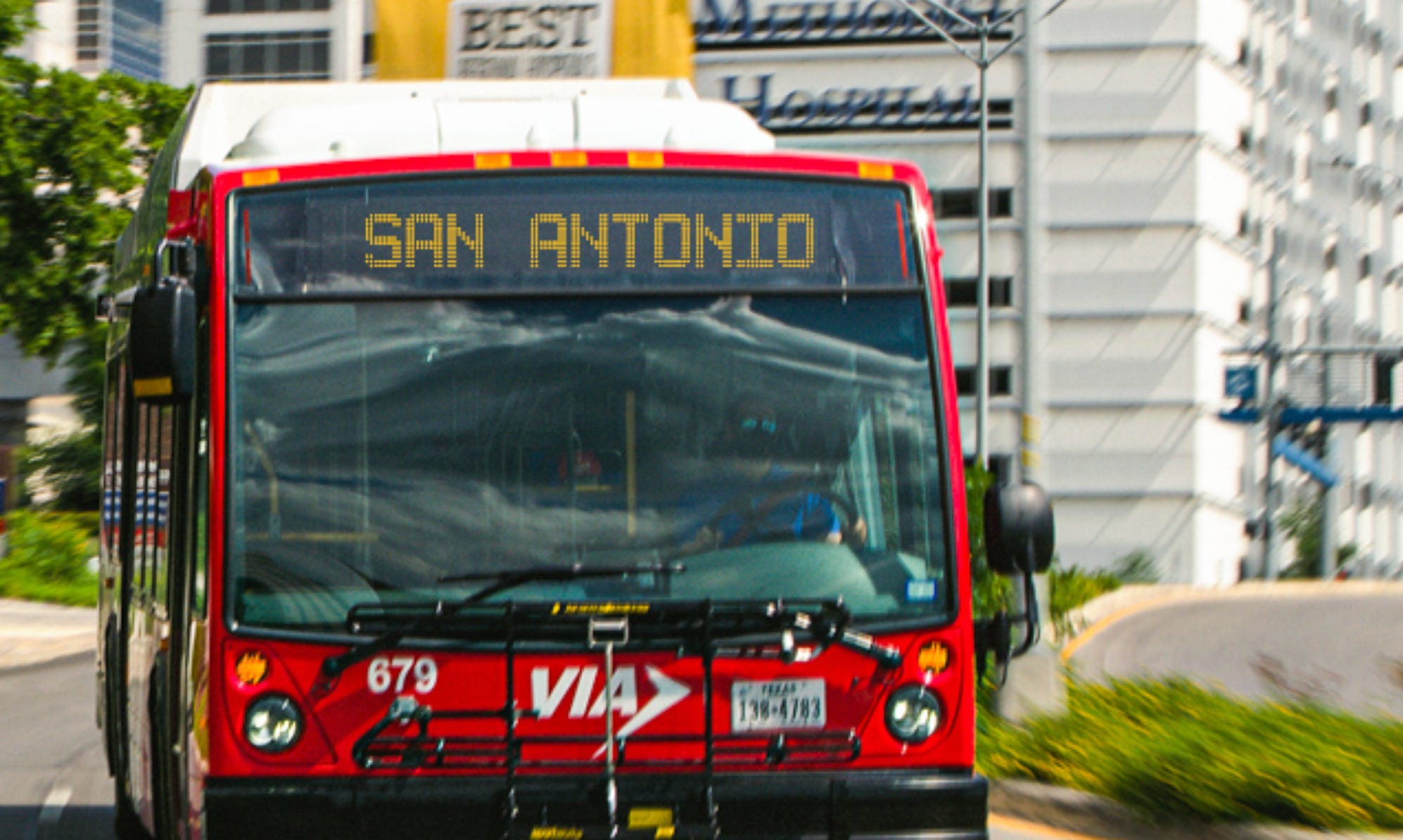
VIA’s bus improvements are working. But it has even bigger goals. (Express-News) → Ridership is up, but nobody has said what each new rider costs. VIA made a concerted effort to hire drivers and restore the frequent service it cut during the pandemic, which resulting in an increase in bus ridership by about 10% this year. That’s rebounding from a low point, though, as VIA carried about 31 million riders last year against nearly 44 million in 2013. An increase in riders is better than the alternative, but riders pay for very little of it. Fares are less than 5% of VIA’s revenue, and by our math last year’s budget worked out to almost $10 for every ride, offset against a small ($1.30) fare. In February, Mayor Jones asked VIA for its cost per rider compared with other Texas cities, and that comparison matters because the next goal, 50 million rides a year, depends largely on two massive rapid bus line projects that will cost more than $870 million per the last increase.
Why 2 San Antonio financial firms are focusing on Y’all Street (SA Report) → Texas is building a financial capital, and San Antonio already has more of that industry than it gets credit for. Frost Bank left the New York Stock Exchange for the Texas Stock Exchange this week, and Victory Capital is listing its funds on Nasdaq’s new Texas exchange. The exchanges are in Dallas, but finance is quietly one of San Antonio’s larger industries. About 100,000 people here work in finance, insurance and real estate, and the Dallas Fed says insurance and financial services are more concentrated here than the national average. That being said, financial-services pay here runs about a quarter below average, a sign that we have the back office and service centers while other cities have better jobs. Victory Capital is the counter example to that, as it moved its headquarters here from Cleveland in 2019 when it bought USAA’s investment arm, and now manages about $355 billion. With the state courting Wall Street, San Antonio should be pitching for the next headquarters.
‘They would have never done it’: Musk-backed business court lands in Hinojosa’s hands (SA Report) → Before the business court becomes a punching bag, it’s worth asking whether Texas needs it. The caseload says it does. The question will be about who controls the court now that our incoming governor (who voted against creating it) could end up naming its judges. But the court does serve a very real purpose. It took 409 cases in its first 20 months, with monthly filings up 69% in the second year, most of them energy, real estate and technology disputes. Judge Marialyn Barnard of the San Antonio division says its caseload has “skyrocketed,” with cases involving large corporations like Valero and NuStar. Most states actually have these business courts, because complicated commercial cases benefit from a dedicated business court. If a Democratic governor ends up choosing the judges, we’ll learn whether the objection was to the court or to who staffed it. A state that recruits headquarters and stock exchanges needs a place to settle their disputes.
As Texas seeks to lower property taxes, it’s time to consider income tax (Express-News) → This will never happen. We should also ask ourselves what built the Texas economy in the first place—it wasn’t the weather. The letter writer notes that an income tax would need a two-thirds vote in both chambers of the Legislature. It would also need the voters, who wrote the ban into the state constitution in 2019 with a 74% majority, and Republicans still hold the Senate. G.K. Chesterton’s rule was that you don’t tear down a fence until you know why it was put up. This particular fence, no corporate or personal income tax, is the first thing Texas tells a company thinking about moving here. The results speak for themselves, with the state now having more Fortune 500 headquarters than any other. There are tradoffs, with the Tax Foundation ranking Texas first in the country on income taxes and 34th on property taxes. But the proposal is to cut one tax by adopting the one whose absence has brought big business to us, even during times of broader economic uncertainty. San Antonio, which is not growing anywhere close to other Texas cities, needs that pitch more than the rest of the state.
The Pick
Our weekly recommendation for what’s going on in San Antonio

Luminaria Contemporary Arts Festival
Digital projections, monumental installations, live music and dance take over West Houston Street for one night at Luminaria, San Antonio’s contemporary arts festival, now in its 18th year. More than 200 artists are on the bill, most of them local, with Los Texmaniacs among the headliners, an art parade and lasers on the Alameda Theater. The festival has a new home this year on the west side of downtown, running to San Pedro Creek. Admission is free. Saturday, November 14, 6 p.m. to midnight, on West Houston Street downtown, with anchor sites including the Institute of Texan Cultures, 111 W. Houston St.
Thanks for another week. Follow us on your platform of choice: X/Twitter, LinkedIn, Instagram, and Facebook. Story tips and reader notes go to our reporter Jarrett Whitener at jarrett@thecivic.com, and my inbox is always open.
A particular thanks to our Charter members, whose continued generosity allows us to operate.
Enjoy your weekend and see you Tuesday.
- Philip Reichert
Editor, The Civic
Whenever the “economic development” term is used, it only means subsidized business development. This term is derived from the CED - Community Economic Development - profession, abused by the commercial real estate industry & their political boosters. True ED has never been practiced.
While business, finance, and real estate sizzles in our press pages, professional & business services represents only about 43% of employment. Leisure & hospitality sevices employment geared toward tourism, represent about 40% of employment.
Now we know why SA ranks as the nation's 3rd poorest, impoverished, & economically segregated city. We are a case study in civic failure given our “urban planning model” design.