



What We’re Watching This Week
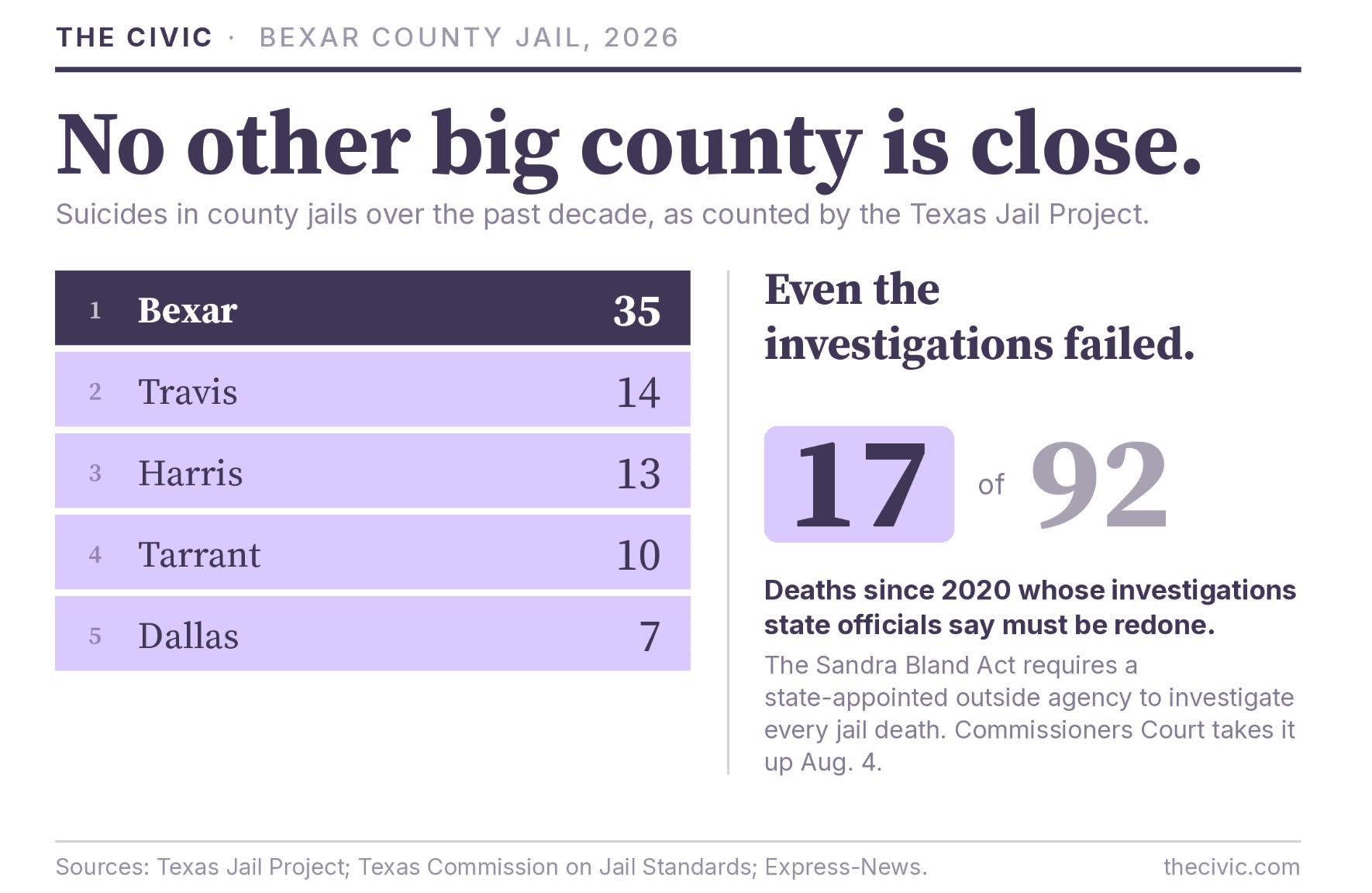
Bexar County is facing demands to treat at least 92 jail deaths since 2020 as a public health emergency. The death toll at the Bexar County Adult Detention Center is tracked by the nonprofit Texas Jail Project and was reported this week by the Express-News. Worth noting, Sheriff Javier Salazar has characterized the jail as being misused as a de facto mental-health and detox facility, and the deaths are often tied to medical episodes or underlying health and substance issues. Also relevant, the nonprofit in question, Texas Jail Project, has a strategic plan committing the group to organizing toward "a fully dismantled criminal punishment system." So when its co-founder calls Bexar's jail one of the deadliest in Texas, that is offered by a group whose remedy for jail deaths is, in the end, fewer jails. Co-founder Krish Gundu says 35 people have died by suicide in the Bexar jail over the past decade, compared with 13 in Harris, 14 in Travis, 10 in Tarrant, and 7 in Dallas. On Tuesday, July 28, a coalition that included ACT 4 SA and All of Us or None demanded a public death dashboard, timely intake medical screening, and continuity of care. We're watching because Commissioners Court pushed its jail discussion from July 7 to August 4, and the county's response will be the biggest tell. Expect an update from us after the meeting.
The city is forcing the Bonham Exchange and Club 727 to close at 11:59 p.m. Saturday, August 1, rather than grant another extension on expensive fire sprinklers. A July 29 memo from Assistant City Manager Lori Houston confirmed that the temporary certificates of occupancy for the Bonham Exchange and Club 727 expire before midnight on Saturday, August 1, and that the city denied extension requests for both venues. This traces back to the February 2026 compliance agreement, whose terms we detailed in our June 9 column: operations limited to the first floor, crowds capped under 300, a third-party fire watch, sprinkler installation costing roughly $550,000, and the venue on the hook for city costs if a fire broke out during the work. For the Bonham, a months-long closure "to reopen at full occupancy" is its own risk. Here is another problem: few small businesses can pay $550,000 for sprinklers in the first place, particularly thin-margin businesses like bars and clubs. Now the city's answer is forced closure, the bluntest instrument available, when the crowd caps and fire watch were already managing the risk. We're watching because Saturday is proof that oftentimes we just refuse to get out of our own way—the city could have exempted them or worked with them further at any point. Letting this happen was a choice.
Mayor Jones spent Wednesday night selling her budget workarounds at a town hall, and the math is still far short of $158 million. Mayor Jones told dozens of people at a Wednesday town hall that the coming cuts are "not going to be pretty" and warned they may be "even more severe than what we were presented with last time." City staff warned in June that without a rate increase the city may slash hundreds of positions. Jones's open letter asking business and philanthropic leaders for three-year commitments matching the $6.5 million the city gives 15 nonprofits has drawn no responses yet, and a Book Festival petition is circulating. Meanwhile, canceling the Ready to Work program could free money to offset budget cuts. At least four council members are already opposed to canceling Ready to Work, with Spears and Whyte in favor. The proposed budget will be presented on August 13, with a budget and tax-rate vote September 17. We're watching to see whether the upcoming proposed budget actually features any of these ideas and whether the Mayor’s "I am not raising people's property taxes if we haven't cut all the fat out of the budget" survives September. Our position: the Mayor is right about Ready to Work, and cutting the budget is the difficult but necessary choice that we have been avoiding for too long.
The Civic is independent, nonprofit, and nonpartisan. We are supported entirely by our readers and our Charter members. Consider supporting our work.
The Reframe

Don’t sacrifice family farms in Texas for water-guzzling data centers (Express-News) → Data centers are our emotional villain, filling in whenever you need something to worry about. A letter in Thursday’s Express-News opposes the 765-kilovolt Howard Solstice line through a fourth-generation farm. Losing farms, the writer fears, “leaves land vulnerable to other uses, including water-guzzling data centers.” Notice what the data center is doing in that sentence: nothing. The threat to the farm is a transmission line and the eminent domain behind it. The data center, nowhere near the story and injected by the author, appears only as a hypothetical future landowner. True, data centers are a real share of the projected load growth behind the state’s new transmission buildout, we are building a lot of them, and their water and power demands are legitimate questions with real factors to consider. But those variables either make sense for the locale or they don’t. The farm’s case deserves real consideration: route alternatives, necessity, compensation. A boogeyman settles none of it and just plays into our fears, relevant or not.
Mayor Jones asks business community to fund nonprofits that rely on city dollars (Express-News) → Mayor asks business community to fund nonprofits that the city can no longer afford. Mayor Gina Ortiz Jones' July 24 letter asked business and philanthropic leaders to backfill the combined $6.5 million the city sends 15 nonprofit organizations, from $40,000 for the Diez y Seis de Septiembre Commission to nearly $2.48 million for the San Antonio Education Partnership's scholarship and outreach program and about $1.1 million for the Botanical Garden. Meanwhile, Councilman Marc Whyte wants the city to go "line-by-line" through the whole budget first (seems like a good idea.) But the math is unforgiving: Jones conceded that zeroing out libraries, animal care, and public health would still leave a $20 million gap. The important takeaway is that a charity drive doesn't fix a recurring shortfall and doesn’t change the structural issues that necessitated it in the first place… And perhaps we should be less generous with city funds for nonprofits in the future.
University Health’s property tax rate to stay flat even as budget is ‘pretty tight’ (Express-News) → One taxing entity on your bill is absorbing $120 million in new-hospital costs at a flat rate while nearly every other taxing entity considers raising them. While the city hunts for cuts, the county hospital system is spending $120 million this year to get two new hospitals running (University Health Palo Alto on the South Side and University Health Retama on the far Northeast Side) while keeping its tax rate flat, per the Express-News. That matters in a state where, as we noted last week, 10.8 percent of Texas children under age 6 were uninsured in 2024, the highest rate of any state. A district carrying expansion and charity care at a constant rate is a standing rebuttal to the idea that flat rates make deficits inevitable. More importantly, it helps San Antonio’s families keep more money in their pocket.
Councilwoman Misty Spears calls for District 9 public safety review (TPR) → Even after years of real progress, San Antonio still struggles with crime. After a string of high-profile North Side incidents, District 9 Councilwoman Misty Spears is convening an August 4 town hall from 6 to 8 p.m. at Christ Community Church. San Antonio recorded 105 homicides in 2025, down from 127 in 2024, part of a more than 13 percent overall crime decline, following a sharp pandemic-era surge (homicides peaked at 231 in 2022) that preceded SAPD's Violent Crime Reduction Plan. The gap: per our data dashboard, San Antonio's violent crime rate has fallen every year since 2022, to 594 incidents per 100,000 in 2024, the most recent full year of FBI data, but the national rate is 359. Property crime is the stickier problem: 4,624 per 100,000 against a U.S. average of 1,760, more than two and a half times the national rate and still above the city's pre-pandemic level. The federal numbers say two things at once: real improvement, and a long way down to average.
The Pick
Our weekly recommendation for what’s going on in San Antonio
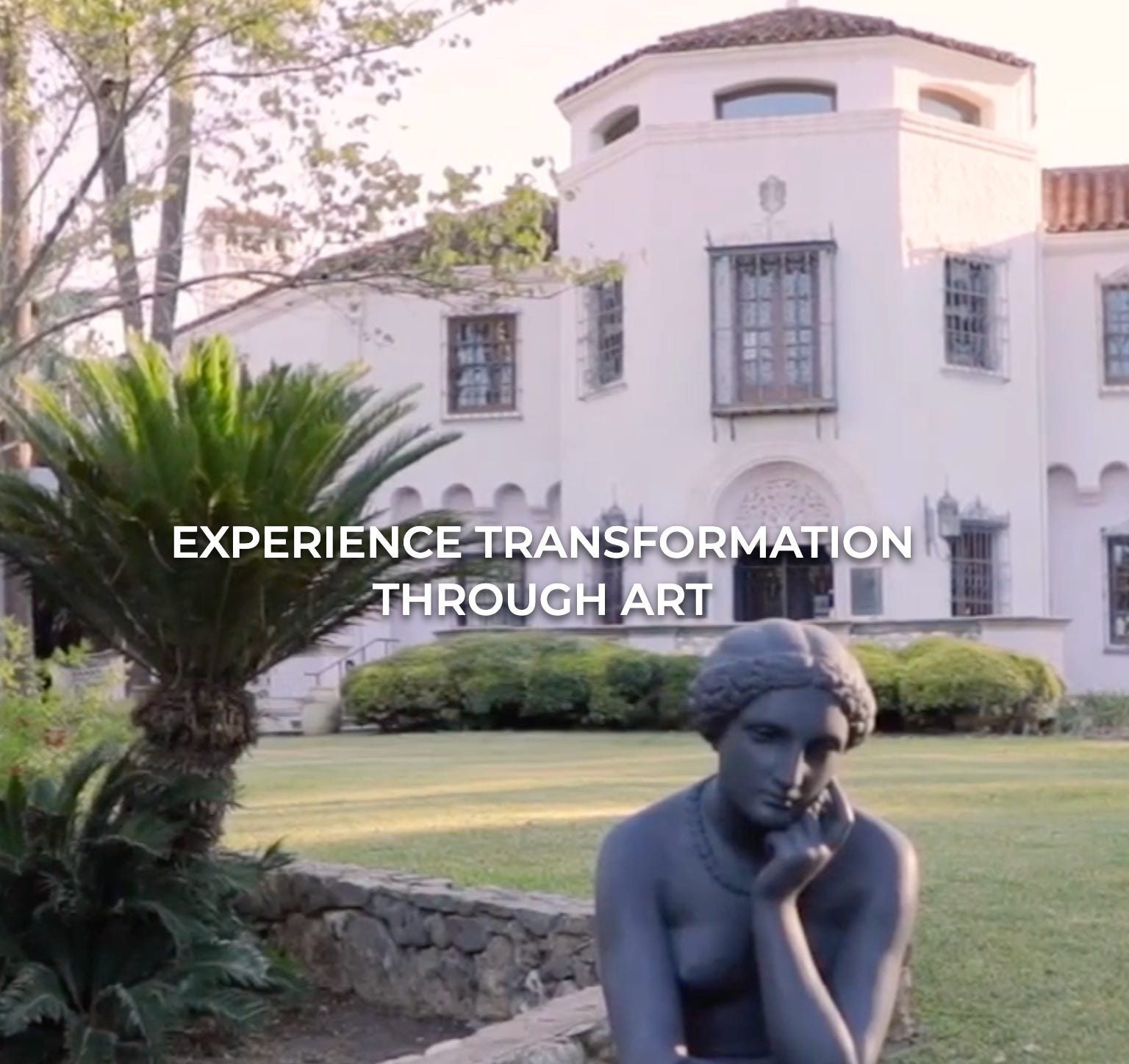
McNay Free First Sunday
This Sunday, August 2, admission to the McNay Art Museum is free, no registration required, from noon to 5 p.m. at 6000 N. New Braunfels Ave. (special-exhibition fees still apply). Go for the sculpture garden, stay for the collection. When McNay opened in 1954 from the estate of Marion Koogler McNay, it was the first modern art museum in Texas.
Thanks for another week. Follow us on your platform of choice: X/Twitter, LinkedIn, Instagram, and Facebook. Story tips and reader notes go to our reporter Jarrett Whitener at jarrett@thecivic.com, and my inbox is always open.
A particular thanks to our Charter members, whose continued generosity allows us to operate.
Enjoy your weekend and see you Tuesday.
- Philip Reichert
Editor, The Civic
The SA media is sure treating the Bonham closing to install required safety equipment as some sort of earth-shattering development.
Philip,
In addition to the proposed budget documents, are there resources available that report on the performance and outcomes of individual city programs, similar to the "Ready to Work" breakdown you highlighted previously? For example, beyond appropriations and spending, I'm interested in understanding how programs are evaluated, what metrics are used, and whether they achieved their intended objectives. Is there a central place where those results are published?
Clint