



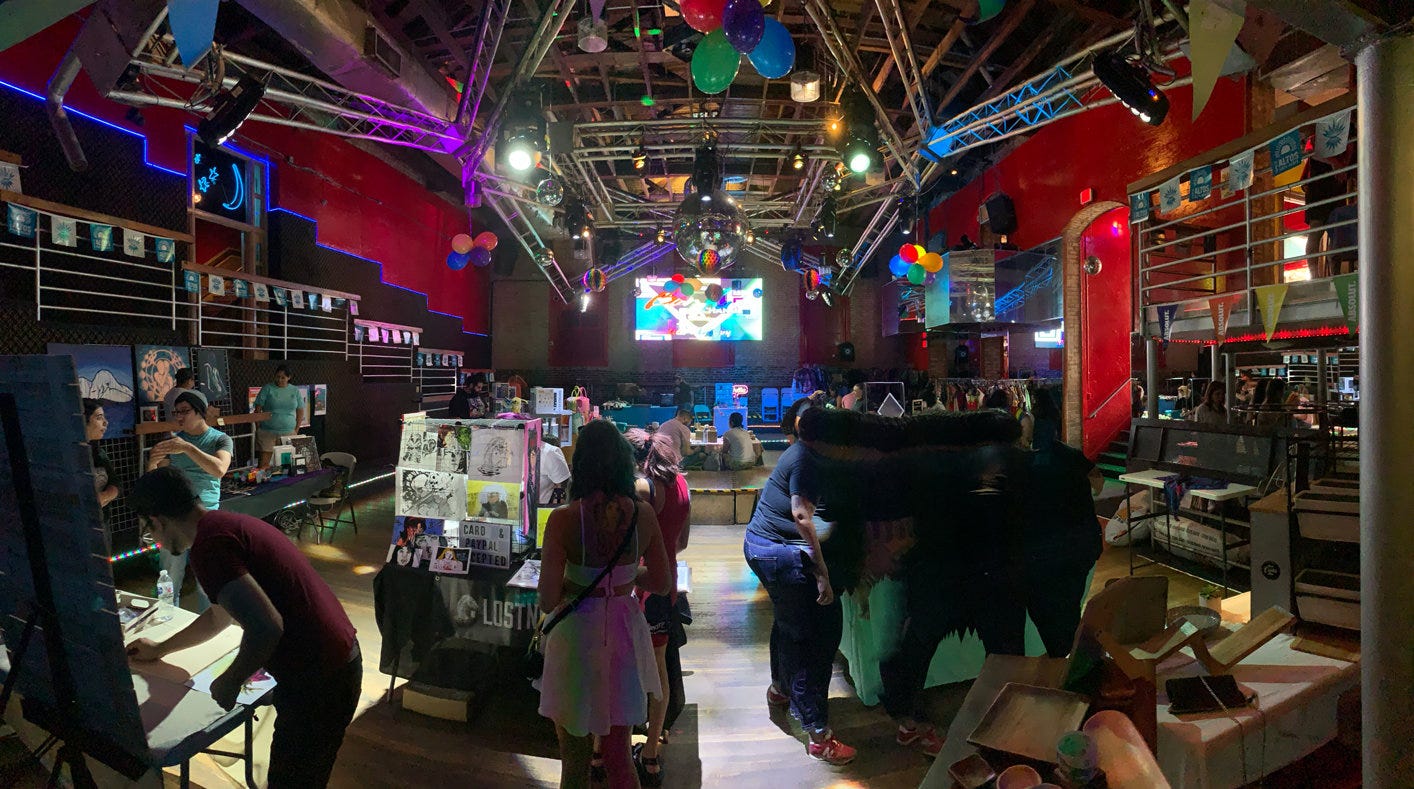
This past February, under threat of closure, the Bonham Exchange signed a deal with the city to stay open. It agreed to operate on the first floor only, cap its crowd under 300, pay for a third-party fire watch, and spend over half a million dollars installing sprinklers, with the venue liable for any city costs if a fire broke out during the work.
But what is this rule, where did it come from, and why are we forcing expensive renovations on existing businesses?
The sprinkler mandate in question, which requires sprinklers in large bars, nightclubs, and so on, is a section of the International Fire Code (IFC), added in 2018 as a distant response to the 2003 Station nightclub fire in Rhode Island. Every major Texas city, Dallas, Houston, Austin, and San Antonio, runs on a version of the same code.
A national committee wrote the code, and a provision that down the line costs a historic venue half a million dollars walked in unnoticed among a host of other changes. Sadly, there’s no sign anyone here looked at it closely. Until we were faced with the closure of local businesses, it’s possible that no one in government really gave it a second look.
San Antonio, and every other city, frequently makes amendments to the fire code to fit local conditions—Dallas did exactly that when it adopted the IFC with a number of regional changes. Had anyone looked into this version of the fire code, there was reason to pause.
The Station fire was deadly because a band’s pyrotechnics ignited flammable foam glued to the walls, the club was overcrowded, and the crowd jammed at the main exit. But the foam and the overcrowding were already illegal, and San Antonio’s code already banned all of it. Sprinklers help, and NIST recommended them, but they are also the most expensive fix for a danger its fire code already addressed several cheaper ways.
We avoid this kind of tradeoff all the time and don’t think anything of it. If preventing traffic deaths were the only thing that mattered, every speed limit would be 10 miles an hour. We accept the “safety cost” because a city has to function.
And the sprinkler safeguard is not cheap. A retrofit runs $2 to $7 a square foot, more for a historic building like the Bonham. Michael Specia of Southtown Joe’s figured a system would have cost him $130,000 to $190,000. In his words, “It would’ve put me out of business,” so he spent two years lowering his capacity below 300 instead.
Once this imposition on local businesses was known, the city had tools to negotiate. Three council members moved to push the deadline to 2027. The Bonham got a compliance agreement, a capacity cut, even a mayor who personally pledged to raise the money. And the mayor framed the rule itself as a done deal, saying “fire code, in my book, is nonnegotiable.” But is it?
Extensions, compliance deals, capacity reductions, even the mayor calling donors for sprinkler money—the city is already treating a “nonnegotiable” fire safety rule as negotiable. While we’re negotiating, someone should have asked whether this provision, as written, should apply to existing historic buildings at all.
Home rule gives San Antonio options: a higher occupancy threshold, a variance for historic structures, hardship exemptions, and so on. The city has used that power to amend the fire code before but has not used it here. Why not?
The Bonham will probably survive, but the sprinkler rule is only one regulation, among hundreds, most of them far quieter and with less obvious tradeoffs. In the name of “public safety,” some iconic businesses may be forced to close, and others may never open at all. All of the setback requirements, parking restrictions, fees, inspections, and, yes, mandatory sprinkler systems add up. Sooner or later you’re looking at a substantial hidden tax on businesses in San Antonio.
The answer isn’t to eliminate fire safety codes or to show blind favoritism to historic venues, but regulators should have to justify the expensive option. Could strict capacity limits plus proper exits get us most of the benefits without forcing businesses to spend hundreds of thousands of dollars to avoid closing?
The mayor is right that fire safety matters, but operating a club or bar shouldn’t require a second mortgage just for the sprinklers. Right now, we’re “solving” decades-old tragedies by pricing our businesses out of existence.
Really great observations here. One answer to why this provision made it is just think about making an argument against “safety”….its a tough side of the debate to draw. Therefore, nobody stepped up to do it. But you made very rational arguments. The same thought process can apply to many codes. The regulations that have been added steadily over my career have added significant cost to any property improvement or development without deep analysis on the cost versus benefit. For instance, there have been huge additions to the mechanical code in the name of energy conservation. But has anybody done the math? I’m personally skeptical on this one.
The city adopted the ordinance in the wake of the Castle Hills fire that claimed five lives. A report on that fire has never been issued, but sprinklers would not have availed the victims one bit. That fire was sui generis, the tragedy caused by other factors was from smoke inhalation. The Fire Chief and the sprinkler industry runners were behind it. The whole thing was ill-conceived. But as a result, while owners of properties had to shell out millions for feckless retrofits the chief was mage Fire Chief of the Year. Then he was fired for eating sushi off a nude woman at a party.