



What We’re Watching This Week
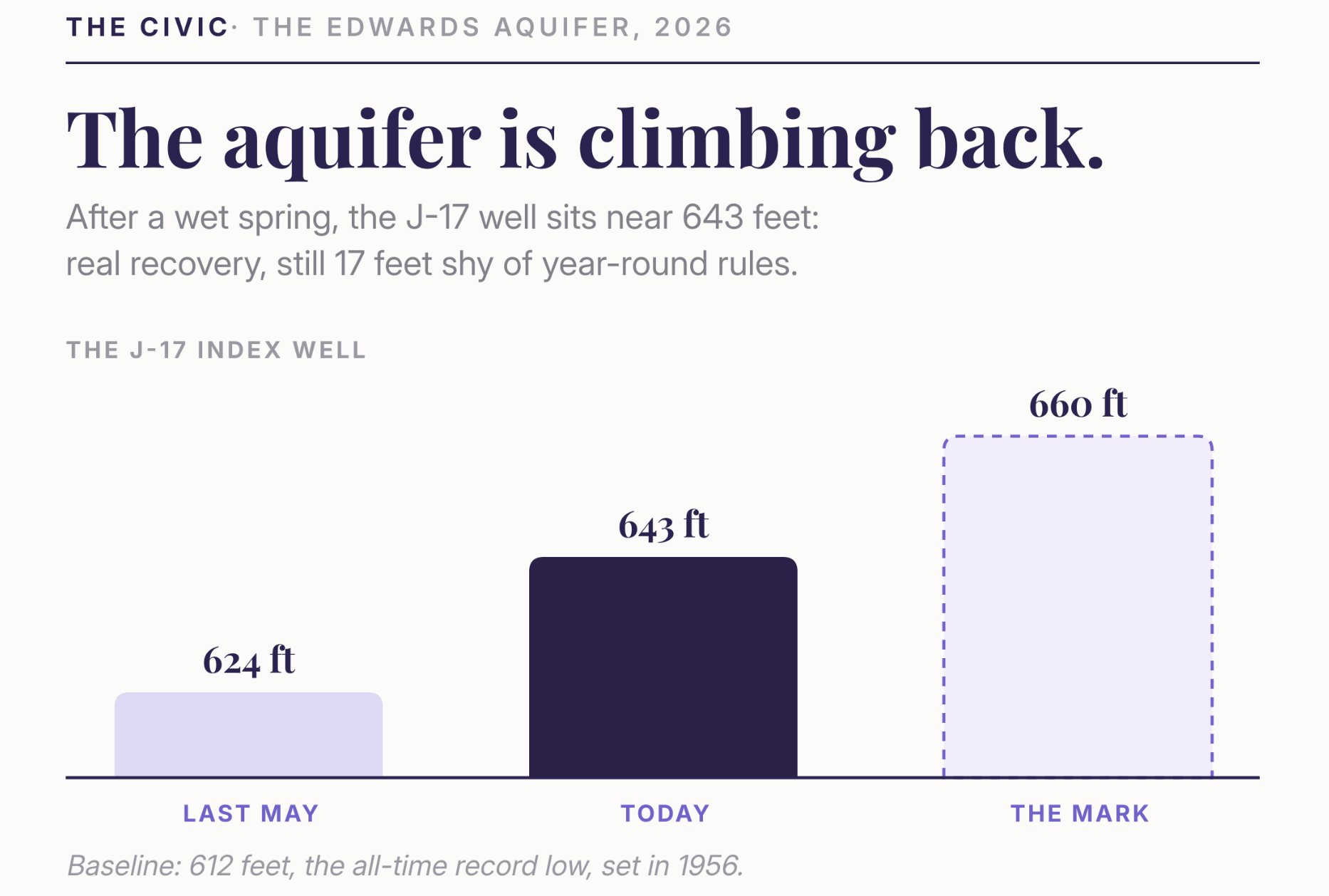
The aquifer is climbing out of last year’s record lows, but the hard months are just starting. A year ago the Edwards Aquifer’s J-17 index well fell to 624 feet, within a dozen feet of its all-time low, and the Edwards Aquifer Authority declared Stage 5 pumping cuts for the first time in its history. After a wet spring, the well now sits at around 643 feet. That is meaningful recovery, but it is still 17 feet short of the 660-foot mark that returns SAWS customers to year-round watering, and July and August are when the aquifer historically falls fastest, as rain stops and irrigation peaks. We’re watching because if the recovery holds through summer, SAWS could exit drought restrictions for the first time in years and the delayed rate increase loses one of its justifications. If it doesn’t, council returns in August to a budget fight and a strained aquifer at the same time.
San Antonio is losing its police chief nearly three months early. William McManus, longtime SAPD chief of police, was expected to retire September 30; instead he leaves July 10 for a role as VP of safety and security at Silver Ventures, the developer behind the Pearl. He departs shortly before council takes up a budget that will likely fund no additional officers. An acting chief will be named from within SAPD, with a selection expected in September. That sequence means the next chief inherits a budget shaped entirely without them. We’re watching because the September pick is the first major personnel decision of the post-recess season and a test of whether the city is optimizing for continuity, reform, or politics. And the exit itself is informative: the police union contract expires September 30, the day McManus was originally set to leave, and he is leaving before both the negotiation and the budget are final.
San Antonio home prices are falling while every other big Texas metro’s are rising. Homes.com data for May puts the metro’s median sales price at $310,000, down 3.1 percent from a year ago. That’s $25,000 below the 2022 peak, and the steepest decline among Texas’s major markets while Dallas, Houston, and Austin all dropped. This is affordability improving in a city whose pitch is that you can still buy a home here, and sales held steady while every other major Texas market declined. But the tax system runs on the same numbers. A slowdown in property values helped push the city towards a possible first tax increase since 1993 and handed the county its worst revenue forecast since the 2008 crash, and officials have now budgeted for a bad stretch. We’re watching because if May is a blip, the forecasts hold and the affordability is a clean win. If it’s a pattern, and analysts already expect a slow fall and winter, the question stops being whether the forecast was grim and becomes whether it was grim enough.
The Civic is independent, nonprofit, and nonpartisan. We are supported entirely by our readers and our Charter members. Consider supporting our work.
The Reframe

San Antonio’s 2019 climate plan reboots for an increasingly tough political environment (SA Report) → Before rebooting the plan, ask the question: why does a city have one? The climate is not a municipal problem. San Antonio emits about 17 million metric tons of greenhouse gases a year—China’s emissions pass that mark roughly every twelve hours. Nothing this council does, or refrains from doing, will register in the only metric that the plan is aimed at. Even the advisor for the update concedes that net zero by 2050 is “not a reasonable goal to achieve,” and the state has already stripped most of the tools the plan assumed. So here’s the question: why did the city sign off on a goal we now know to be unreasonable? What remains is a document that cannot change the temperature but can absolutely change your utility bill, because this city owns CPS Energy and SAWS, and that is where climate planning becomes rate policy. A city that hamstrings its own growth to gesture at a planetary problem is not focused on real governance. The best end for this plan is an early retirement.
TAMUSA’s first doctoral program now accepting applications (SA Report) → The university’s growth is good news but this credential deserves scrutiny. A first doctorate is a real milestone for the Southside campus (whose student journalists impressed us last week) But look at what’s actually on offer: a fully online Doctor of Education in Educational Leadership built for working principals, assistant principals, and superintendents. Principal quality matters enormously for students. The doctorate is another matter: do we really need more Doctors of Education? Is this truly one of the limiting factors for San Antonio’s students? For contrast, we recently learned Alamo Colleges is seeking approval for the city’s first land surveying certificate, which is a cheap and tangible path into a new occupation and what seems like an institution listening to the labor market.
German aerospace manufacturer Blackwave to open first U.S. factory at Port San Antonio (Express-News) → Success finds the institutions that put themselves in its path. Last week we noted Port San Antonio spending its own money to chase the Air Force’s cyber command rather than waiting to be picked. This week we get to note a big win: a German rocket-component maker, Blackwave, surveyed 20 Central Texas sites and picked Port San Antonio. Their facility will be operational by fall and is on its way to roughly 250 jobs and a $99 million annual impact. And no incentives package changed hands: Blackwave decided, in the words of greater:SATX chief executive Sarah Carabias Rush, that “the Port provides some pretty great, kind of built-in, incentives, if you will.” The Port campus sits inside a foreign-trade zone, which matters to a German firm that says tariff uncertainty drove it to build here rather than ship from Europe.
Bexar County launches budget town halls as officials warn of future shortfall (KENS 5) → The county is asking what you think, and its budget office has already told you what it thinks. Bexar County is running a round of town halls and a survey, open through July 22, to gather input on a $2.8 billion budget, and the budget director’s stated priority is to “maintain the expenses as best as we can, and avoid cuts.” Meanwhile, the county projects a $148 million gap by 2028 in its worst property-tax revenue stretch since the 2008 crash, existing property values just fell by $4.8 billion, and the county manager has pledged to try not to touch the tax rate, extending a longtime streak. No new taxes, no cuts, and no revenue growth: pick two. Last week’s UTSA poll found residents favoring cuts over taxes seven to one. If the town halls are real, that math should survive them.
The Pick
Our weekly recommendation for what’s going on in San Antonio

Stars & Stripes on Houston Street
The country turns 250 on Saturday, and downtown marks it with its first Fourth of July fireworks in roughly fifteen years. The day runs start to finish: a 5K at 8:30 a.m., the parade down Houston Street at 10, a food and music festival at Civic Park at Hemisfair through the afternoon, and the Downtown Spectacular at 9 p.m., fireworks over Civic Park. A full day, downtown, to mark America’s birthday.
Free, except the 5K, which requires registration. Saturday, July 4, 8:30 a.m. to 9 p.m., Houston Street and Civic Park at Hemisfair.
Thanks for another week. Follow us on your platform of choice: X/Twitter, LinkedIn, Instagram, and Facebook. Story tips and reader notes go to our reporter Jarrett Whitener at jarrett@thecivic.com, and my inbox is always open.
A particular thanks to our Charter members, whose continued generosity allows us to operate.
Enjoy your weekend and see you Tuesday.
- Philip Reichert
Editor, The Civic