



What We’re Watching This Week
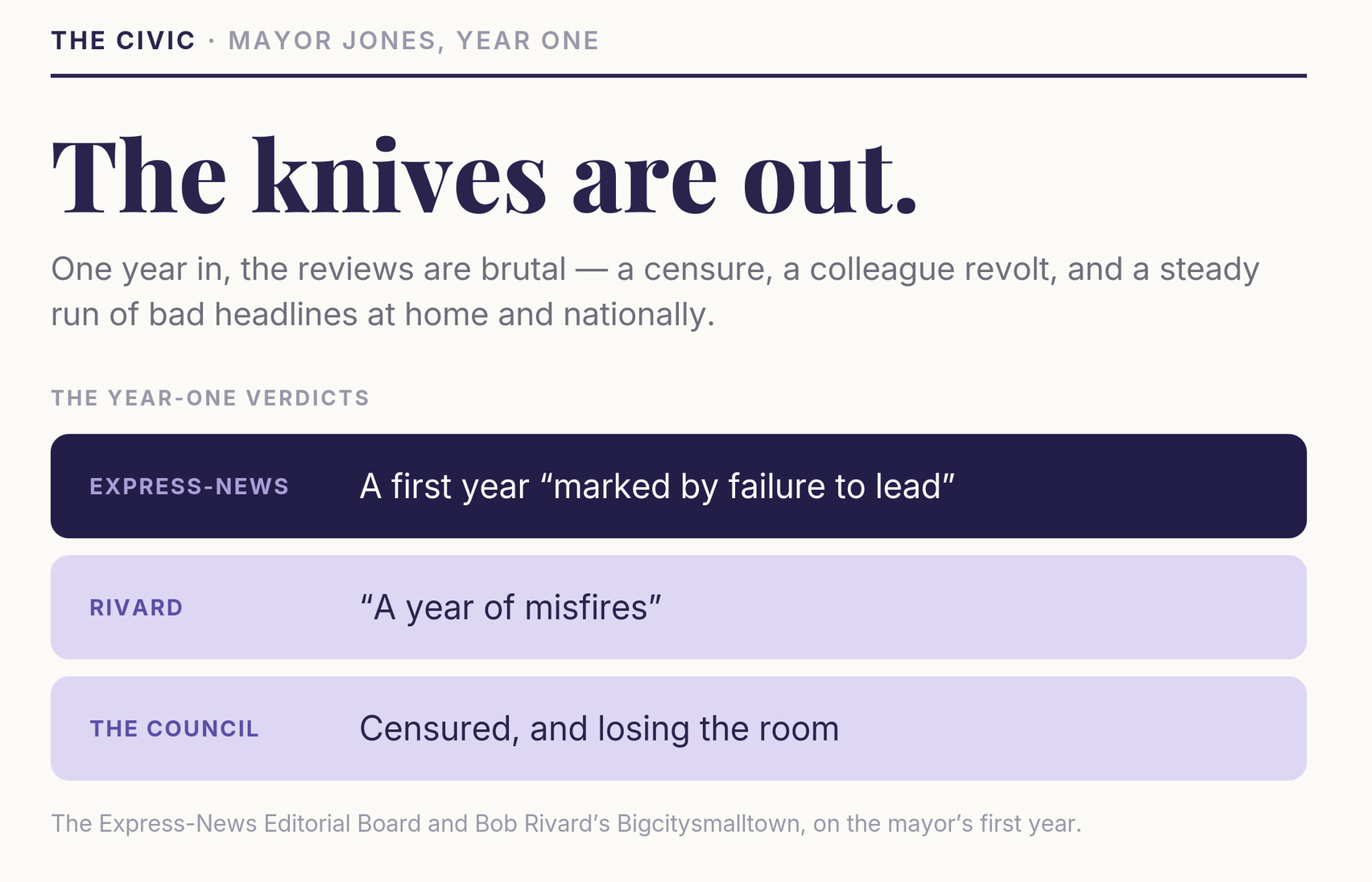
The knives are out for Mayor Jones. The Express-News Editorial Board has described Mayor Jones’ first year as “marked by [a] failure to lead.” Bob Rivard, in his midweek newsletter, says that she has suffered from “a year of misfires.” She has been censured, drawn the ire of her colleagues, and reliably earns negative national media. If the status quo continues, she could be relegated to another year or more with no political capital. If she continues to trend downward, it would not be out of the question to see a serious effort to recall her, though it would be prohibitively difficult to garner the required number of signatures to begin. We’re watching because Mayor Jones’ political capital is near rock bottom. This impedes her ability to push her policies, emboldens future mayoral candidates and her opponents, and also makes it difficult to survive any serious future scandal.
City council is out for the month of July, but work on the budget continues. City council took its one public pass at the trial budget last week, and now the budget moves into the background until August, with the next budget session not until August 13, when the city manager presents the proposed budget and council takes up the tax rate. The time in between is where the budget is actually hammered out in meetings between the city manager and staff, and in the district town halls where members collect constituent feedback on the cuts. By the time council is back in public, the budget will have largely taken shape. We're watching because the resolve council showed in June—refusing the rate hike, delaying the SAWS increase—is still being tested. The rate increase is the path of least resistance, and whether June's resistance to an increase survives the recess remains to be seen.
Despite recent setbacks, Port San Antonio is paying to chase Air Force cyber command. Port San Antonio has been trying to land the Air Force’s cyber headquarters for several years. Port President and CEO Jim Perschbach has pitched relocating Air Forces Cyber, the 16th Air Force, from its aging facilities at JBSA-Lackland to the tech campus three miles away: a $1 billion-plus building the port says it could deliver through an intergovernmental support agreement rather than traditional military construction, saving taxpayers around a billion dollars. There have been numerous setbacks: Pentagon turnover, the Air Force cut Biden-era plans to elevate the command, and Gov. Abbott vetoing $50 million in state support last summer. The port pressed on anyway, signing an MOU with the Air Force last month to formally explore the move and allocating $1 million on Wednesday to develop design, engineering, and financing proposals. We’re watching because the port is one of the city’s most impactful institutions, and here it’s chasing after an opportunity instead of being passive. We hope the bet pays off.
The Reframe
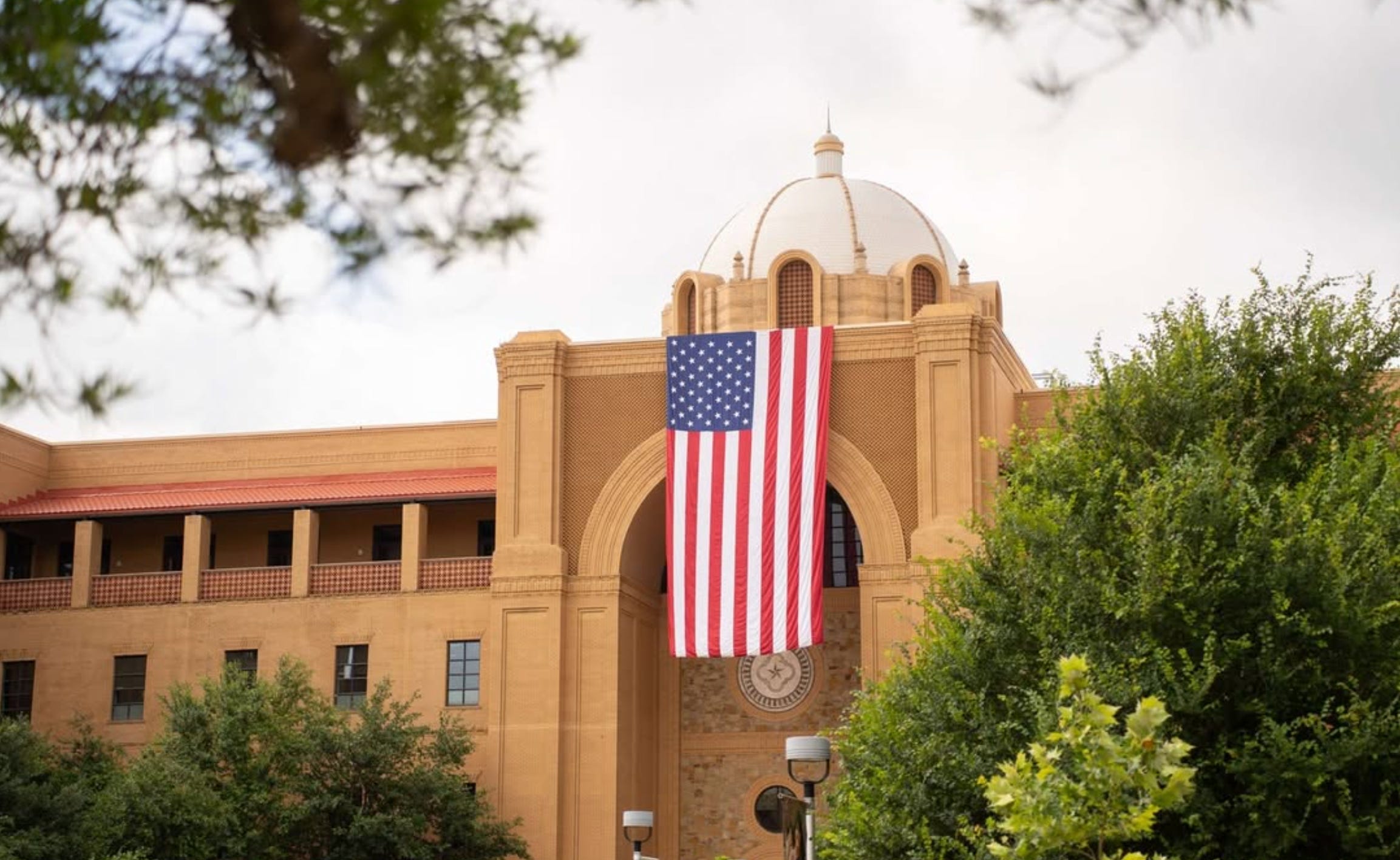
When Hill Country town lost its newspaper, students stepped in to fill the void (Express News) → Beyond a feel-good story, this points to the cheapest way to get a reporter back in the room. San Antonio is generally underserved by journalism despite its spot among the top 25 large metros in the U.S., and standing up a publication to fix that takes resources most people would put elsewhere. But we have numerous geographically dispersed universities and colleges that could serve as micro-hubs, diffusing the work across infrastructure that already exists, making the process cheaper. The Cypress, a newspaper operated by students out of Texas A&M - San Antonio, shows that students can restore presence and be a body in the room at the school board and city council of underserved areas. Done well, it's also a public good that could draw community and foundation support to the universities themselves.
Mayor Jones wants to defund San Antonio Botanical Garden as city’s budget deficit looms (SA Current) → In this instance, the mayor is unpopular but correct. We must prioritize core services. It’s always worth crediting the mayor when she’s correct and it costs her to be. Staff proposed trimming just $200,000 of the garden's $1.2 million subsidy; Mayor Jones asked, why not cut all of it? This isn't really a question of whether the Garden is entitled to public money, it’s just smart prioritization. A garden that draws 400,000 visitors a year (and charges a ticket fee) will, in the mayor's words, "be okay," and a $1.2 million operating subsidy is exactly the discretionary cost that should give way when the alternative on the table is cutting core city services. Even when the discretionary spending is on something people like, like the botanical garden.
UTSA poll: Facing budget cliff, Bexar County residents are split on raising taxes (SA Report) → Don’t be fooled, the “split” is largely rhetorical. Force the binary: cut spending or raise taxes, and 46.8% of residents favor cutting only, against 6.3% who favor raising taxes only. That’s 7-1 in favor of cuts. Read inclusively, 87.7% want at least some spending cut, while about 47% would accept at least some tax increase. Still nearly two to one in the same direction. Whichever way you do the math, the public clearly shows an appetite for cutting spending and the “split” only survives if you ignore that both framings lean toward cuts. It’s interesting, given this result, that nearly all of our institutions reach reflexively for more revenue when it’s against the public preference.
North East ISD passes budget as voucher projections cloud financial outlook (Express News) → What is a challenge for the district is born out of a choice for the families. Our public school system is a tremendously valuable piece of civic infrastructure, with hundreds of thousands of students across the city literally growing up in it. But when presented with a genuine choice, families will choose what's better for them, and if they keep choosing other options—driving enrollment and funding down—it falls to the public schools to build a more compelling product. Critics say that's impossible with reduced funding, but even a recent Brookings analysis finds spending to be a far weaker lever than the funding fight assumes: improving schools is "not, in general, a mere matter of money," and the real question is how well the dollars are spent. Competition has stripped the district's ability to coast; whether it converts that pressure into improvement is now the measurable question.
The Pick
Our weekly recommendation for what’s going on in San Antonio
The Sound of Freedom - America at 250

The country turns 250 this Fourth of July, and First Baptist Church of San Antonio is marking it the night before with a free concert with patriotic music—two hours, all ages, free parking. A straightforward, local way to mark the anniversary.
Free, with free parking, but you can reserve a spot. 7:00–9:00 p.m., 515 McCullough Ave, San Antonio, TX 78215. Reserve a spot here.
Thanks for another week. Follow us on your platform of choice: X/Twitter, LinkedIn, Instagram, and Facebook. Story tips and reader notes go to our reporter Jarrett Whitener at jarrett@thecivic.com, and my inbox is always open.
A particular thanks to our Charter members, whose continued generosity allows us to operate.
Enjoy your weekend and see you Tuesday.
- Philip Reichert
Editor, The Civic