



What We’re Watching This Week
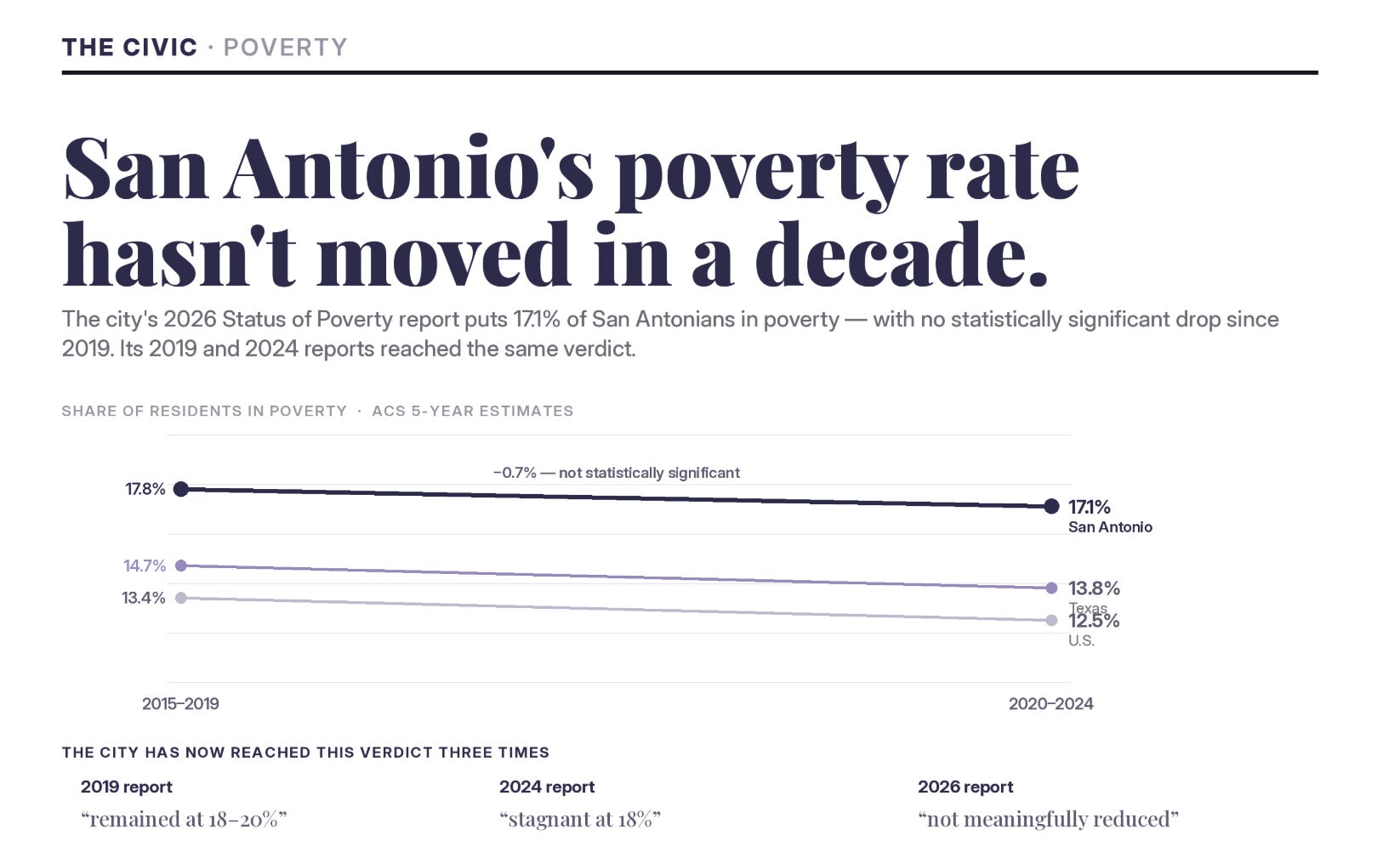
The city’s new poverty report reaches the same conclusion as 2019 and 2024: not much has changed. The Department of Human Services briefed a council committee last week on its 2026 Status of Poverty report, which puts 17% of San Antonians below the poverty line. The report says there has been no statistically significant decrease in poverty since 2019, and says poverty “over the past decade in San Antonio has not been meaningfully reduced.” The city’s 2019 report said the rate had “remained at 18-20%” since 2013; its 2024 report called it “stagnant at 18%.” The Census Bureau’s one-year estimates say the same: about 17% in 2024, against 17.8% a decade earlier. Among big Texas cities, only Houston is poorer, and the San Antonio metro ranked third-poorest among the 25 largest metros in last year’s Census data, behind only Houston and Detroit. Notably, the report describes poverty in detail but it doesn’t measure whether the programs the city funds to reduce it have worked or had any effect. The closest thing to a conclusion is a line saying the city “has the opportunity to strengthen community collaboration.” In response, staff recommended more public-private partnerships and prioritizing services by vulnerability. Marc Whyte said the focus should be economic development and higher-paying jobs. Marina Alderete Gavito said “the city funds a lot of great nonprofits, but I do think that it’s time for us to kind of take a step back” and make sure tax dollars are “used wisely and really strategically.” We’re watching because though much of our public focus remains on “solving poverty,” little has changed.
The city’s arena deal with the Spurs has seen delays in its schedule while the rest of Project Marvel keeps shrinking. City staff said in January, and again in June, that the definitive arena agreements would be done by the end of this year. On Wednesday, Ben Gorzell, who runs the city’s finances, told media: “we have begun negotiations with the Spurs, and we don’t have a specific timeline of when they will be done.” Meanwhile, the project around the arena keeps getting smaller: the convention center hotel is gone, the land bridge over I-37 was shelved, an $85 million Alamodome garage was cut last month, and a billion dollar Alamodome overhaul is now pushed back to 2035 or later. The city still hasn’t closed on the site where the arena would go, and the hotel tax zone meant to pay for much of this is now projected to raise $1.9 billion over 30 years, down from the $2.5 billion cited in June. We’re watching because the arena’s price and the city’s share of the costs haven’t changed, but everything around them is worsening. Also relevant: the term sheet bars the city from issuing arena bonds until at least $500 million of the Spurs’ promised development is built.
Tuesday’s ballot asks Bexar County voters for about $2 billion in school bonds and five school districts are asking for tax rate increases. The biggest asks: Northside wants $886 million in bonds plus a tax rate increase, and San Antonio ISD wants $600 million in bonds and a tax rate increase. The City of San Antonio’s Prop A would renew Pre-K 4 SA’s eighth-cent sales tax for 20 years past 2029, and Converse voters decide whether to drop VIA service. All of this is just weeks after the city raised its property tax rate for the first time in more than 30 years and Alamo Colleges raised its rate, and a year after the county’s arena tax passed with 52.1%. Turnout is high: up 34% on the first day from 2022, and about 301,000 through Sunday. In fact, the elections administrator expects more votes than in the 2024 presidential election. We’re watching because this is the first test of whether San Antonians will approve higher taxes since the city increased its property tax rate. Last year, two of the five districts asked and were rejected.
San Antonio City Council approves amendment giving council control over data center development

San Antonio City Council has approved a Unified Development Code (UDC) amendment that gives council final approval over all new data center development within city limits.
The Civic is independent, nonprofit, and nonpartisan. We are supported entirely by our readers and our Charter members. Consider supporting our work.
The Reframe
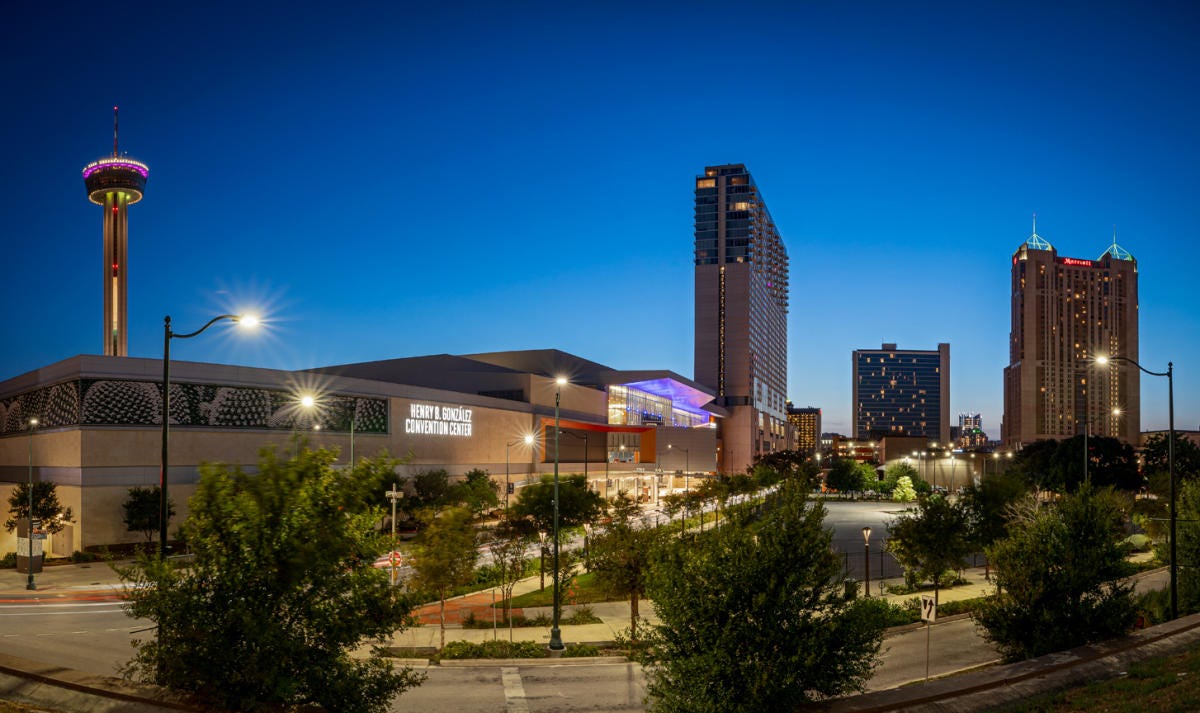
City eyes $850M convention center expansion (Business Journal) → Before we spend $850 million to keep up with Houston, Dallas and Austin, ask what the last $540 million bought. The city has expanded the convention center twice in 25 years, $215 million in 2001 and $325 million in 2016. Conference attendance in 2024 was around 375,000 by the city’s count, about 12% above the 337,000 in 1989. The consultants who made the case for the first expansion in 1990 predicted at least half a million per year by 2000. Now Visit San Antonio says the city is “currently holding our own” on bookings against Austin, Dallas and Fort Worth, but that the pace plummets in 2031, when Dallas’s $3.8 billion and Austin’s $1.6 billion convention centers and the first phase of Houston’s $2 billion overhaul are all open and chasing the same opportunities we are. UTSA professor emeritus Heywood Sanders, who wrote “Convention Center Follies,” told the Express-News last year: “It defies credulity that every last one of these places is going to see these kinds of results.” Mayor Jones asked the right question Wednesday: “How do we know that more space makes us more competitive?”
Nuclear power projects flock to Texas, with billions in federal subsidies (Express-News) → San Antonio should want in. Nuclear is safe, clean and reliable, and the first local reactor is already being planned. America’s reactors ran at 91% of capacity last year, against 59% for a combined-cycle gas plant and 34% for wind. At that capacity, nuclear produces almost half of the country’s carbon-free electricity. And counting accidents and air pollution, it causes just as few deaths per unit of power as wind or solar. The upside: San Antonio already owns a piece of this, as CPS Energy holds 40% of the South Texas Project and agreed in 2024 to buy more. And in April, the Air Force named Joint Base San Antonio a candidate site for a microreactor that Antares Nuclear would pay to build, and that the Air Force wants running by 2030, with CPS Energy as a partner. The state has even created a $350 million fund to reimburse companies that build advanced reactors in Texas. Nuclear is simply a good idea, and CPS should be planning for the next one here.
Fewer babies, more empty nesters and ‘fierce’ competition: Why NEISD is proposing the closure of 3 elementary schools (SA Report) → Closing three schools a year is the slowest and most painful way to shrink a school district. NEISD knows where this is headed. North East ISD has lost a quarter of its enrollment in 12 years. Sixteen of its elementary schools meet all three of the district’s own closure tests: having fewer than 450 students, are less than 60% full, and have a cost per child at least 5% above average. The board is expected to vote next month on whether to close three of them in order to save an estimated $4.06 million (against a deficit the district puts at about $20 million). Then it plans to wait—Superintendent Anthony Jarrett has said: “We’re going to have to talk about somebody else next year and somebody the year after that.” The way things are headed is already crystal clear. Texas lost 76,000 public school students last year alone, and a demographic expert told state lawmakers that this is “the start of sustained enrollment decline.” That’s a problem when every elementary school carries over $1 million per year in overhead even before teacher salaries are factored in. A slow drip of closures means carrying those costs, and more, on other sparsely populated campuses until the inevitable happens. The better way is to zero-base the whole district. Decide how many schools we really need, and where, and announce the closures and the transition plans together. A harder year, perhaps, but a kinder decade.
San Antonio’s bond must serve entire city while not fueling a tax increase (Express-News) → A merit-based bond with no tax increase takes a council that can agree on something, and we don’t have that council. The editorial asks for a more competent world: for projects to be picked on merit rather than geography, to avoid a tax increase, and for a mayor who wins votes and unites the council with soft power. Optimistic! And most of it unlikely to happen. In reality, we will likely continue to struggle our way through the bond process. A truly merit-based bond would start with the city’s own pavement ratings and put the money where the roads are worst with no guaranteed share for anyone. Instead the argument is over how to divide a number nobody likes among people who don’t trust each other.
The Pick
Our weekly recommendation for what’s going on in San Antonio
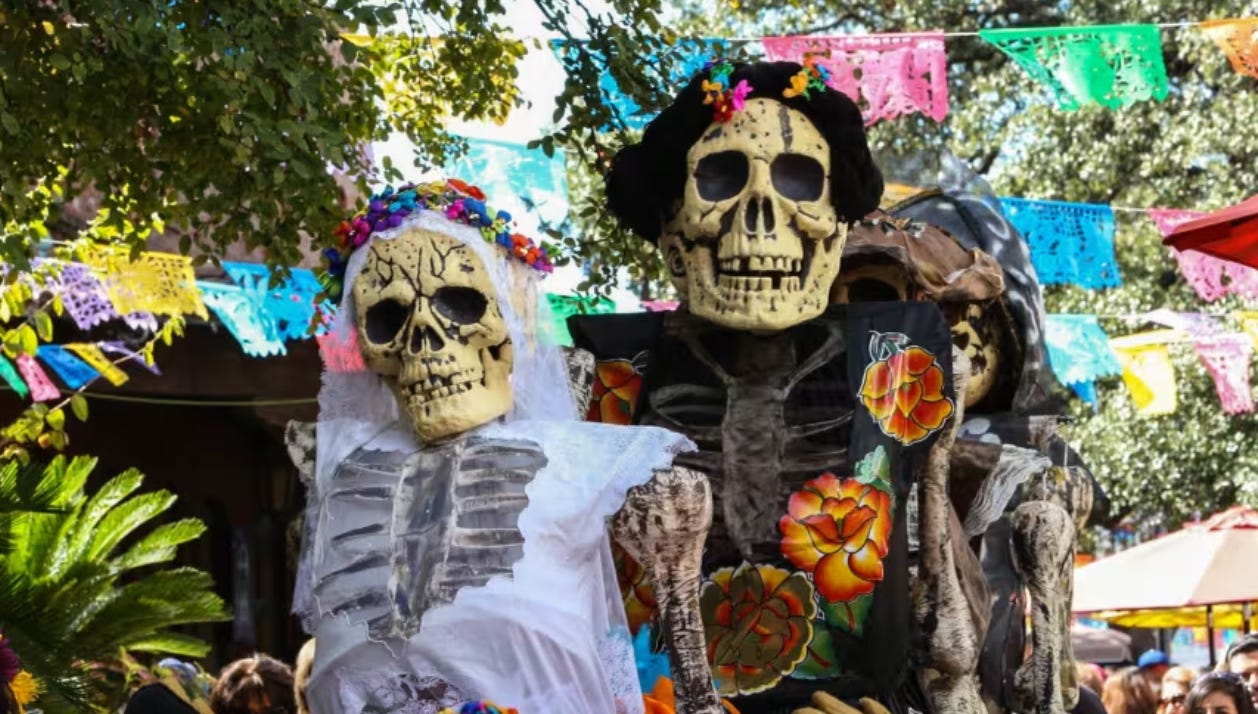
Calaveras de Azúcar Festival at Market Square
Altars, live music and local vendors fill Historic Market Square on Día de los Muertos weekend for the Calaveras de Azúcar Festival. The market’s self-guided tour runs daily through Nov. 6, and the River Walk’s Día de los Muertos Tradition Trail, with 23 altars at hotels, restaurants and attractions downtown, ends Monday. Admission is free. Saturday, October 31, 10 a.m. to 9:30 p.m., and Sunday, November 1, 10 a.m. to 8:30 p.m., at Historic Market Square, 514 W. Commerce St.
Thanks for another week. Follow us on your platform of choice: X/Twitter, LinkedIn, Instagram, and Facebook. Story tips and reader notes go to our reporter Jarrett Whitener at jarrett@thecivic.com, and my inbox is always open.
A particular thanks to our Charter members, whose continued generosity allows us to operate.
Enjoy your weekend and see you Tuesday.
- Philip Reichert
Editor, The Civic