



What We’re Watching This Week
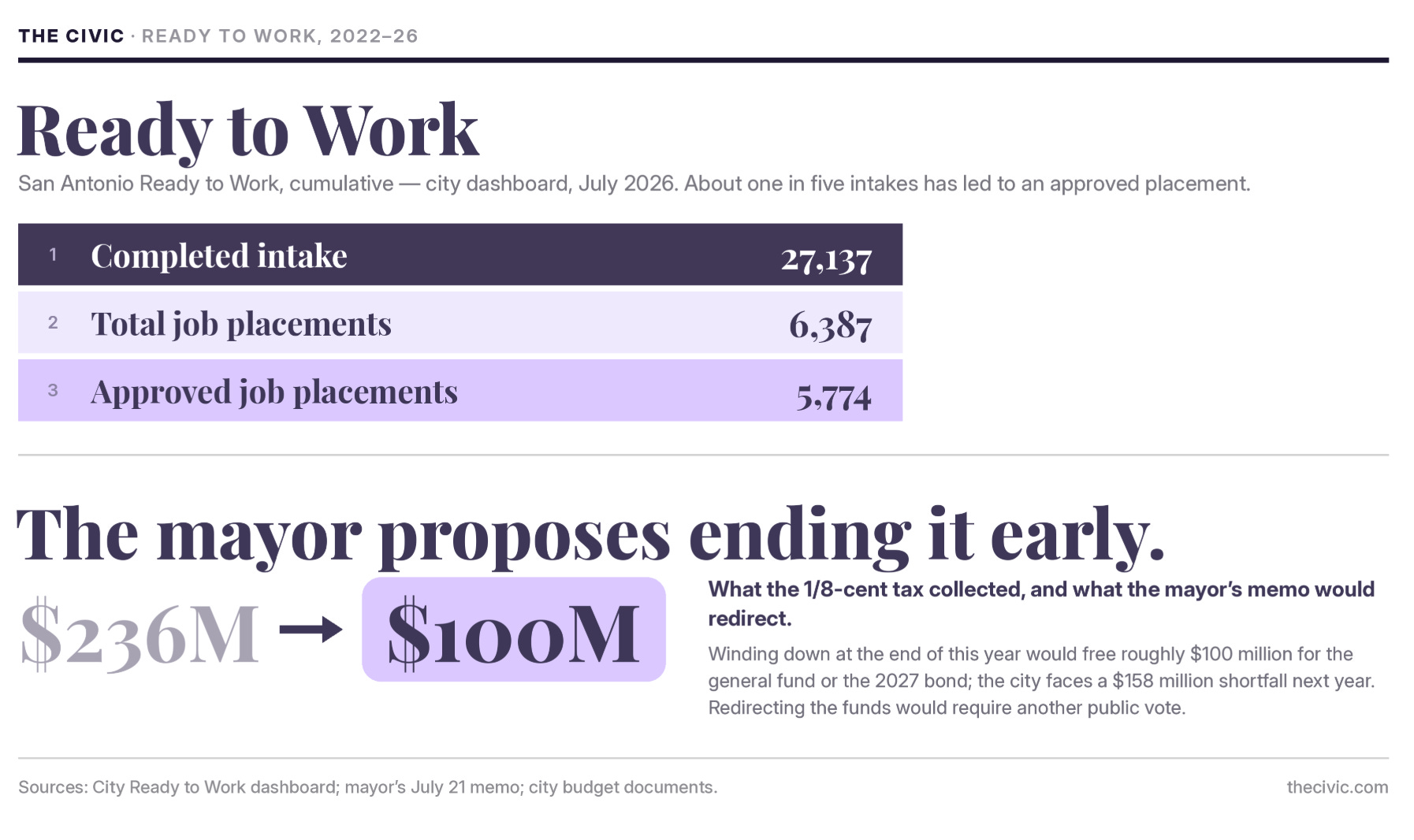
Mayor Jones wants to end Ready to Work early and put the money toward the budget instead. In a Tuesday memo to council, the mayor proposed winding down the workforce program and redirecting the remaining funds (roughly $100 million according to her office) toward the general fund or next year’s bond, calling a property-tax-rate increase “a last resort.” Ready to Work was created by 77 percent of voters in 2020 and was funded by a 1/8-cent sales tax San Antonians are still paying, now going to transportation projects, which is why unwinding it may require another election and why the city attorney thinks it may be complicated to repurpose the funds. The proposal prompted a rare Wednesday column from us. Other line items are already feeling the same pressure: the mayor has floated cuts to Fiesta, the Botanical Garden, and the Book Festival. We’re watching to see how creative the council gets, whether there is enough support to cut our losses with Ready to Work, and which programs come under scrutiny next.
San Antonio ISD has a new superintendent, and the hire is ultimately about keeping the state out of the city’s core district. The board voted 5-2 Monday to bring in Adrian Bustillos at a starting salary of $315,000. He arrives from the Houston area’s Aldine ISD, where he has been chief transformation officer since 2019, and he starts next month. He inherits roughly 44,000 students (and about 2,000 fewer projected next year), a fifth consecutive year of budget cuts, and a $23.2 million deficit. The Express-News reports nine SAISD campuses are at risk of a fourth consecutive “unacceptable” rating, and a fifth would give the Texas Education Agency grounds to replace the elected board, the same mechanism that put Houston ISD under state management. San Antonio ISD is not the only ISD feeling pressure: Northside, the area’s largest district, is weighing its own campus consolidations as it also considers a near-billion-dollar bond. We’re watching because the stakes are quite high—if Bustillos fails we are likely looking at state takeover.
San Antonio just took on the biggest airport debt in its history. The city went to the bond market this week and sold roughly $869 million in airport bonds—a deal marketed at $944 million—the largest airport borrowing it has ever done. This is only the beginning of an expansion program officials expect will require more than $2 billion in borrowing in total. The money will go toward building the long-awaited Terminal C, an 18-gate terminal larger than either of the existing two, set to open in mid-2028. Two things worth knowing. First, this debt is repaid by the fees built into tickets, parking, and concessions, not by property taxes. Second, it is a bet on growth: the plan works if passengers climb from about 10 million before the pandemic to 14.5 million by 2040, and Moody’s trimmed the airport’s credit rating a notch, noting that the debt load is getting heavy. The bond paperwork even cites the planned downtown Spurs district as a source of future travelers. We’re watching because the terminal is a big bet on future growth, and the state of the airport has hurt us in the past.
The Civic is independent, nonprofit, and nonpartisan. We are supported entirely by our readers and our Charter members. Consider supporting our work.
The Reframe
Study: Texas ranks among worst states to raise children (SA Current) → The ranking is completely meaningless but one number matters. This “study” (which does not appear to exist anywhere on the internet as of this writing) comes from a nanny-recruitment company, so calibrate your expectations. The 23-metric index claims Texas has less than one pediatrician per 100,000 children, a figure implausible enough that someone should have caught it before publishing (Texas has around 7.5 million children—their figure would imply fewer than 100 pediatricians in the entire state. Not true, the real number is some 88 pediatricians per 100,000 children, nearly 100 times the cited figure.) But one number in the pile is real and actually matters: 11 percent of Texas children have no health insurance, the highest rate in the country. Uninsured kids don’t stop getting sick, they end up in emergency rooms, and in Bexar County a large share of that uncompensated care lands on University Health, which is the hospital district line on your property tax bill. If you’re looking for something relevant from this story, ignore the study, focus on this statistic.
San Antonio housing lacks affordability, not inventory (Express-News) → San Antonio IS affordable, and getting more so. A reader responds to the Express-News’s coverage of the new federal cap on institutional investors by noting San Antonio has nearly 16,000 homes listed for sale, so the problem isn’t supply, it’s that the supply is unaffordable. On the diagnosis we agree, supply is our great gift. And that supply, we would remind everyone, is already cheap, with San Antonio the cheapest major metro in Texas and near the bottom of the largest metros in America in terms of median home value. The letter’s prescription, to wait for owners to walk away then have the federal government buy the distressed homes and resell them at a discount, is unnecessary and foolish. We don’t need Washington to serve as a glorified house flipper. The market-based version of what the author wants is already underway: prices here are drifting down as listings sit and supply remains high, with prices down 3% over the last year. So the author is correct that we do not lack inventory, but to say that one of the cheapest housing markets in America lacks affordability is simply not true and we continue to get MORE affordable, not less.
Tesla robotaxi hub near Pearl clears zoning hurdle (Business Journal) → You can't lose housing that nobody is building. The Zoning Commission voted 8-2 on Tuesday to let Tesla lease a lot on West Josephine near the Pearl as a charging lot hub for up to 56 robotaxis. This was against the recommendation of city staff, who recommended denying the proposal because a parking lot conflicts with the area’s mixed-use ambitions. One dissenting commissioner called it "a bad, bad use for the space." Here is the space: zoned in 2024 for 225 apartments, a hotel, and commercial space that were never built because rates and construction costs killed the project, briefly listed for sale and then delisted. The zoning already allows a public parking lot with EV chargers, the fight is just over whose cars park there. In May we asked why Texas's biggest builder invests everywhere but here. Perhaps we’re getting in our own way? Council takes it in August and should say yes. A city hungry for investment can't afford to be a choosy beggar.
Could bus routes link New Braunfels to San Antonio, San Marcos and Seguin? (Express-News) → By the study’s own math, the bus lines don’t make sense. The Alamo Area Metropolitan Planning Organization and New Braunfels commissioned a study on bus routes between San Antonio and New Braunfels, and the result recommends several routes between the two cities. But consult the ridership section… On an average Thursday, 13,303 trips are made between New Braunfels and San Antonio, and the study assumes the buses would capture 1 to 2 percent of them, roughly 130 to 270 riders on the flagship route, spread across thirteen hours of buses every half hour. That's a handful of passengers per bus, in a city whose own analysis finds 92.5 percent of households already have access to a car. Even the story's opening sales pitch, take the bus down for a day of tubing on the river, dies in the study. The San Antonio route runs weekdays only, 6 a.m. to 7 p.m., so the “tubing bus” wouldn’t run on weekends. New Braunfels has seen tremendous growth and the interstate can be genuinely miserable, but we still don’t need a bus line.
The Pick
Our weekly recommendation for what’s going on in San Antonio

National Day of the Cowboy at the Briscoe
The Briscoe Western Art Museum is hosting its annual National Day of the Cowboy, a free community day, museum admission included. Expect lasso demonstrations, cowboy poetry, chuckwagon treats, storytelling, and live Western music across the galleries and the McNutt Sculpture Garden. The observance started in 2005 and Texas made it an official day of honor in 2015.
Saturday, July 25, 10 a.m. to 4 p.m., Briscoe Western Art Museum, 210 W. Market St. on the River Walk. Registering is recommended before you go.
Thanks for another week. Follow us on your platform of choice: X/Twitter, LinkedIn, Instagram, and Facebook. Story tips and reader notes go to our reporter Jarrett Whitener at jarrett@thecivic.com, and my inbox is always open.
A particular thanks to our Charter members, whose continued generosity allows us to operate.
Enjoy your weekend and see you Tuesday.
- Philip Reichert
Editor, The Civic