



What We’re Watching This Week
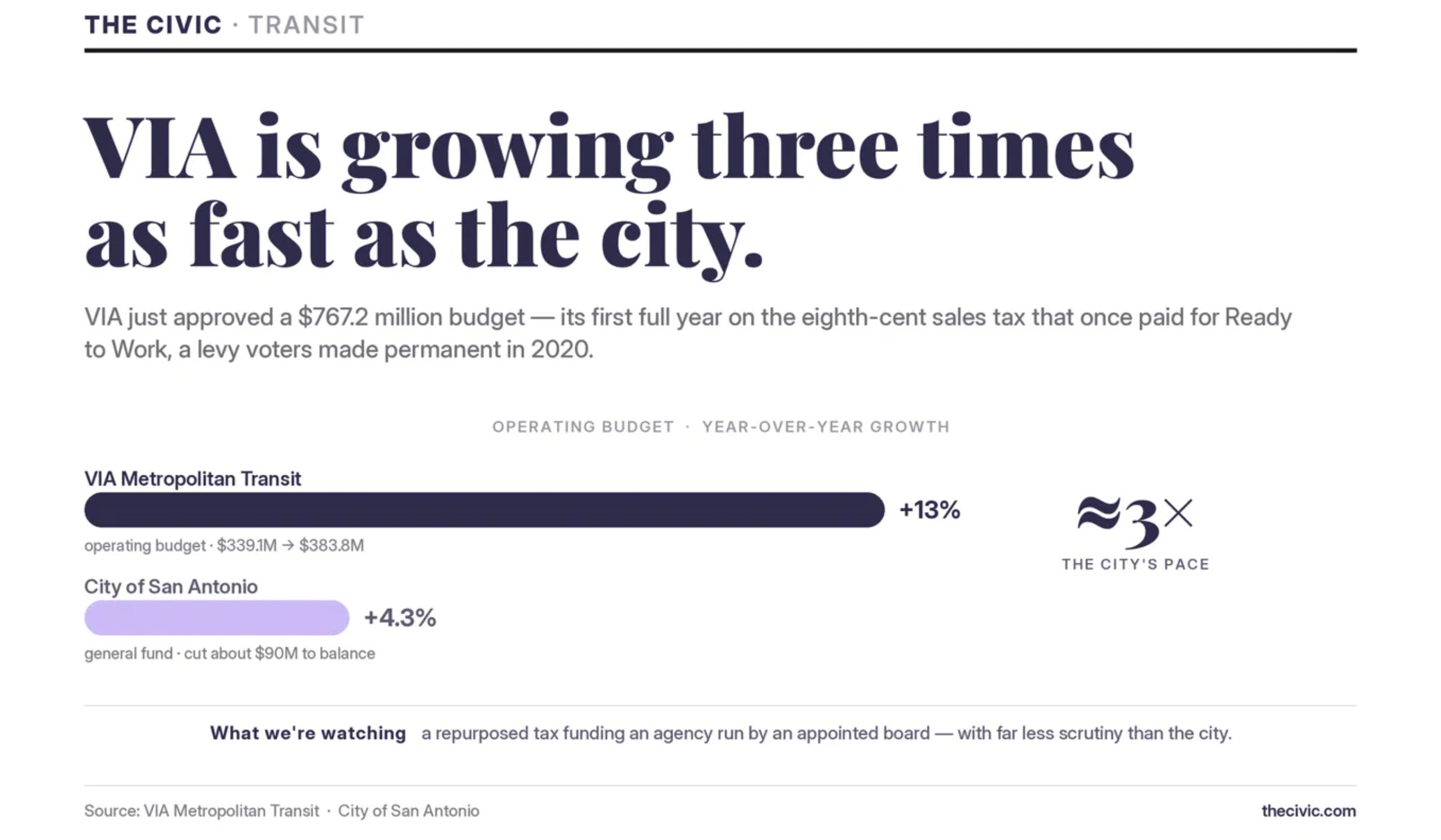
VIA just locked the first full budget including the sales tax that used to fund Ready to Work. VIA’s appointed board unanimously approved a $767.2 million budget for this fiscal year, along with a five-year, $1.1 billion capital plan. The eighth-cent sales tax that paid for Ready to Work through 2025 began flowing to VIA in January and should bring in about $51 million this year for rapid transit, VIA Link microtransit, and other projects. The Green Line, VIA’s first Advanced Rapid Transit line, is due to open in April 2028, and a new VIA Link zone is coming to Stone Oak. This scale of activity coincides with VIA's adopted operating budget rising from $339.1 million to $383.8 million, about 13%, driven mostly by the recurring cost of last year's service expansion plus higher labor, benefits, fuel, and contracted service costs. Meanwhile, the city held its general fund spending growth to 4.3%. VIA describes the budget as "a foundational reset," and the board approved it unanimously. We're watching because VIA's operating costs are growing faster than its revenue as new rapid lines approach (and have their projected costs increase).
San Antonio’s two largest chambers of commerce are proceeding with merger discussions. The Greater San Antonio Chamber and the Metro SA Chamber will combine in January into one organization representing more than 2,000 businesses. The two considered merging in 2023, but the effort fell through. This time both boards unanimously approved a joint committee in September to explore a formal partnership. Its stated priorities run from small-business advocacy and the cost of doing business to the downtown Spurs arena and Missions ballpark. “We see this as an opportunity to have a bigger combined voice, together,” said Paul Basaldua, the Metro SA board chair. We’re watching who is picked to lead the new chamber, whether it is more ambitious than existing chambers, and how a single, larger business lobby engages City Hall on major issues and pro-business policy. The chairmen of both chambers recently appeared on Eddie Aldrete’s Beyond The Bite to discuss the merger:
SAISD is asking voters for $600 million, but a forensic review of its last bond is still ongoing. On August 19, San Antonio ISD sought audit proposals from independent accounting firms for a forensic audit of the $1.3 billion bond that voters approved in 2020, about $420 million of which remains unspent. According to the Express-News, it has since hired Weaver and Tidwell for the audit, which began work September 30 and expects to finish in late October. The firm is set to present findings to trustees November 10, a week after Election Day. The district’s deputy superintendent and chief of staff have been on paid administrative leave since early September. Sources told the Express-News that the deputy superintendent had raised concerns about bond accounting months earlier, and that the chief of staff’s leave involves her hiring an outside contractor to look into them. Meanwhile, the new bond package asks for $492 million for modernization and safety, $102 million for technology and $6 million for Alamo Stadium and the Convocation Center, and a tax rate election. We’re watching because early voting starts October 19 and Election Day is November 3, a week before the audit of the last bond reaches the board.
The Civic is independent, nonprofit, and nonpartisan. We are supported entirely by our readers and our Charter members. Consider supporting our work.
The Reframe

Trump makes last-minute pitch in San Antonio after upending the GOP map (San Antonio Report) → San Antonio is quietly becoming more politically relevant. We should embrace and leverage it. Wednesday’s rally at Freeman Coliseum, for Senate nominee Ken Paxton and congressional nominee Carlos De La Cruz, was the president’s third trip to Texas in a month. Speaker Mike Johnson calls Texas' 35th Congressional District “the whole enchilada.” Democrats have made a similar calculation. James Talarico opened his general-election campaign at the Paper Tiger in May, telling the crowd “there’s no way to win Texas without winning Bexar County,” and Gina Hinojosa rallied there in July. The administration has come too: cabinet secretaries Pete Hegseth, Doug Collins and Scott Turner have all visited this year. The last thing anyone wants is more divisive national politics seeping into our daily lives, but this is actually good news: A city both parties have to compete for has leverage.
San Antonio’s fee hikes for emergency services will hurt (Express News) → We will get more of the same without solving structural problems with our budget. Thanks to fee increases in this year’s budget, an ambulance ride now costs $1,700 plus mileage, up from $1,000 in 2024. That represents a 70% increase in just a few years. This increase came with dozens of other fee hikes in a budget that closed a nearly $158 million two-year gap with about $90 million in cuts, $34.8 million in new fees and revenue, and the city’s first property-tax rate increase in more than 30 years. Even so, the city projects further fiscal troubles in each of the next few years. Fees are the path of least resistance: they balance the books without forcing the harder question of what the city spends and why, which is why they’ll be back the next time the budget gap opens—next year! And they stack up. Unless San Antonio city council finds it within themselves to make difficult decisions, these fees will probably all go up again next year. All signs point to a city growing less affordable.
San Antonio school districts could lose $29 million under Texas voucher program (Express News) → San Antonio school districts lose funds when people move elsewhere. This only happens when they are the less compelling choice. The estimate comes from two groups that oppose the program, which calculates around $8,000 in lost state funding per each student who leaves a public school for a voucher. This is how school funding in Texas works, school funding follows enrollment. But locally, vouchers are the least of our worries. SAISD lost 450 students to vouchers when it was already expecting about 2,000 fewer students this year, part of a decline that runs back years. Statewide, only about 30% of recipients came from public schools at all. The fixed-cost argument, that buses, buildings, and teachers don’t shrink one student at a time, is not wrong. But as we wrote in June, what is a challenge for a district is just a binary choice for families. The way to keep the money is to be the school families choose.
How Louisiana landed SpaceX: Inside the secret negotiations behind a $100B project. (Express News) → This is what chasing opportunity looks like. Working under nondisclosure agreements and a code name, “Project Osprey,” the state of Louisiana assembled what the Louisiana Illuminator values at $27.5 billion in incentives, mostly a 25-year property tax exemption, and passed new laws shielding aerospace companies from certain lawsuits and public records requests. In return it gets a $100 billion launch complex and at least 3,000 jobs by 2035, averaging $92,600 a year. The price deserves scrutiny at nearly $8 million per committed job, negotiated out of public view. But the posture is: Louisiana decided what it wanted and organized itself to win it. We want to see San Antonio work with the State of Texas to pursue big things as strongly as Louisiana did.
The Pick
Our weekly recommendation for what’s going on in San Antonio

Jingu Festival
A free evening in the Japanese Tea Garden for the 100th year of the Jingu House. Live music, the garden after dark, and Japanese street food for sale, put on by the San Antonio Parks Foundation. Admission and parking are free. Saturday, October 10, 5 to 9 p.m., at 3853 N. St. Mary’s St.
Thanks for another week. Follow us on your platform of choice: X/Twitter, LinkedIn, Instagram, and Facebook. Story tips and reader notes go to our reporter Jarrett Whitener at jarrett@thecivic.com, and my inbox is always open.
A particular thanks to our Charter members, whose continued generosity allows us to operate.
Enjoy your weekend and see you Tuesday.
- Philip Reichert
Editor, The Civic
"We want to see San Antonio do big things with the state of Texas" ironically endorses the misguided idea that state capitalism is superior to a state-free, vibrant market economy. Our 50-yr, city-led state capitalism "urban planning" record, has yet to be studied, for its failed outcomes as a nat'lly ranked poor, impoverished, economically segregated city.