



What We’re Watching This Week
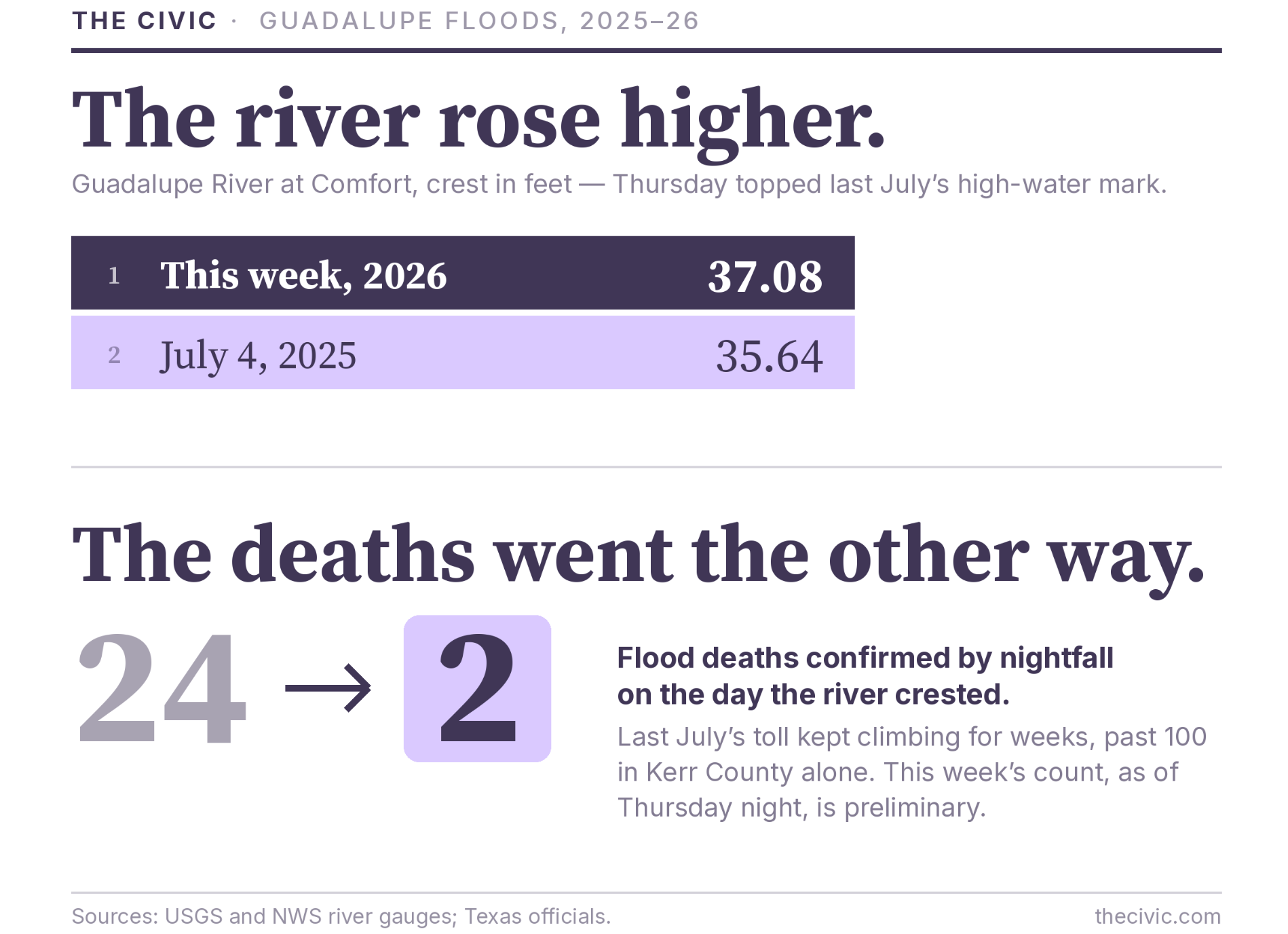
Major flooding returned this week, and new systems bought after last summer got their first test. Four days of tropical rain put South Central Texas back underwater. An EF-1 tornado tore across the Northwest Side near The Rim on Wednesday, Uvalde ordered mandatory evacuations, and by Thursday morning the Guadalupe at Comfort was at 37.08 feet (above last July's record) with two deaths confirmed as of Thursday night. Kerr County's new sirens sounded around 2 a.m. Thursday, reportedly for the first time, and more than 80 people were evacuated from riverside campgrounds ahead of the crest. On July 4 of last year, the county sent no cellphone alerts and Kerrville got 26 minutes of effective warning. San Antonio barricaded 20 low-water crossings by Wednesday afternoon, and thirteen months after 13 people died at crossings like them, Bexar County has reported no flood deaths as of Thursday night. We're watching because this is an early audit of what is different from last year: in the coming weeks we'll be asking, system by system, what worked, what wasn't built yet, and what still needs to be done.
San Antonio’s housing bargain is real, but getting more complicated. Last week we noted that San Antonio home prices were falling, making it easier to buy a house. New data this week shows what happens after closing: the Houston Chronicle reported roughly 6 percent of FHA-backed loans in Texas were at least 90 days delinquent in April, up from 3.7 percent a year earlier, as average home-insurance costs have climbed 80 percent since 2020. San Antonio has more first-time buyers than most large markets and a lot of entry-level inventory, which makes the warning especially relevant here. It is also why a new federal cap on institutional investors' purchases of single-family homes will matter locally: investors bought nearly 16 percent of the market last year, typically at the lower end. We're watching because "housing affordability" is the sale price PLUS property taxes, insurance, SAWS rates and CPS bills, all on the same household. A cheaper house is a real advantage but the cost to carry the home is still a factor.
The Bonham Exchange is asking for more time and says the mayor’s fundraising assistance never came. The Bonham Exchange says it cannot make its Aug. 1 sprinkler deadline and is asking the city for more time. The club has secured a loan covering the full system and is finalizing the installation contract, work its contractor expects to take five months, and the city has already extended another nightclub’s deadline after it showed progress on permits and construction. When we wrote about this fight in June, it had already caused a postponed council vote, a confrontation, and ultimately the first censure of a San Antonio mayor in modern history. What it had not produced was the money. The Bonham signed its compliance agreement only after Mayor Jones publicly committed to help raise the ~$550,000 needed for new sprinklers, and general manager Joan Duckworth says that promise was why she signed. The fundraising help never materialized and the club ultimately borrowed the money itself, five months of construction too late to make the deadline. We’re watching because if Aug. 1 arrives with no extension and no explanation, the Bonham loses its certificate of occupancy.
The Civic is independent, nonprofit, and nonpartisan. We are supported entirely by our readers and our Charter members. Consider supporting our work.
The Reframe
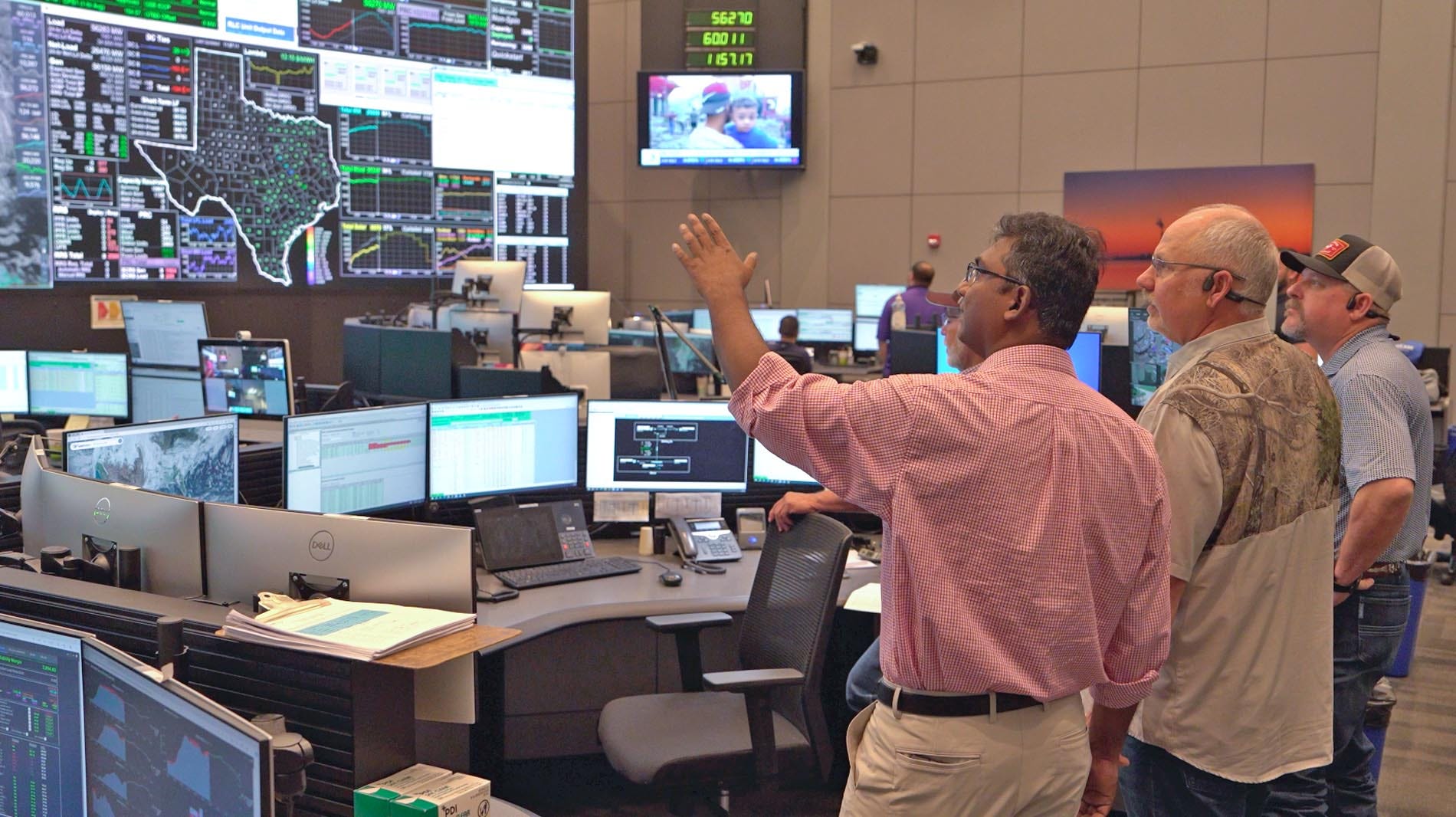
ERCOT nowhere near meeting Texas goal for residential demand reduction (Express-News) → Your thermostat is failing as a power policy. Texas targeted a 20 percent reduction in power usage from homes enrolled in programs that let utilities ease demand during peak hours. The program is failing in two ways: in the rare windows where enough households even participated to measure, ERCOT found 2.5 percent saved against a 20 percent goal, and in the vast majority of peak periods it couldn’t be measured at all. Voluntary conservation programs are useful but clearly they are not an answer to industrial load growth, and the article itself notes that most projected demand is coming from data centers and other large industrial users, not homes. As thousands of megawatts of proposed data-center capacity move toward San Antonio, CPS and state regulators should recognize that curbing residential usage is probably not a solution.
Mayor Jones’ voting commission recommendations merit civic consideration (Express-News) → Turnout measures how much people care, and City Hall cannot make people care. The Mayor's Commission on Voting, a 12-member advisory group Jones convened this spring, released its 56-page report last week. As we wrote in our newsletter, the recommendations mostly create permanent municipal machinery: a new Office of Civic Participation, a permanent commission, a nonprofit coordination roundtable, and critically: a grant fund for civic-engagement organizations. That is a publicly funded get-out-the-vote operation, and running one is not the city’s job no matter your political views. The column’s own acknowledgement that such work must be “impeccably nonpartisan” is actually a huge problem. If this new infrastructure needs to be policed to stay neutral, which it absolutely would, the city government shouldn’t run it. And all of this is window dressing. At the end of the day, if people care enough to vote then they will vote—a problem with turnout is primarily one of apathy. Besides, the mayor already pulled the one lever that really matters: her December win moving city elections to November will do more for participation than everything in this report combined.
Hey, Greg Abbott, make passenger rail between Austin and San Antonio a reality (Express-News) → Doable is not the same as worth doing… Or fundable. The argument leans on TxDOT's new study of the San Antonio-Austin rail corridor, which lays out service options on the existing Union Pacific-owned line. The most ambitious option would serve up to eight round trips a day at about two hours end to end: only slightly faster than what Amtrak's current run takes now, and slower than a car outside rush hour. Even with thousands of total riders, it would not compare to the interstate that moves six figures of vehicles a day. The price is as high as $1.9 billion, before the overruns the editorial itself concedes governments inevitably produce, so call it $2 billion, for capacity that wouldn’t make a meaningful difference. But the real problem is a legal one. TxDOT's constitutionally dedicated money like the gas tax, registration fees and the Proposition 1 and 7 billions cannot be spent on rail. A train isn’t going come out of general revenue, and the editorial asks for an appropriation when the rail fund Texas voters approved in 2005 has never once received one from the legislature. A meaningful rail connection would stitch the two cities together, but this isn't the answer and its not likely to happen.
Study: Texas residents face more financial stress than those of almost any other state (San Antonio Current) → When money is this tight, the most valuable thing a city can do is get out of people’s way. WalletHub’s index is not exactly concrete but its direction matches the harder numbers above: FHA delinquencies doubling, insurance up 80 percent. The Current frames the ranking as midterm ammunition, and it’s true that Austin and Washington will spend the fall litigating whose inflation this is. But a San Antonio household experiences it as bills and a lot of them run through City Hall. The recently proposed trial budget balances on the first property-tax-rate increase since 1993, with the city owned utilities planning rate hikes on top. Even if it’s a modest increase per household it’s the wrong direction in a year like this. The test for every budget line (and really every government decision at City Hall) should be simple: does this make living here easier or harder? The city cannot gift prosperity but it can stop taxing the margin of people already at the edge, and it can clear the fees, delays and compliance costs it alone controls.
The Pick
Our weekly recommendation for what’s going on in San Antonio

Balcones Heights Jazz Festival
The Balcones Heights Jazz Festival turns 33 tonight, which makes it one of those local institutions easy to overlook until you realize how long it has lasted. Trumpeter and vocalist Ilya Serov opens at 7:30, followed by Lubbock-born saxophonist Tom Braxton at 9. Both admission and parking are free.
Bring a lawn chair and arrive early. Friday, July 17, 7:30–10:30 p.m., Wonderland of the Americas, 4522 Fredericksburg Road. Given this week’s weather, check the official page for updates before leaving.
Thanks for another week. Follow us on your platform of choice: X/Twitter, LinkedIn, Instagram, and Facebook. Story tips and reader notes go to our reporter Jarrett Whitener at jarrett@thecivic.com, and my inbox is always open.
A particular thanks to our Charter members, whose continued generosity allows us to operate.
Enjoy your weekend and see you Tuesday.
- Philip Reichert
Editor, The Civic