



What We’re Watching This Week
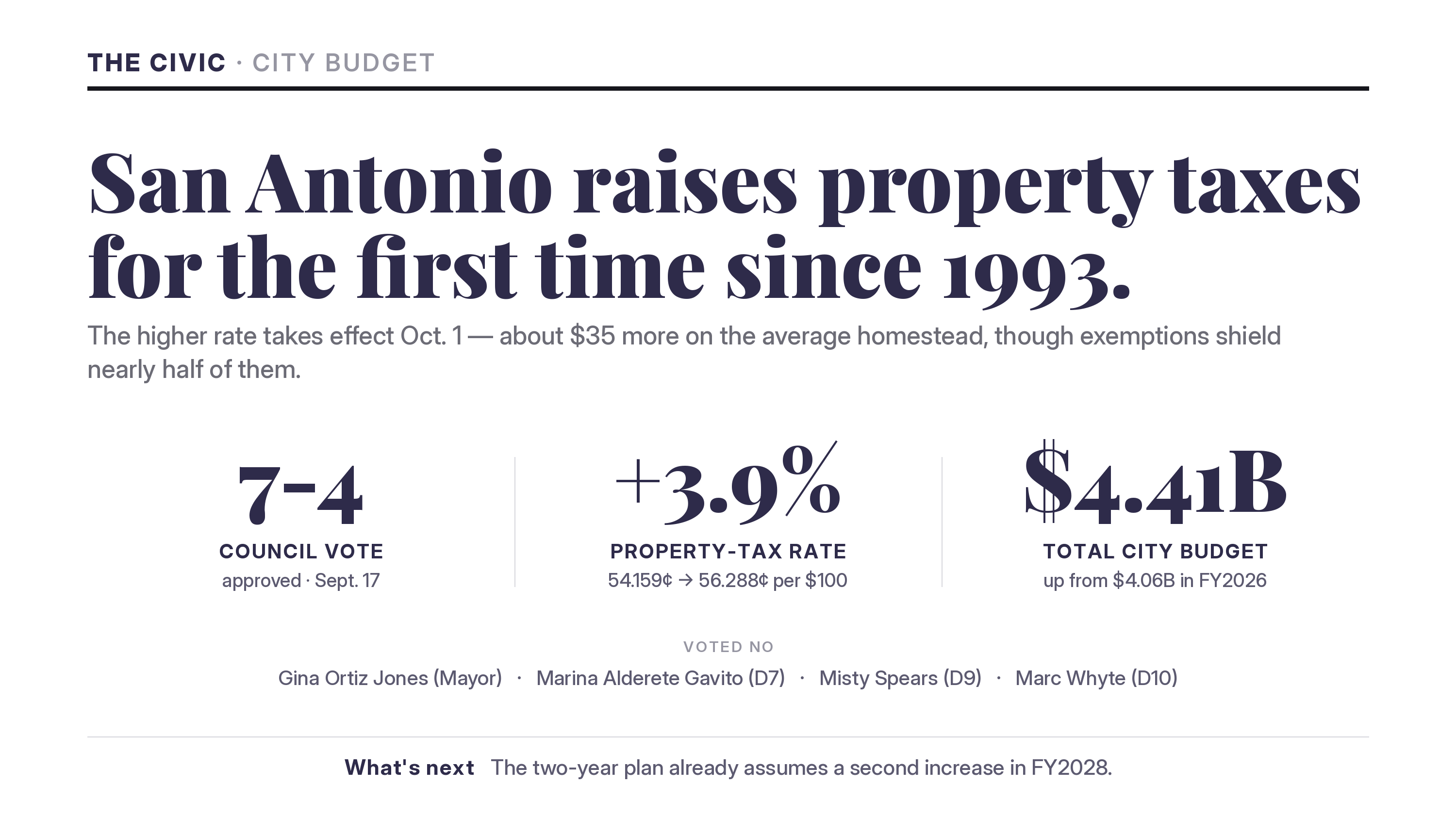
City council approves a new $4.4 billion budget and a rate increase. The long debated budget cycle has reached its end, culminating in the expected $4.4 billion budget and the expected property tax rate increase of 3.9%, which we warned was basically inevitable for over a month. The budget also raised a swath of fees and restored about $4.5 million in program funding on top of raising district capital accounts from $200,000 to $1 million each, paid for with debt. Mayor Jones called the tax increase a ‘last resort’ and said other options were not adequately considered. Various amendments to delay the vote, impose across-the-board cuts, or add patrol and SAFFE officers all failed. So, as the law requires, the FY 2026-27 budget is balanced. We’re watching because the two-year plan already assumes a second tax increase next year. By 2031, the projected deficit is $136 million. Is this the new normal for San Antonio’s budget discourse? Without structural change, we could be doomed to a self-perpetuating system of tax increases.
Read The Civic’s breakdown of the budget and this council meeting here.
Not to be outdone, Alamo Colleges also voted to increase their property tax rate. On Tuesday the Alamo Colleges Board of Trustees voted unanimously to raise the district rate for the first increase since 2013. Enrollment has surged from 64,000 students in 2021 to a projected 95,000 this fall, and the district was facing a $27 million shortfall despite the increase in students. Looking back: Alamo Colleges had a total budget of $354 million in 2017. Going into 2027, that budget has increased to $585 million—up around two-thirds in a decade. You may notice a recurring theme: budgets have increased by what seems like an impossible amount for every major public institution in San Antonio and no one seems concerned with how this is supposed to continue. We’re watching because enrollment is growing significantly faster than tuition revenue and state funding. This could become a budgetary lifestyle creep for Alamo Colleges.
A Night in Old San Antonio canceled for next year as a “reset” is planned. The Conservation Society’s board voted 17-10 Wednesday to pause A Night in Old San Antonio after planning difficulties and a 48% drop in attendance since COVID. The event has lost money four years running and carries about $600,000 in upfront costs, so the Society's preservation grants and student tours have been running on reserves. City staff say NIOSA is the only Fiesta event that fully reimburses the city, paying SAPD more than $383,000 for off-duty officers this year. We're watching because the Society says it would take about $600,000 in sponsorships to stage NIOSA without risking another loss, and the Fiesta Commission's response to the cancellation brought up the city's funding problems. We want to see if anyone gets asked to fill the gap, or if another event gets held in its place.
The Civic is independent, nonprofit, and nonpartisan. We are supported entirely by our readers and our Charter members. Consider supporting our work.
The Reframe
‘Culture of sabotage’: How San Antonio’s City Council went off the rails at budget time (San Antonio Report) → It’s tempting to think things simply ‘went off the rails’ when in reality things are proceeding roughly as intended. The budget process basically ensures growth and indecision. Even in an ‘austerity’ year, our budget grows almost completely unimpeded—meanwhile the two-year plan already assumes more tax increases in the future. The city walled off the budget by classifying roughly 85 percent of police and 97 percent of fire as mandated or priority and freezing several categories as completely untouchable, which leaves behind a moderate list of cuts on library hours and nutrition centers. And our eleven council members have no recourse but to argue over a senior center, nonprofit grants, and other feelgood items while, structurally, nothing changes. A united council would get the same result. So the rate goes up, this year's spending becomes next year's floor, and the word from City Hall is that council was too broken to do anything else.
Enough studies, rail between San Antonio and Austin needs a dedicated funding source (Express News) → The author is right—any rail project between San Antonio and Austin needs a dedicated funding source. That’s the hard part. As the author rightly points out, we are not infrequently subjected to “feasibility studies” and other such yearning for a rail connection between Austin and San Antonio. Also correct, the author notes that this will not happen without a dedicated source of funding allocated by the state. It is precisely this detail, dedicated legislature funding, which is so politically unlikely. Decades of advocacy for precisely this project has resulted in nothing approaching legislative consensus, and to change that would require the entire state legislature to unite around an infrastructure project that benefits primarily the two smallest of the Big Four metros. Perhaps a rail project for the entire Texas Triangle could be considered, but the cost for it would be so extremely prohibitive (even before the inevitable cost overruns that plague such programs) that this will also likely never happen. We should invest our efforts into outside-the-box solutions that have the chance to move forward like autonomous transportation and tunnel projects.
Disinterested San Antonio council members send message to engaged public (Express-News) → Council is interested. Those speaking at City Hall are interested. Almost nobody else is. A letter to the editor explained that she waited six hours to speak before City Council on the Midtown TIRZ issue. She described a disinterested council—looking at their phones, typing, leaving the dais, and so on. That could be seen as rude. But let’s look at a different sort of math: fifteen people spoke on that issue and San Antonio has nearly 850,000 registered voters. The most recent municipal elections in May had less than four percent turnout. Meanwhile, the people on council live these issues every week (for better or worse.) The people in the chamber are almost always the same small group who show up for these issues and, until something changes, scolding a council member for checking their phone in hour five is focusing on the wrong problem.
North East ISD will present plan by end of 2026 to close up to 4 campuses (Express News) → Our school districts continue to wither as student populations drop, but a real reckoning remains distant. NEISD has named 16 campuses that use less than 60% of capacity and cost more per student than the district average. The district already closed three campuses last year and is looking to cut four more—which is managing the structural, city-wide problem one cut at a time. Elementary enrollment in the San Antonio area is down more than 20,000 in a decade. Northside, North East, and San Antonio ISD are all smaller than they were and South San Antonio ISD is down about 25% since before COVID. Meanwhile, charter campuses in the region went from about 40 to more than 100. Northside is “optimizing,” SAISD has been closing schools for years, and we still have more school space than children. To put it bluntly, the school system was built for a larger student population than we have now. Until the school system matches the population, nothing changes.
The Pick
Our weekly recommendation for what’s going on in San Antonio

Charreada at the Charro Ranch
The San Antonio Charro Association, founded in 1947, puts on a Saturday afternoon of roping, riding and escaramuza at its South Side ranch next to Mission County Park. Charrería is the ranching tradition that American rodeo grew out of, and this is one of the oldest outfits in the country still practicing it. Food and drink on site. Saturday, September 19, 3–6 p.m., 6126 Padre Drive.
Thanks for another week. Follow us on your platform of choice: X/Twitter, LinkedIn, Instagram, and Facebook. Story tips and reader notes go to our reporter Jarrett Whitener at jarrett@thecivic.com, and my inbox is always open.
A particular thanks to our Charter members, whose continued generosity allows us to operate.
Enjoy your weekend and see you Tuesday.
- Philip Reichert
Editor, The Civic