



The Democratic Socialists of America, or DSA, are having the best year in their history. Membership has surged since Zohran Mamdani began his rapid ascent that captured the Mayor’s office in New York City, but that was only the beginning of the current wave of success. In June’s primaries, DSA-backed challengers unseated sitting Democratic members of Congress in New York and Colorado, including a fifteen-term incumbent in Denver. On July 5, the national organization announced it had passed 120,000 members on the Fourth of July. Whatever you think of the DSA, it is now the ascendant organized force on the American left.
San Antonio is actually part of that story. Three of the eleven votes on city council belong to members the local DSA chapter vetted, endorsed, and knocked doors for: Jalen McKee-Rodriguez in District 2, Teri Castillo in District 5, and Ric Galvan in District 6.
It is within this context that, last Thursday, Texas Public Radio’s The Source hosted a conversation on the DSA and its platform. The episode featured four guests: one of the DSA’s national co-chairs, both co-chairs of the San Antonio DSA chapter, and a Columbia University political theorist introduced as the hour’s neutral explainer, a role she clarified by saying she had come to “debunk some of the more absurd claims” about democratic socialism. And in the closing minutes, during the station’s pledge drive, host David Martin Davies concluded: once you actually listen to them, “they’re not that different than everybody else.”
After listening to the episode, we spent some time with the transcript and the thing the hour was ostensibly about: Workers Deserve More, the DSA’s new national platform.
The two documents seem to describe different organizations.
A program that proposes to rewrite the very fabric of American government deserves to be discussed constantly and seriously the same way we argue about any other issue. What follows is an attempt to describe what the DSA’s platform actually says.
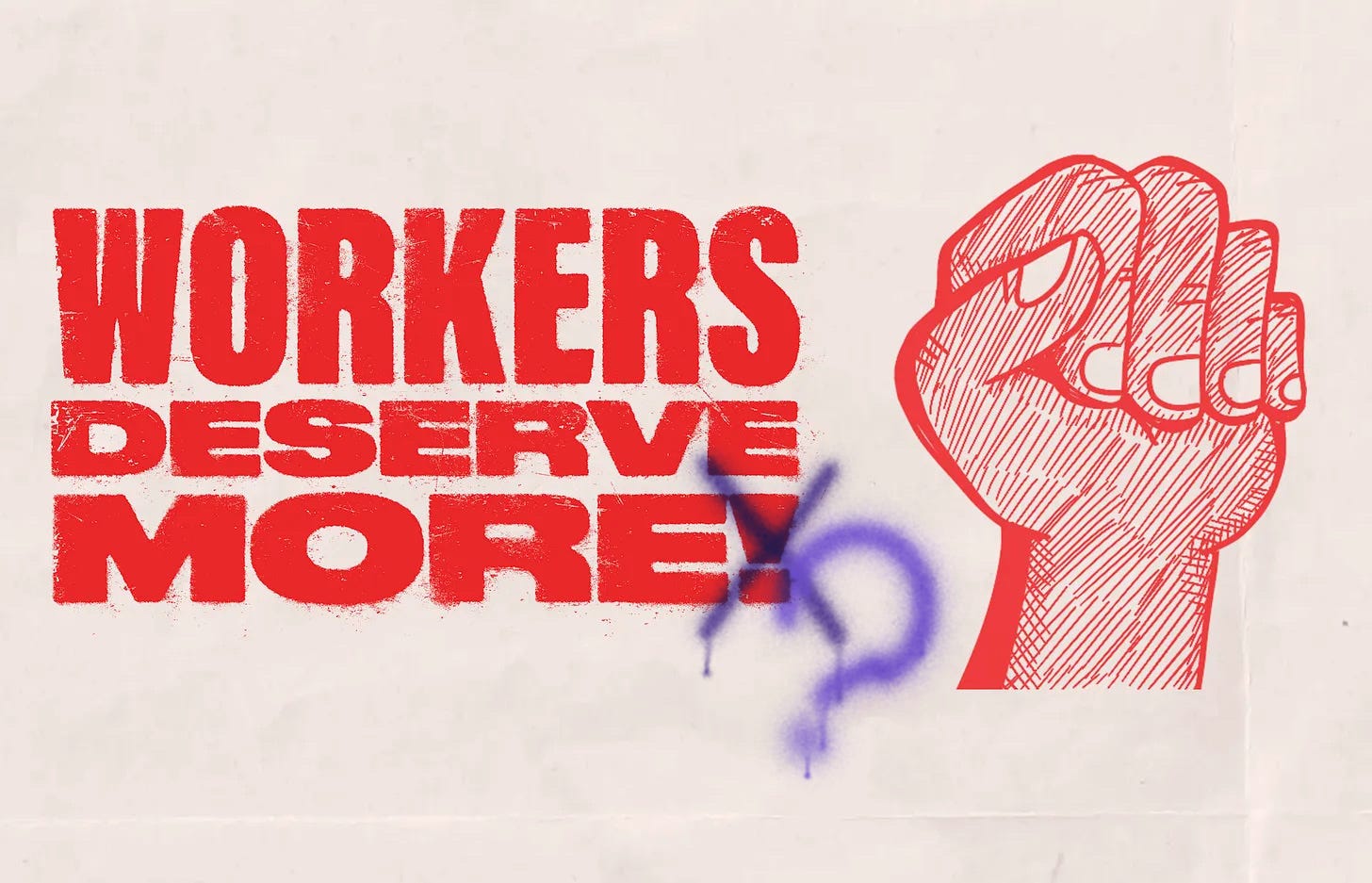
Workers deserve more
“Workers deserve more” is more of a mood than a substantive claim, and a mood intentionally designed in such a way that no decent person can be seen to reasonably oppose it. When we asked District 6 Councilman Ric Galvan, one of our local DSA-endorsed council members, about the national program last week, his office answered: “The national DSA program is not something I was personally a part of creating,” before adding that in a city where working people face rising costs in housing, healthcare, and groceries, “workers deserve more.”
Sounds reasonable. And some of it, in fairness, is the ordinary foundation of progressive politics. Paid family leave. Subsidized child care. A higher minimum wage. Free community college. Sounds great, you can find versions of these in most of the Democratic platforms in America, and many of them poll very well with the working-class voters the DSA is trying to win over. If that were the entire platform, Davies’ verdict would be correct.
But that is not the platform.
The platform says, in its own preamble, that the DSA and its members are fighting “to win the battle for democracy, draft a new constitution, and create a democratic socialist republic.” Some may recognize the first phrase: “win the battle of democracy” is Karl Marx’s wording in the Communist Manifesto, nearly verbatim, for the proletariat’s seizure of political supremacy. The DSA did not include that language by accident, and they go on to say: “Some of these demands may be won under our current system, but we know complete victory will require building a new society from the ground up. We push these demands to their furthest extent today.”
What does the furthest extent look like, written down? Under the heading “A Real Democracy,” the program proposes to abolish the Electoral College and to “replace the President and Supreme Court with an executive and judiciary chosen by and subordinate to Congress.” Under “A Democratic Congress,” it proposes to abolish the Senate. Under “Economic Democracy,” the program calls for “public ownership of the largest corporations and essential industries.” Under criminal justice, it describes demilitarizing police and disempowering police unions “as steps towards fully abolishing the police and prison system.” Its foreign policy section would “defund the Department of War,” close overseas bases, end sanctions on Cuba, Venezuela, and Iran, among others, and terminate “all military and economic aid to Israel” while affirming a “right to resist military occupation.” Its democracy section would extend “full voting rights to all permanent U.S. residents.” That is, to non-citizens. Its immigration section would “legalize migration” outright and end visa caps and quotas. The lifestyle details, including universal rent control, a 32-hour week at full pay, cancellation of all student debt, and so on, are almost tame by comparison.
Every phrase in the paragraph above is taken from the program. None of this is a caricature—the strongest case against the DSA’s platform IS the platform.
The organization’s defenders have a ready answer for criticism, and the national co-chair, Ashik Siddique, gave it on air when Davies asked why “abolish the Senate” was on the platform at all, as it gives ammunition to the DSA’s critics. It’s part of a “longer-term horizon,” Siddique said.
But a long term horizon is still the direction of travel. On the same broadcast, San Antonio DSA co-chair Amador Salazar described the chapter’s electoral record: “we had already elected two DSA members, Jalen McKee-Rodriguez and Teri Castillo,” and then, most recently, Ric Galvan, a campaign in which the chapter says it knocked more than 20,000 doors. He then explained why city races suit the project. Because municipal ballots carry no party label, they give “a little bit of space for individuals that want to implement some of the national DSA vision, but here locally.”
A San Antonio DSA endorsement is not something that happens, passively, to a candidate. The chapter publishes its process and every step of it is highly involved. The candidate must request the chapter’s questionnaire and complete it, then hold a mandatory Q&A session with the general membership, then personally write the endorsement resolution, with a sponsor and four co-sponsors, that goes before a general meeting, where it passes only with a two-thirds vote of members present at a 60-percent-quorum meeting.
None of our three councilmembers ran on this document—it was drafted this spring and published on July 14, after all of their elections. So, once the new DSA platform was published, we asked each DSA-endorsed councilmember their thoughts on the national platform. As of publication, Galvan’s office has provided the statement above; Councilwoman Castillo’s office has not responded; Councilman McKee-Rodriguez’s office has not responded.
If you were looking for a substantive engagement with these elements of the DSA’s platform on this episode of The Source, you would be disappointed. The program contains over a dozen policy prescriptions and only one (abolish the Senate) received critical examination over the length of the episode, and much of that questioning concerned its constitutional feasibility and the political ammunition it gives Republicans. The host corrected his own colleague on air to say the hour was “not about socialism,” a distinction the DSA platform itself declines to make, given that it describes its demands as steps toward “a socialist future.” At one point, discussing the general strike, the host asked the panel, “What are you guys waiting for?”
Every voice on the panel, including the scholar booked as an authority, was a supportive one. Policy positions that command nowhere near majority support in this country like the abolition of police and prisons, the elimination of the Senate, voting rights for non-citizens, and the nationalization of large companies all entered the studio as the adopted program of a socialist organization and left it as “not that different than everybody else.” They are not popular positions in either party and most elected Democrats will not touch the majority of them—go ahead, ask them.
Every tension the hour permitted itself was imported from national politics. Trump, the Red Scares, Stephen Miller, which party is closer to fascism. The questions that belong to this city weren’t asked, on a local program, with both local chapter chairs in studio and three local elected officials in the subtext. Nobody asked what “steps towards fully abolishing the police” implies for the police contract this council will vote on. Nobody asked what their “Green New Deal” will mean for a city-owned utility. Nobody asked what “finishing reconstruction” or “universal rent control” looks like in San Antonio’s neighborhoods. Nobody asked what “defunding the Department of War” looks like in Military City U.S.A. Nobody asked if the DSA considers USAA big enough to be nationalized, or Valero, or H-E-B. Nobody asked whether the members the chapter elected support the program the organization published.
In Chicago, the council's Democratic Socialist Caucus holds six of fifty seats. In New York the DSA cohort is four of fifty-one. In Los Angeles, four of fifteen. In San Antonio, three of eleven votes on the council. This makes San Antonio one of the largest DSA strongholds in America in terms of proportional city council power, as among major cities, only Minneapolis and Portland have handed the DSA a larger share. And our council will vote this term on a police contract, a city-owned utility, and a multibillion-dollar budget. Whether it’s politically convenient to answer them or not, these questions matter here.
The Source opened with the promise: “We're going to hear what the DSA actually is and what they want.” What the DSA wants is written down, and the national co-chair told listeners where to find it, on the air. The organization is publishing it, promoting it, and pushing it, in its own words, to the furthest extent. The missing half is local.
Maybe the three members elected here govern as ordinary progressives and call the platform noise. But they have been asked, and the answers so far are the slogan and silence. Until that changes, the platform is the only account on offer of what this project means for San Antonio.
No matter how much lipstick you put on a pig it’s still a pig. A rose my any other name is still a rose. Socialism is a failed ideology that only leads to misery and decline. It’s little brother, redistribution, does the same.
Nobody asked???? Keep asking….don’t just let the fringe minority take over because nobody asked the questions!!! Ask! Ask again! Publish their positions! And use your critical thinking skills to demonstrate what a disaster their proposals would be in reality! Fools listen to this jingoistic bullshit and think that “workers deserve better” means they gain something….until their own neighborhoods become hell holes!