



What We’re Watching This Week
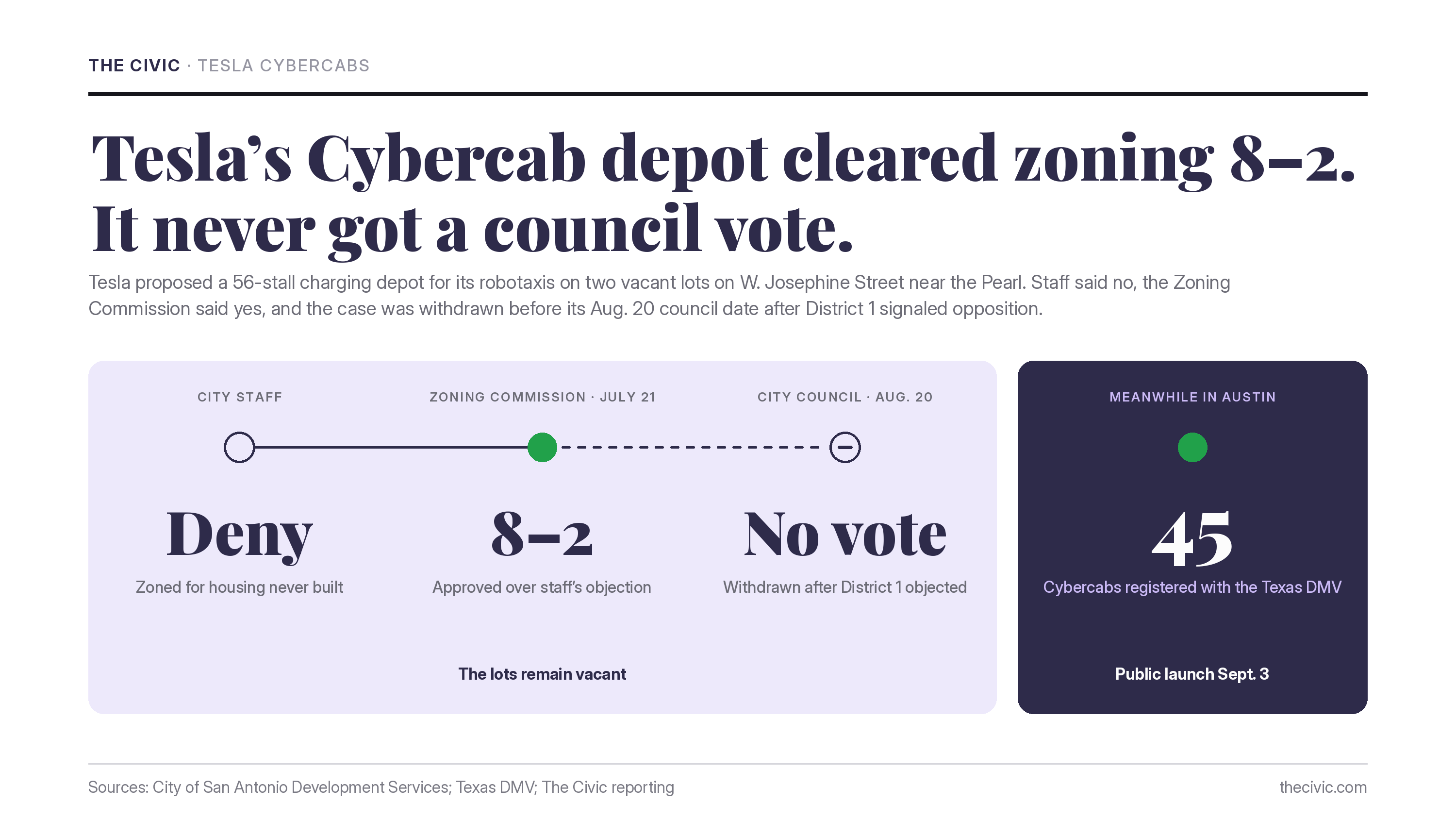
Tesla Cybercabs launch in Texas, but not in San Antonio. Tesla registered 45 Cybercabs with the Texas DMV ahead of Thursday’s public launch in downtown Austin: the two-seat robotaxi with no steering wheel or pedals that Elon Musk unveiled in 2024 and began building at Gigafactory Texas in April. If you’re wondering why not here… Tesla is trying to, and you may have seen the gold Cybercabs driving downtown. In June the company applied to rezone two vacant lots near Pearl for a charging depot. City staff recommended to deny because the block had been zoned for high density residential that was never built, but the Zoning Commission overrode staff 8-2 in July to send it to council. Despite this, the case never actually reached council—though it was scheduled for a vote in an August 20th council meeting, Development Services confirmed that it was withdrawn. According to a person with knowledge of the decision, District 1 signaled opposition to the rezoning, and as council defers to the district member on zoning, Councilwoman Kaur’s position was effectively the vote. Her office did not respond to a request for comment. We’re watching because the apartments the city zoned for haven’t materialized in years, the lot is empty, an important customer wants to use it—and a council office decided to stop it.
Storm recovery: four days to restore power, two deaths, and a homeowner repair program due this week. Friday night’s storm sent damaging winds from northeast Bexar County through San Antonio, downing poles and hundreds of power lines. Over 100,000 CPS Energy customers lost power at the peak. In response, CPS more than doubled its field crews with outside contractors and Pedernales Electric Cooperative, and the last customers were restored Tuesday night. Police are investigating two deaths associated with the storm, including a woman swept down San Pedro Creek. At Tuesday’s budget workshop, City Manager Erik Walsh said staff had been working “for the last day or so” on an emergency homeowner repair program, with a proposal expected by the end of the week. We’re watching because the bill lands on CPS as it was already eyeing a rate increase. Watch what the repair program costs and who qualifies, and whether CPS's accounting of the storm becomes the argument for more money.
We are now in budget month and the budget vote is Sept. 17. Our likely “austerity” budget is bigger. The proposed FY2027 budget is $4.4 billion, up 8.6%, with a general fund of $1.76 billion, up 4%. It carries the first tax rate increase in over three decades, a 3.9% increase that works out to about $35 a year for the average home, alongside $41 million in cuts next year and $90 million over two years. The cuts eliminate more than 100 civilian positions, consolidate departments and defund several senior nutrition centers, among other minutiae that is still subject to change. Council member Marina Alderete Gavito argued in the Express-News on Sunday that the gap is 1.6% of the budget this year and 2% next and can be closed without a rate increase, through higher fines and less spending on travel and food. Marc Whyte wanted the rate increase killed outright, and Walsh says doing that means finding roughly $30 million more this year, but it is highly unlikely that council reaches any meaningful consensus on that front. Meanwhile, Bexar County, held its rate flat and cut spending instead despite facing the worst property-tax year since 2008. We’re watching because we’ve heard nothing but the terrible financial circumstances we face, with a rate hike and a hundred positions gone, yet the budget still comes in 8.6% bigger.
The Civic is independent, nonprofit, and nonpartisan. We are supported entirely by our readers and our Charter members. Consider supporting our work.
The Reframe
‘Unacceptable’: San Antonio nonprofits rally against proposed $5.1M cut to city grants (Express-News) → The city betrayed the nonprofits twice. It never seriously tried to figure out which contracts work, so it couldn’t cut what doesn’t, and it never seriously tried to shrink itself, so their money is an easy target. More than 60 nonprofit leaders rallied on Wednesday over $5.1 million in cuts that council won’t vote on until next September. We’re somewhat critical of nonprofit spending, but nonprofit spending isn’t actually the problem as a rule. The problem is when we can’t tell whether we get what we pay for. A grant that helps a group make culture is one thing but a contract that pays for a specific, measurable job or service is just a transaction. The city never built the means to check whether we get our end of the deal out of those transactions: no consolidated total for what it pays nonprofits, and no outcomes audit of the contracts like the one Austin ran in July, so there’s no way to cut what doesn’t work (we don’t know!) Instead, the city cut by proximity to city-determined priorities: a spokesman said the targeted programs “do not have a direct impact on City Services.” Three-tenths of one percent of the general fund, spread across groups that nobody measured the value of, was the easiest target. And, as expected, the city refuses to shrink itself.
Pre-K 4 SA says it will increase toddler access, affordability if city funding reauthorized by voters (San Antonio Report) → Monday’s briefing was a sales pitch and the math doesn’t quite add up. In August, council put Pre-K 4 SA on the November ballot three years early and for 20 years, not the eight years that voters approved in 2012 and 2020. Monday’s case for two more decades of sales tax was toddler seats, nights-and-weekends care and a “tri-share” model with employers the San Antonio Report calls “still very conceptual” with the specifics to come later, in an upcoming voter guide. Councilwoman Gavito did the math: with a $62 million budget and just shy of 2,000 kids in four centers, that works out to about $31,000 a student which is more than St. Mary’s Hall. CEO Sarah Baray’s answer is that the budget also covers business support and training for other providers, district partnerships and wraparound services. Important to note, though, that doesn’t increase the number of enrolled kids. What does the rest of the money buy? Is it worth it? The current ask is to skip the next check-in until the late 2040s even though an eight-year approval window was working just fine and we don’t know for certain we’re getting enough out of the program.
‘Blank check’ for developers? Why city cuts can’t touch $170M in special projects. (San Antonio Report) → Good that someone at City Hall is looking for money but be realistic. The TIRZ-funded projects that council approves next Thursday is greenhouses at the Botanical Garden, an animal hospital at the zoo, a jail diversion center on the West Side and land for the arena… A.k.a public facilities paid for with captured city property tax. Most of these projects would not exist otherwise without a general fund allotment, which is why the zones are quietly popular with the members demanding cuts everywhere else. Under Texas Tax Code, the captured amount can pay for bonds and project costs inside the zone and nothing else, so the mayor’s idea of pulling it back to close the deficit is not an option. Councilman McKee-Rodriguez’s proposal, to keep the zone alive and point it at shelters and supportive housing, is just using the restricted fund for a different preferred agenda. The truly reachable money is less exciting: the general fund itself, which nobody seems to want to look through line by line. Developers are the easy villain but going after them won’t help us.
San Antonio narrows to-do list of 2022 bond projects as council mulls 2027 budget and bond (San Antonio Report) → A city that needs a standalone department to make its projects start and finish is telling you something about itself, and it’s not good. A year ago Erik Walsh split Public Works into two departments and moved nearly two hundred employees into a Capital Delivery Department whose only job is completing capital projects. Its staff, he told council, would “wake up in the morning and go to bed focused on this effort.” Delivering the projects that voters approved was already the job of Public Works and the city had almost a thousand people for it. A year later, 78% of the 2022 bond’s 183 projects “completed or started,” with 85 still unfinished as the city prepares for the next bond. But started and finished are two dramatically different stages and counting them together seems like garbage in, garbage out. Marc Whyte asked Wednesday whether the restructuring worked and the answer was that the metrics seem to say so, but the question the reorganization raised was never answered: what, specifically, was broken?
The Pick
Our weekly recommendation for what’s going on in San Antonio

El Mercado turns 50 at Market Square
El Mercado's tenants association is throwing a 50th anniversary celebration Saturday morning at Historic Market Square, and it opens three days of free Labor Day weekend programming from the city: local bands, food vendors and a kids zone. Saturday, September 5, 11 a.m.–noon for the anniversary and 10 a.m.–6 p.m. Saturday–Monday. for the rest. Historic Market Square, 514 W. Commerce St. Free.
Thanks for another week. Follow us on your platform of choice: X/Twitter, LinkedIn, Instagram, and Facebook. Story tips and reader notes go to our reporter Jarrett Whitener at jarrett@thecivic.com, and my inbox is always open.
A particular thanks to our Charter members, whose continued generosity allows us to operate.
Enjoy your weekend and see you Tuesday.
- Philip Reichert
Editor, The Civic