



What We’re Watching This Week
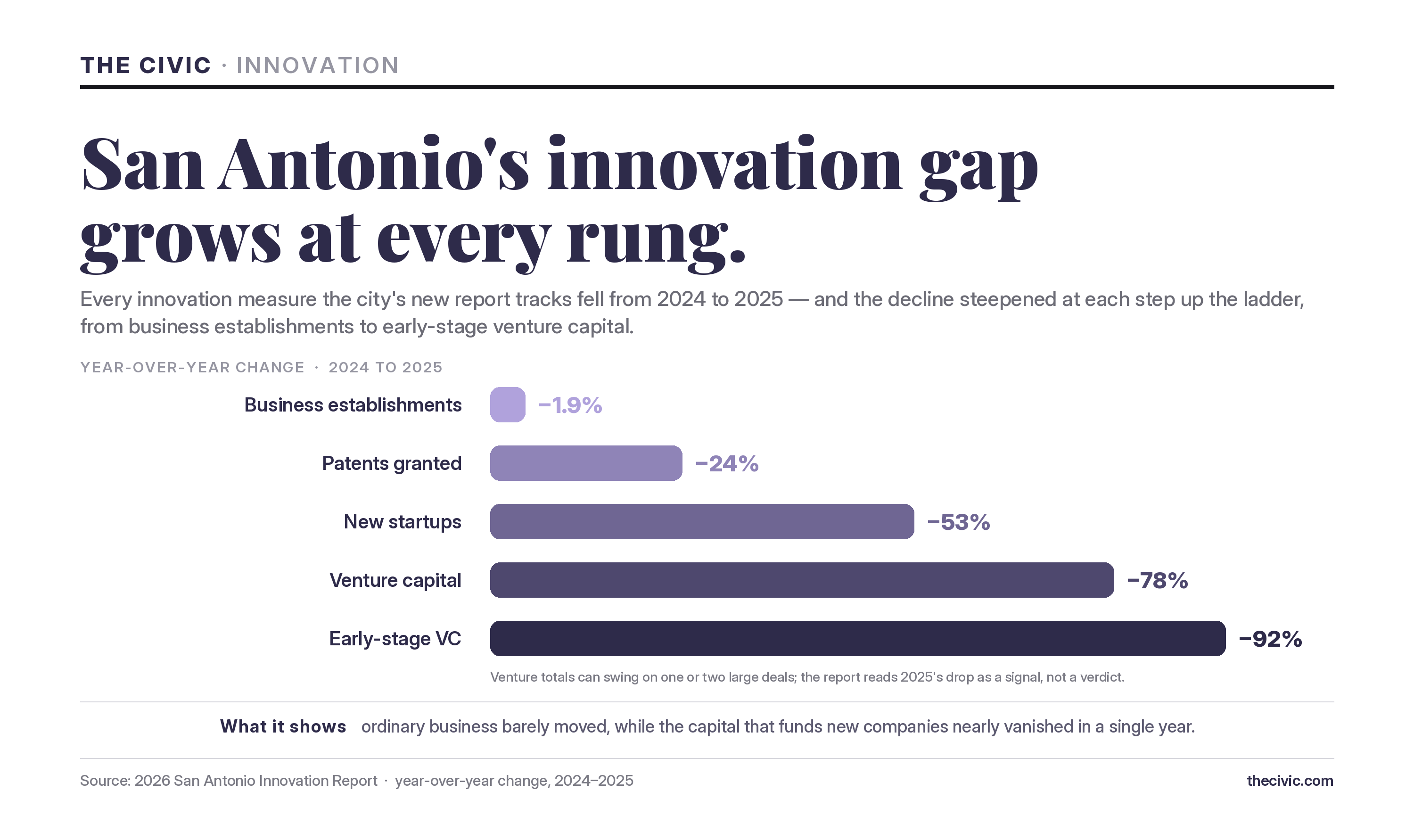
San Antonio’s first innovation scorecard: more jobs, far fewer startups and a collapse in venture capital. The Innovation SATX Consortium (VelocityTX, Geekdom, Tech Bloc and Port San Antonio, with greater:SATX supplying the data) released its 2026 San Antonio State of Innovation Report on Wednesday and VelocityTX CEO Rene Dominguez called it “an eye opener”. The good news is on jobs: 55,054 across nine “innovation sectors” in 2025 with the second-fastest growth of the metros compared, and they pay much more than the metro average. But many of the other figures are not as optimistic: venture capital fell from $141 million in 2024 to $31 million, while early stage money fell 92%. Crunchbase found just 23 new, identifiable startups, down from 49 the previous year. The consortium’s four priorities include a “capital continuum” and a dedicated Innovation Promotion Fund, but does not attach a dollar figure or funding source. We’re watching because the numbers match Tuesday’s column, Stagnate, Raise Taxes, Repeat, where San Antonio companies had raised $39 million this year through September against Austin’s $10.7 billion, and because the consortium promises to continue to measure these figures every year. Read more below:
San Antonio’s innovation economy grows, but new report highlights gaps in regional competitiveness
·
A new report from the Innovation SATX Consortium finds modest job growth across the city’s innovation industries, while identifying challenges in attracting businesses, retaining talent and competing with other major …
Texas elected a Democratic governor and flipped its House, and Bexar County is now one of the bluest places in the state. Gina Hinojosa beat Gov. Greg Abbott by about seven points, and James Talarico beat Ken Paxton by about 12 to become the first Democrat Texas has sent to the U.S. Senate since 1988. In Bexar County, unofficial results have Hinojosa at 65% and Talarico at 67%, on turnout of about half of registered voters. Democrats are projected to hold as many as 83 of 150 Texas House seats, while Republicans kept the Senate. Locally, Zack Dunn took House District 121 from Marc LaHood, the first Democrat to win it since 1981. Ron Nirenberg won county judge with about two-thirds of the vote and inherits a $2.6 billion budget balanced with $68 million in surplus funds. We’re watching because this is a huge flip for Bexar County and San Antonio: where before there was a structural disadvantage with a blue city dealing with a red state government, now our leadership will be on the “same team” as the state government.
Bexar County voters said no to every school tax increase and bond on the ballot, and yes to the one tax that wasn’t going up. Northside and SAISD together asked for about $1.5 billion in bonds plus higher operating rates, and every proposition failed. East Central’s rate election lost for the third year running, South San’s lost, and Comal ISD’s bond package failed as well. The exception was Pre-K 4 SA, whose renewal passed easily. It wasn’t a Bexar County mood, either: every school rate election in the Austin area failed, and so did big bond packages in McKinney and Keller, on the same night Democrats swept the state. The chairman of SAISD’s bond campaign sees “this anti-tax sentiment out there,” and a Northside trustee said the challenge was whether voters understood school finance. We’re watching because this is the second November in a row they’ve refused new money to districts that are losing students, and Northside’s consultants are due this month with recommendations from the district’s “optimization” study, which could include closing schools.

The Civic is independent, nonprofit, and nonpartisan. We are supported entirely by our readers and our Charter members. Consider supporting our work.
The Reframe
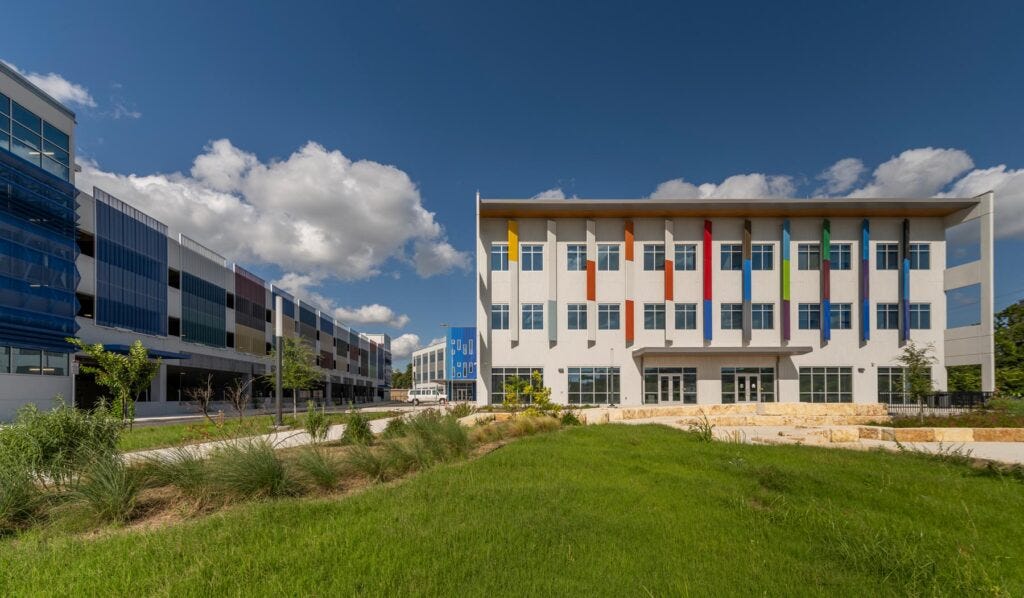
Preparing San Antonio Independent School District for the future of learning through bond program (Express-News) → The op-ed answers every question except the one voters asked: we paid for the last bond. Did it do what we asked? SAISD’s board president wrote that every decision “should begin with our students.” In August we called this the politics of unaskable questions: frame spending as a reflection of our “values” and nobody can ask whether it worked. Voters said no to all four propositions. Enrollment has fallen by 3,000 students since 2022 and the district operated 86 campuses in January while the right number is closer to 50. Worst of all, 34 of its campuses are rated D or F. Voters were asked for $600 million by a district that hasn’t finished spending the last $1.3 billion, is closing schools that money was supposed to fix, and couldn’t say where the new money would go. The people, given a choice between paying more and saving their money, rightfully chose to save it.
San Antonio leaders will now have to OK every new data center (SA Report) → Every data center is now a council decision. CPS already serves over a dozen data centers under contracts written to recover the cost of serving them, and the industry uses less than a single percent of SAWS’s drinking water. While staff offered a list of rules and the Zoning Commission offered a compromise, council voted the compromise down 6-5 and chose to review everything case-by-case. Marc Whyte said that means: “we’re telling them essentially that the rules are not written down. They get made in this room, one vote at a time.” For a company choosing between San Antonio and over the county line, or just somewhere else, that’s a reason to choose somewhere else. Microsoft has filed plans for a $483 million data center in Castroville and CyrusOne is developing a $4 billion to $6 billion campus in Medina County. The region carries the power demand either way but the city gets the tax base only if the building is inside city limits.
In the wake of vouchers, Democrats with public education backgrounds won up and down the ballot in Texas (SA Report) → The new majority will be tempted to spend its way to better schools but history shows this probably won’t work. Gina Hinojosa’s bill in 2023 was a $40 billion plan for teacher raises, but Texas has already run that particular experiment. Per-student funding from all sources rose 43% between 2016 through 2024, or 9% after inflation. The results: on the 2024 national assessment, Texas scored below its 2019 scores in all four tests and above the national average in only one of them. Brookings reviewed the state-by-state evidence last year and concluded that improving schools is “not, in general, a mere matter of money.” San Antonio’s districts aren’t short of state money so much as students: North East has lost 17,000 students in 12 years, and on Tuesday voters in Northside and San Antonio ISDs declined to pay more. Then there’s the political reality in Austin: Republicans hold the Senate by a comfortable margin and replacing the education commissioner takes a two-thirds majority vote. Other possibilities, like changing the voucher program, would be an uphill climb for Democrats. The path of least resistance: focus on how the districts use what they already get.
The Pick
Our weekly recommendation for what’s going on in San Antonio

DiwaliSA at Hemisfair and the Arneson River Theater
Dancers and musicians on the main stage, food from Chennai and beyond, and diyas lit at dusk make up DiwaliSA, San Antonio’s Festival of Lights, now in its 18th year, put on by Anuja SA and co-hosted by the City. Thousands came last year to float candles on the river, and the night ended with fireworks over the Tower of the Americas. Saturday, November 7, 4:30 p.m. to midnight, at Hemisfair, 434 S. Alamo St., and the Arneson River Theater.
Thanks for another week. Follow us on your platform of choice: X/Twitter, LinkedIn, Instagram, and Facebook. Story tips and reader notes go to our reporter Jarrett Whitener at jarrett@thecivic.com, and my inbox is always open.
A particular thanks to our Charter members, whose continued generosity allows us to operate.
Enjoy your weekend and see you Tuesday.
- Philip Reichert
Editor, The Civic