



What We’re Watching This Week
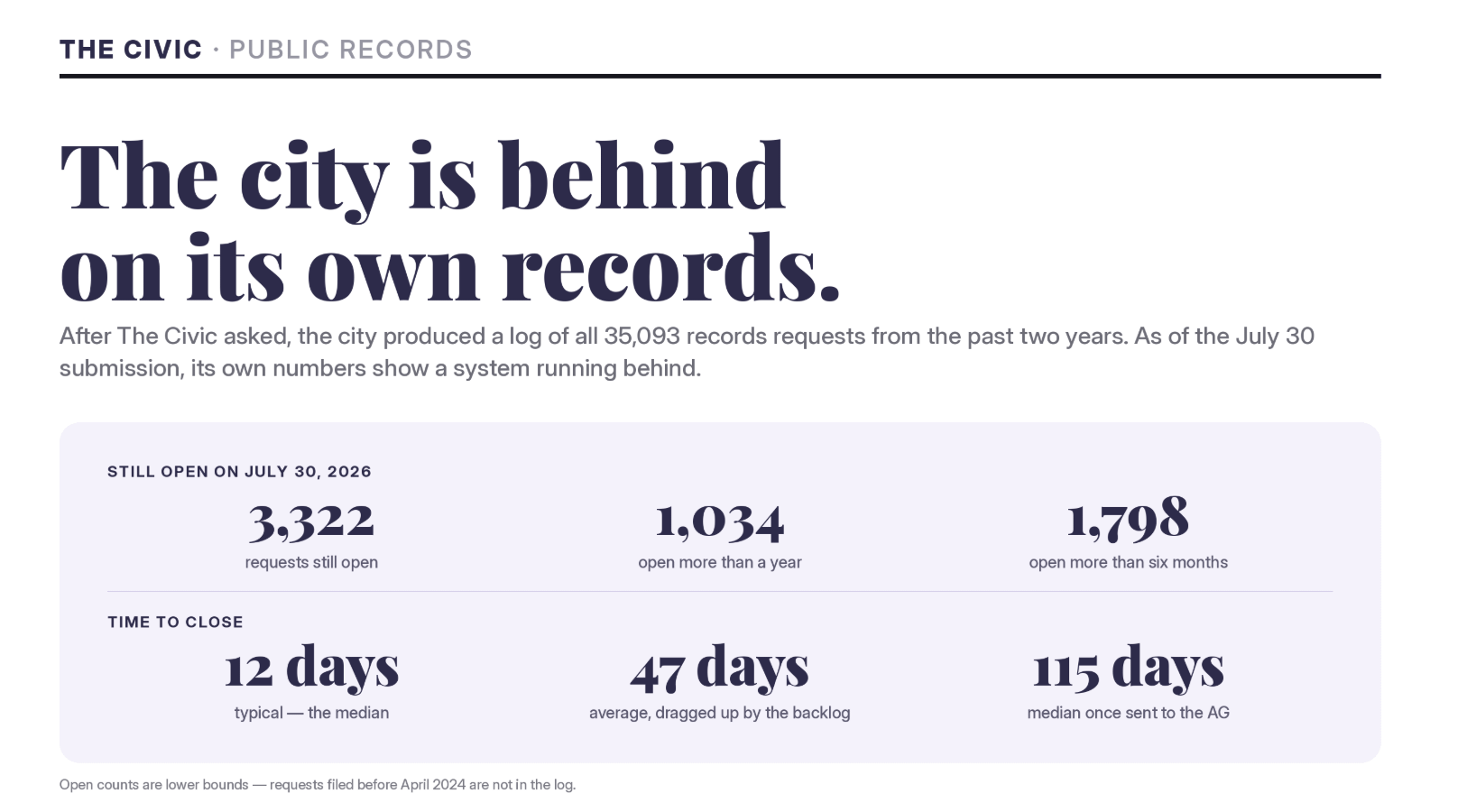
The city’s own records log backs up our transparency column. On October 13 we wrote that San Antonio’s records system misses its own deadlines, and that we had asked for the city’s log of every records request to see whether others were waiting, too. Since then, the city has provided us with a snapshot of its records requests, a PDF over 1,000 pages long with the status of every records request submitted in the last two years. On July 30, at least 3,322 requests were open, 1,034 of them for more than a year. Routine records like Fire, Police and Development Services make up 86% of requests and close in a median of 12 days. The offices that hold the records of how the city spends and makes decisions are slower: only about a third of requests to the City Manager’s Office, Mayor and Council, City Attorney, Finance and other policy offices got an answer within 10 business days, and one in nine at the City Manager’s Office. Requests sent to the attorney general took a median of 115 days to close, against 11 days for everything else. The administrative issues are not an anomaly for us, either, as 455 closed requests are still listed as “Assigned” or another in progress status, and our request for the log is still “Waiting for Cost Estimate Approval” in the report it produced. One thing we didn’t expect: between September and October, the city closed 892 requests more than a year old, against 208 in all the months before, 90% of them Fire Department or Environmental Assessment requests and two-thirds marked “No Responsive Documents.” Prior to that, there were over 1,000 requests that had been open for more than a year and nearly 2,000 requests that had been open for more than six months. We’re watching because the slowest offices are the ones holding the records of how the city spends money, just as it prepares to ask voters for another bond. Read more below:
City Council ended Mayor Jones’ sole say over the bond’s tri-chairs, a puzzling fight over a job with no direct power. In a 19-minute special meeting Wednesday, council voted 7-3 to give itself final approval of the three tri-chairs who lead the 2027 bond committee, a job previous mayors have traditionally filled on their own. Two days earlier, Jones had named Port San Antonio’s Jim Perschbach, the Center for Health Care Services’ Jelynne LeBlanc Jamison and the San Antonio Food Bank’s Mario Obledo Jr. Now Sukh Kaur and Phyllis Viagran will review candidates and recommend picks to the full council. Marc Whyte, who called the meeting with Teri Castillo and Marina Alderete Gavito, said Jones hadn’t consulted council on her picks. But the tri-chairs have no direct authority over what goes in the bond; City Manager Erik Walsh described them as its public face, able to raise money during the election in ways council members legally can’t. Jalen McKee-Rodriguez said council was there to “manufacture conflict related to the bond despite the fact that we haven’t even figured out the final dollar amount.” A similar proposal failed in June but this time Ric Galvan and Ivalis Meza Gonzalez voted yes. We’re watching because the fight took place a week before council takes the bond back up on October 29, when a vote to move it forward is expected. That’s the decision that actually matters, and a council and mayor still fighting over who sells the bond will have a harder time later on.

San Antonio City Council limits mayor’s role in bond tri-chair appointments

The San Antonio City Council has stripped Mayor Gina Ortiz Jones of her sole authority to appoint tri-chairs to the executive committee for the 2027–2032 bond package. While not mandated by city code, previous mayors have traditionally appointed the three tri-chairs.
The Civic is independent, nonprofit, and nonpartisan. We are supported entirely by our readers and our Charter members. Consider supporting our work.
The Reframe

A tax fight over Pre-K 4 SA was years away. Then City Council stepped in. (Express News) → There’s just no need to lock funding for two decades. The program’s sales tax doesn’t expire until 2029, and its leaders had planned to go back to voters next year or in 2028. Instead, council voted 7-2 in August to put a 20-year renewal on the November ballot, hoping that midterm turnout would secure long-term funding for the program. They wouldn’t be briefed on the program’s (still-conceptual) plan for the money until weeks later. Both previous terms ran eight years and the cycle worked as intended. The program passed narrowly, with about 53.5% in 2012, came back eight years later with results and won about 73% in 2020. That process turned a narrow win into a mandate, but we lose it with a twenty year term. If the program is as good as its supporters say, it will win again in 2028. Under the ballot language, the 20 years start when the current term ends, so the tax could run through 2049 without another vote.
Northside’s school bond: Understanding what the ballot language doesn’t tell you (Express News) → The ballot language is pretty clear—a district asking for more money. Former Superintendent Brian Woods argues that “THIS IS A PROPERTY TAX INCREASE,” a line state law requires on school bonds, doesn’t accurately describe Northside’s bonds, because the district doesn’t plan to raise the part of its tax rate that repays debt. But a bond is a loan, and taxpayers repay it. Propositions B, C and D would let the district borrow up to $886 million, about $1.84 billion with estimated interest, on top of the $4.1 billion, with interest, it already owes. New bonds keep taxpayers paying today’s rate for decades instead. That rate already brings in more than this year’s scheduled payments need—case in point, the district plans to use the extra funds to pay off some debt early. And the same ballot asks for more money outright, with Proposition A’s increase to the rate that funds operations. Whether Northside needs that money is the fundamental question, and the ballot language is honest about it.
UTSA’s new $35M center key to larger sports venues plan (Business Journal) → One of the great avenues for growth for a university is, ironically, sports. UTSA just opened a $35 million basketball and volleyball training center, built with donors and $5 million each from the city and Bexar County, and the Business Journal reports about $20 million more is coming for other athletic projects. It may seem counterintuitive, particularly with the state of college athletics, but this is a strong move. Winning athletics brings in applicants. Researchers have found that a top-20 football season or a Sweet 16 run raises applications up to 8%, and that going from “mediocre to great” on the football field lifts them nearly 18%. Think of UCF, which says its 2017-18 winning streak cemented it as a national brand. It joined the Big 12 in 2023 and is consistently one of the largest universities in the country. App State’s applications jumped nearly 15% after it beat Michigan in 2007. The return on these projects shows up in applications and brand visibility, which is why these projects are how a local flagship is supposed to behave.
Rising arrests of children 10 to 13 shows overreliance on school police (Express News) → We are almost certainly overly reliant on school police for discipline issues at school campuses, but this is symptomatic of broader school dysfunction. The New York Times and Express-News investigation behind the editorial found Texas children ages 10 to 13 were referred to law enforcement more than 47,000 times since 2014, with most accused of minor offenses. State law already says school officers shouldn’t handle “routine student discipline”, so why does it keep happening? Since 2023, the state has required an armed officer at nearly every campus, while the staff meant to handle misbehaving children are stretched thin, with 70% of Texas teachers saying they lack adequate campus support for students with behavioral challenges. Sen. Charles Perry, who carried a 2025 law letting schools suspend disruptive students longer, said “disruptions are impeding both the ability of teachers to teach and the ability of students to learn.” Swapping out police chiefs and officers, as the editorial recommends, merely treats the symptom.
The Pick
Our weekly recommendation for what’s going on in San Antonio

Muertos Fest at Hemisfair
More than 80 handmade altars, two processions and live music fill Hemisfair this weekend for Muertos Fest, San Antonio’s Día de los Muertos festival, now in its 14th year. Admission is free, and it runs Friday, October 23, 5 to 11 p.m.; Saturday, October 24, 10 a.m. to 11 p.m.; and Sunday, October 25, noon to 9 p.m., at Hemisfair, 434 S. Alamo St.
Thanks for another week. Follow us on your platform of choice: X/Twitter, LinkedIn, Instagram, and Facebook. Story tips and reader notes go to our reporter Jarrett Whitener at jarrett@thecivic.com, and my inbox is always open.
A particular thanks to our Charter members, whose continued generosity allows us to operate.
Enjoy your weekend and see you Tuesday.
- Philip Reichert
Editor, The Civic