



What We’re Watching This Week
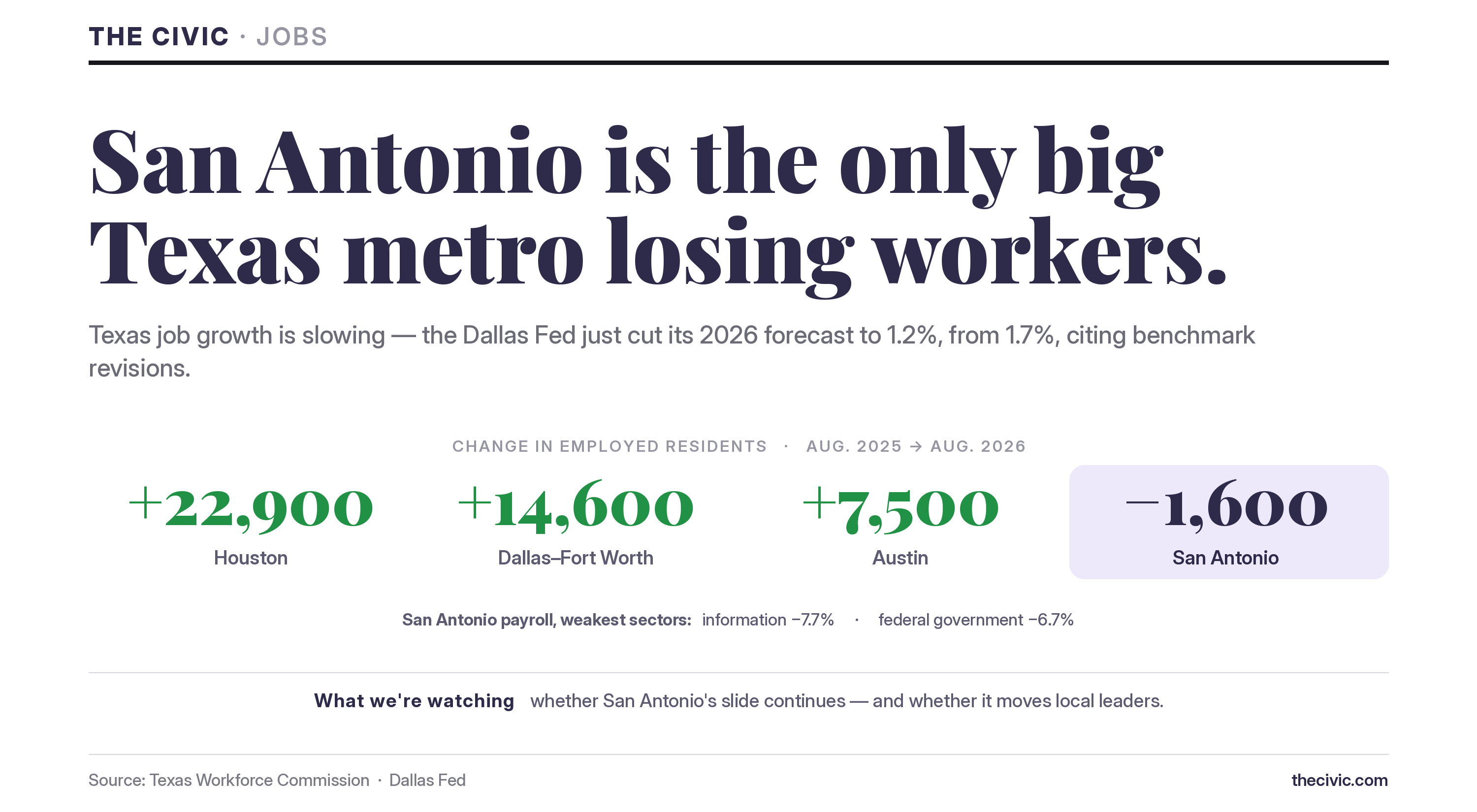
Texas job growth slows and San Antonio loses workers while other cities gain. The Dallas Fed cut its 2026 forecast for Texas job growth by half a percent, from 1.7% to 1.2%, mostly because of benchmark revisions. Meanwhile, in August, the number of San Antonio-area residents with jobs was 1,600 lower than a year earlier, and unemployment rose a fraction of a percent. Elsewhere in Texas, Austin gained 7,500 employed residents, and Houston and Dallas-Fort Worth both saw five-digit gains. That makes San Antonio the only of the state's four largest metros to lose ground. On the payroll side, the weakest sectors were information (down 7.7%) and federal government (down 6.7%), while transportation, warehousing, and professional services grew. We're watching to see whether San Antonio's losses continue and to see whether this spurs local leadership.
City staff wants the smallest bond in more than 20 years, but some on council want more than twice as much. City staff presented a recommended $442 million bond on Wednesday, which would allocate $261 million for streets, bridges and sidewalks and about $181 million toward facilities, housing and parks—making it just over a third the size of the $1.2 billion bond voters approved in 2022. A majority of council members are willing to look at a larger bond package of up to $1 billion, which would require yet another tax rate increase, while others back the staff recommendation. The split resembles the budget vote, with Marc Whyte and Marina Alderete Gavito outright against a larger bond and several other members seemingly in favor of exploring what a bigger bond could pay for. The discussion will return on October 14 with more detail based on council feedback, which should give a clearer picture of what a larger $1 billion package would look like. Council has until February to finalize the bond and call the May election. The city hasn't had a bond package fail since 1979. We're watching to see if that record holds when voters see a billion dollar bond package and another tax rate increase. Read Jarrett Whitener’s detailed coverage of the bond proposal below:
The SAWS rate increase council delayed in June is back. In June, council voted 6-5 to put off a four-year plan that would have raised SAWS rates yearly through 2029. The revised version is here, and rates will still go up. Residential rates as written would rise in the mid single digits every year through 2030, culminating in up to $17 more a month by 2030, the same high end cost as the June plan. Members who pushed for the delay cited leaks and distrust of SAWS leadership. Now, Sukh Kaur, one of the critics, says SAWS needs the money and that her question was whether they could show progress. Meanwhile, SAWS says the delay forced it to shrink its five-year capital program from $3.2 billion to $2.6 billion, dropping about $600 million in work, including new water mains. The same bill may also carry a higher city stormwater fee, which staff proposed Wednesday, to fund $175 million in drainage work outside the bond. We're watching to see whether SAWS answers the June complaints with details on leaks and water loss, and where the $600 million in dropped work was taken from.

The Civic is independent, nonprofit, and nonpartisan. We are supported entirely by our readers and our Charter members. Consider supporting our work.
The Reframe
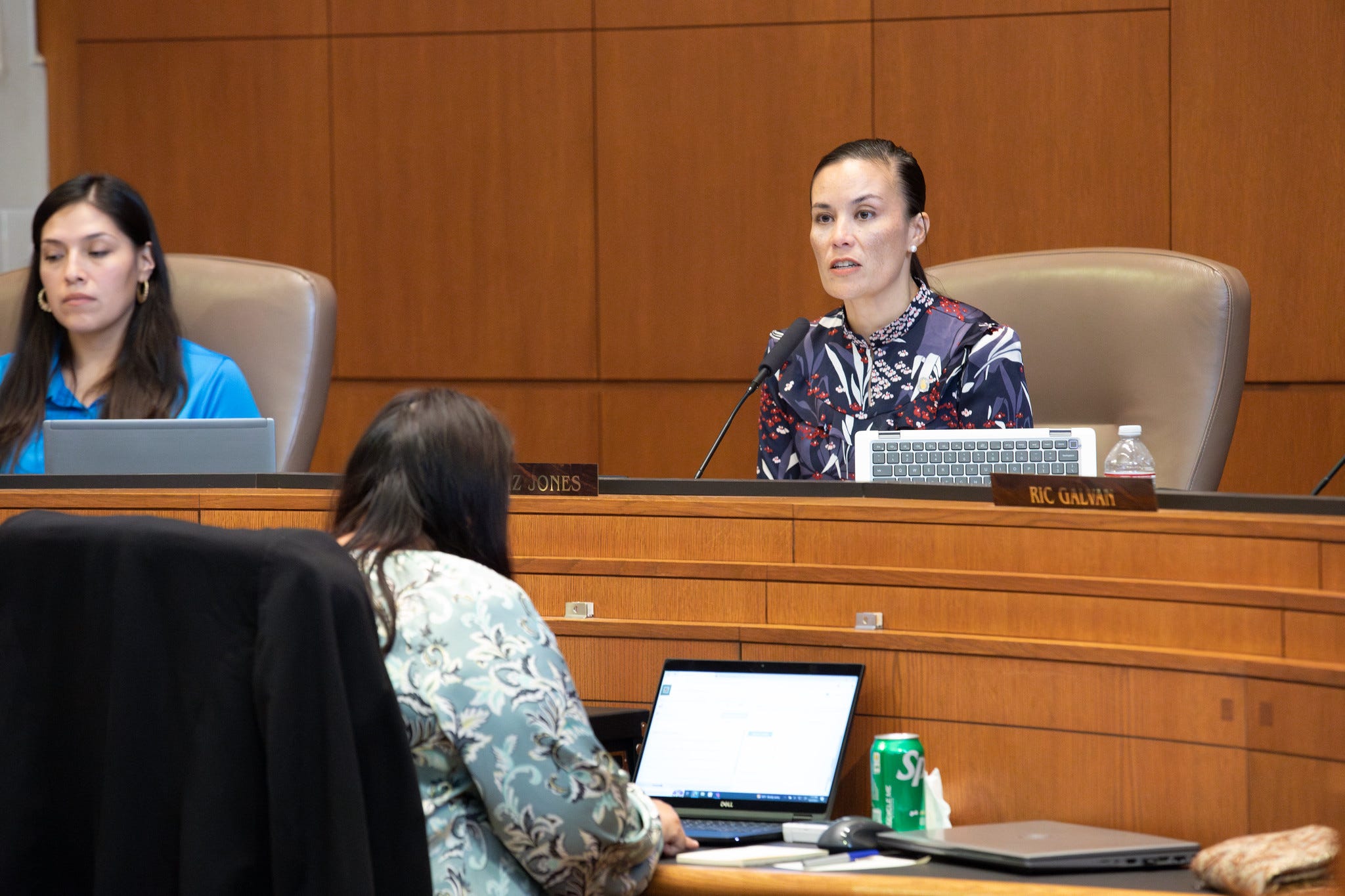
Mayor Jones loses big votes and divides the community. It’s time for a recall. (Express News) → Elections have consequences. A recall is not impossible, but San Antonio will have to live with choices made. A letter to the editor describes the current political climate surrounding Mayor Jones and makes the argument that an effort to recall her is warranted. The author rightly points out that a recall would require around 85,000 signatures—but to get that many signatures in six months (a signature is only valid for 180 days) you would need to have a massive canvassing operation. As a reminder, Mayor Jones won the runoff election with around 78,000 votes, so you would need over 7,000 more signatures than the votes she received in the first place just to put her back on the ballot. The negative sentiment towards her is a reelection problem down the road, but it’s not enough to force a serious recall effort. And it should be said: Mayor Jones has had her share of mistakes, and she has certainly failed to be the leader San Antonio needs, but she is only part of a broader problem with civic leadership.
City made many budget cuts while prioritizing services residents expect (Express News) → Dance around the issue as much as you want: San Antonio’s budget is up over a quarter of a billion dollars in one year. There’s nothing about that which screams “hard choices.” Erik Walsh argues in the San Antonio Express News that the budget passed recently makes hard choices AND prioritizes everyone’s preferences re: city services. No doubt that it seems that way from where he sits... Let’s look back, though: Erik Walsh’s first budget as city manager totaled $2.9 billion. In less than a decade the budget is up to $4.4 billion, an increase of $1.5 billion. It is hard to listen to the city claim that difficult choices were made when the budget is up hundreds of millions of dollars.
Spurs Finals deliver big bounce for downtown hotels (Business Journal) → Despite significant hype, an NBA finals run nets a relatively small bump in hotel revenue. The Spurs' Finals run has been sold as a significant economic boon for San Antonio. There's no doubt that it's partly true, but with revenue figures in hand it looks much less impactful than originally billed—at least in terms of hotel revenue. Downtown hotel revenue for the entire second quarter, with the playoff run and World Cup spillover included, rose 1.2%, about $2 million, over the same quarter last year, when the Final Four was in town. Swap one marquee event for another and the total barely moves. Sports tourism is important for us, but clearly has a low ceiling.
Who wants San Antonio bond money? City, nonprofits, developers seek $5.8B (Express News) → The only argument you need for fiscal restraint is the scale of our spending ambitions. Asked for requests for the upcoming 2027 bond, local stakeholders assembled $5.8 billion in total requests. That number is merely a measure of how much people can ask for when someone else is paying. A logical, hard limit is the only thing that forces prioritization—a bond sized to what the city can borrow without raising taxes forces the city to decide which projects actually matter most. A bigger bond package is a veiled push to skip that step by just funding more of the list and sending the difference to taxpayers. It's the budget fight all over again. When making the tough choices gets hard, raise the rate.
Listen: Civic Editor Philip Reichert joined Eddie Aldrete on Beyond the Bite, Aldrete’s podcast on San Antonio business and public policy, to talk about how The Civic came to be, what shrinking newsrooms mean for local accountability, Project Marvel, tensions at City Hall, and the budget vote. Episode 91 is out this week on YouTube and wherever you get your podcasts (Apple, Spotify).
The Pick
Our weekly recommendation for what’s going on in San Antonio

Monarch Butterfly & Pollinator Festival 2026
Citizen-science monarch tagging, plant adoptions and a migration obstacle course, with live music and more than 45 education partners. Project Bloom's festival is in its 11th year. Admission is free for all ages. Saturday, October 3, 9 a.m. to 2 p.m., at Brackenridge Park's Pecan Grove, 3700 N. St. Mary's St.
Thanks for another week. Follow us on your platform of choice: X/Twitter, LinkedIn, Instagram, and Facebook. Story tips and reader notes go to our reporter Jarrett Whitener at jarrett@thecivic.com, and my inbox is always open.
A particular thanks to our Charter members, whose continued generosity allows us to operate.
Enjoy your weekend and see you Tuesday.
- Philip Reichert
Editor, The Civic
From my 50-yr perspective, civic success is still measured limited to GDP metrics and AAA bond ratings, as per the mainstream business page and Editorial Opinion. We have no other counter-offer from the taxpayer, community, grassroots, progressive, academic, or professional practitioner leadership.
Without this necessary interactive dynamic, we are only seeing a one-sided, private sector profile; our socioeconomic prospects remain missing from any analysis. Nothing is ever said, much less understood, about the impacts & outcomes from adopted public policies, "policies" which are not even publicly available or archived. We still live in a vacuum of transparency and accountability, with no "watchdog" press demonstrating historical context or subject-matter expertise.