



What We’re Watching This Week
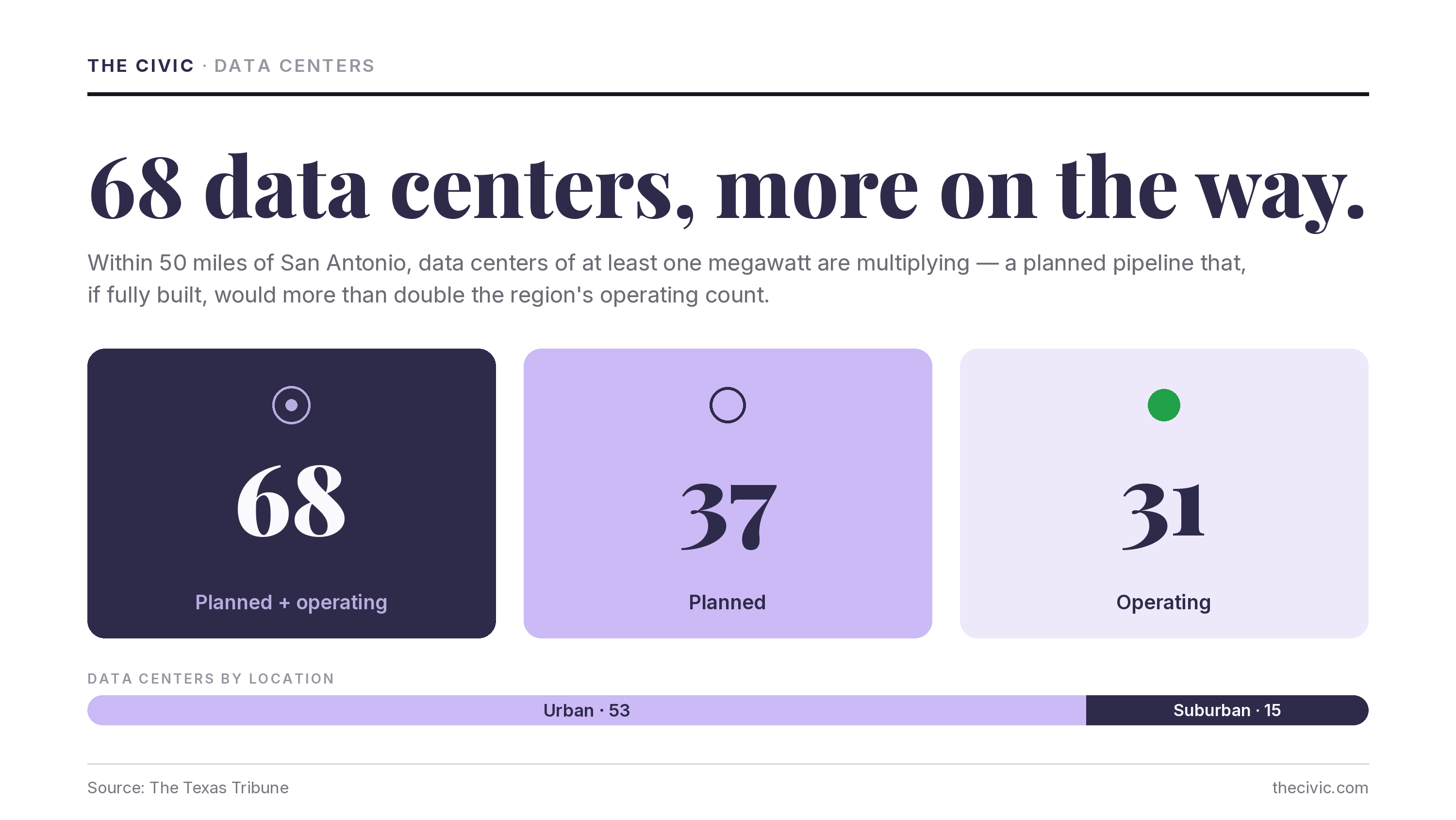
City Council is deciding how tightly to regulate data centers. At a Wednesday briefing, staff laid out two ways to update the city code in order to regulate data centers, and both would limit them to industrial and heavy commercial zones. Under the first plan, a project could build without a council vote if it stays 500 feet from sensitive areas like homes and schools, sets back 50 feet from its property line, adds landscaping, and stays off the Edwards Aquifer Recharge Zone. Under the second, every project would go to council, with public comment. Mayor Jones floated a hybrid: council approval on every project, plus a 45-day pre-filing notice and backup generators enclosed “as much as possible.” District 6 Councilman Ric Galvan, who wants council votes on every project and recycled water only, counts just under 30 data centers in the city, 18 or 19 of them in his district. The Zoning Commission takes it up Tuesday, and council votes October 29. We’re watching because the vote decides whether a project that meets the standards can count on a yes. Staff warned that case-by-case review means “less predictability and certainty,” the two things they said developers look for. District 9’s Misty Spears was blunter: with too many restrictions, “they’re not even going to look at us.”
City staff recommended a $442 million 2027 bond that can be issued without raising the tax rate, but some council members want substantially more. City staff sized the 2027 bond to avoid raising the debt-service tax rate, which has held at the same level since 2004. The bulk of it would go to streets, bridges, and sidewalks. Drainage would be paid for separately, with a stormwater fee increase to raise $175 million. On Wednesday, at least four members said they favor a $750 million bond, including Sukh Kaur, who wants drainage folded into the bond, and Teri Castillo, who wants more for affordable housing. Finance staff said that they couldn’t promise the tax rate would hold if the bond goes above $442 million. The bond matters for the arena, too: under the Spurs’ non-binding term sheet, the city’s $489 million share is subject to voters approving a bond program. A formal council vote is expected October 29, with a May 2027 election. We’re watching because council raised the property tax rate for the first time in more than 30 years just last month, on a 7-4 vote, as taxable values fell 2.7%. Staff’s number fits under the current debt-service rate but the bigger number would likely mean raising that rate too, on top of last month’s increase and another the city already plans for next year.
Waymo opened fully autonomous rides to everyone in San Antonio on October 14, including airport trips. Anyone in San Antonio can now download the Waymo app and hail an autonomous ride, in an area stretching much of the city core that includes downtown, the River Walk and the airport, where Waymo began trips in late March. But getting here took a while and there were some hiccups. Waymo opened to invited riders in February, then went dark after an empty Waymo vehicle was swept into Salado Creek during April flooding, and came back nearly five months later. None of it took a tax, a construction project or dedicated lanes. VIA, meanwhile, just adopted a $384 million operating budget, up more than 10% from last year’s projected spending, and its Green Line is scheduled to open in April 2028. We’re watching because San Antonio is locking in long term transit bets whose ridership is still a forecast, at the same moment a privately funded alternative is scaling up.
The Civic is independent, nonprofit, and nonpartisan. We are supported entirely by our readers and our Charter members. Consider supporting our work.
The Reframe

Defense startup moves headquarters to downtown San Antonio (Business Journal) → San Antonio’s defense credibility lands unicorn. Defense Unicorns, a veteran founded company that builds secure software delivery tools for military systems, raised a $136 million Series B in January that valued it at more than $1 billion, and the Express-News reported in March that it had moved its headquarters from Colorado Springs to downtown San Antonio. Explaining the move, CEO Rob Slaughter called San Antonio “one of the biggest cyber capitals of the world.” The local footprint is still small, about 20 of some 200 mostly remote employees as of March, so it’s not a huge jobs story, but it’s the same lesson as Ynios Pharma in August: know the advantage you have, and play to your strengths.
Republican Marc LaHood rode into office on Abbott’s school voucher train. Now he’s struggling to defend it. (SA Report) → We aren’t concerned with the debate, but this article is more advocacy than news. When LaHood said he wanted to know how many students with disabilities had applied, the story originally claimed that fewer than 30 of the roughly 28,000 students in the program’s top priority tier had disabilities, though that tier is entirely made up of students with disabilities and their siblings. SA Report has since corrected this, but the new version says fewer than 30 received “the full $30,000 benefit for students with disabilities,” without noting, as its own source does, how few students could ever qualify for the maximum, or that the average award was about $16,000. Neither version answers his question: about 29,400 students (or their siblings) with disabilities qualified for the top tier, and students with disabilities make up nearly a quarter of recipients, per SA Report. Dunn’s line that it’s “a billion dollars that was taken away from our public education system” goes unexamined, too. The law gives the program its own account, and the ESA bill was deliberately paired with a funding bill that added roughly $8.5 billion for public schools, though districts do lose formula funding when students leave. “Lion’s den” and “struggling” are the reporter’s own characterizations in a news story, and readers deserved to know that debate co-host Raise Your Hand Texas was, by its own description, “a consistent opponent of vouchers” for many years. It’s reasonable to question vouchers as policy, but you should at least characterize both sides correctly, and fairly.
Support San Antonio’s future by backing Northside ISD’s bond, tax increase (Express News) → The premise that “the state has failed to adequately fund public education” does not match the record. The editorial rests on the premise that “the state has failed to adequately fund public education.” That’s hard to square with the numbers. State funding for Texas schools grew from $23.2 billion in 2016 to $33.5 billion in 2024, and per-student funding from all sources rose 43% during that time, 9% more than inflation. Then the Legislature added $8.5 billion more through House Bill 2 in the last session, with almost half of that going to teacher pay. The fair complaint is narrower: lawmakers steered the new money toward raises, so the basic allotment, the most flexible money, rose just $55 per student, its first increase since 2019. Ultimately, Northside’s bond and tax increase should be judged on their own merits, not on the idea that Austin failed to fund the schools.
‘All means all’: How this SAISD high school became one of the city’s highest rated (Express News) → Maybe we’re measuring things the wrong way. Brackenridge High School earned an A for 2025-26, up from a B the year before, despite the fact that 84% of its students are considered economically disadvantaged. The Express-News reports it’s the first traditional neighborhood high school in SAISD to earn an A, and credits a returning principal, consistent expectations, double-blocking for students behind grade level, and holding onto teachers (but not funding!) It is certainly an accomplishment, but 52% of its students still scored below grade level on the STAAR. The A leans more heavily on a ~96% graduation rate and the 91% of graduates the state counts as “college or career ready.” It does beg the question: if a school can earn the highest possible grade while 52% of its students perform below grade level, maybe we’re measuring things the wrong way.
The Pick
Our weekly recommendation for what’s going on in San Antonio

Archaeology Adventures at SAMA
A free day of hands-on art projects, real artifacts, and local archaeologists, as the San Antonio Museum of Art marks International Archaeology Day. Kids get a scavenger style gallery guide to track down hidden treasures, and community partners run live demonstrations. Admission is free, and registration isn’t required but is encouraged. Saturday, October 17, 10 a.m. to 5 p.m., at 200 W. Jones Ave.
Thanks for another week. Follow us on your platform of choice: X/Twitter, LinkedIn, Instagram, and Facebook. Story tips and reader notes go to our reporter Jarrett Whitener at jarrett@thecivic.com, and my inbox is always open.
A particular thanks to our Charter members, whose continued generosity allows us to operate.
Enjoy your weekend and see you Tuesday.
- Philip Reichert
Editor, The Civic