


What We’re Watching This Week
JCB is doubling down on its San Antonio investments. British equipment manufacturer JCB has announced plans to invest a further $8 million into campus expansion by building an additional three buildings, the San Antonio Report shared on Tuesday. The new additions, scheduled for completion in 2028, will total 12,500 square feet and will serve as the company’s Texas headquarters. Those plans will supplement the ongoing construction of a 1 million-square-foot plant that is slated to create 1,500 new jobs within five years. We’re watching to see if JCB’s investment is an outlier or part of a growing trend.
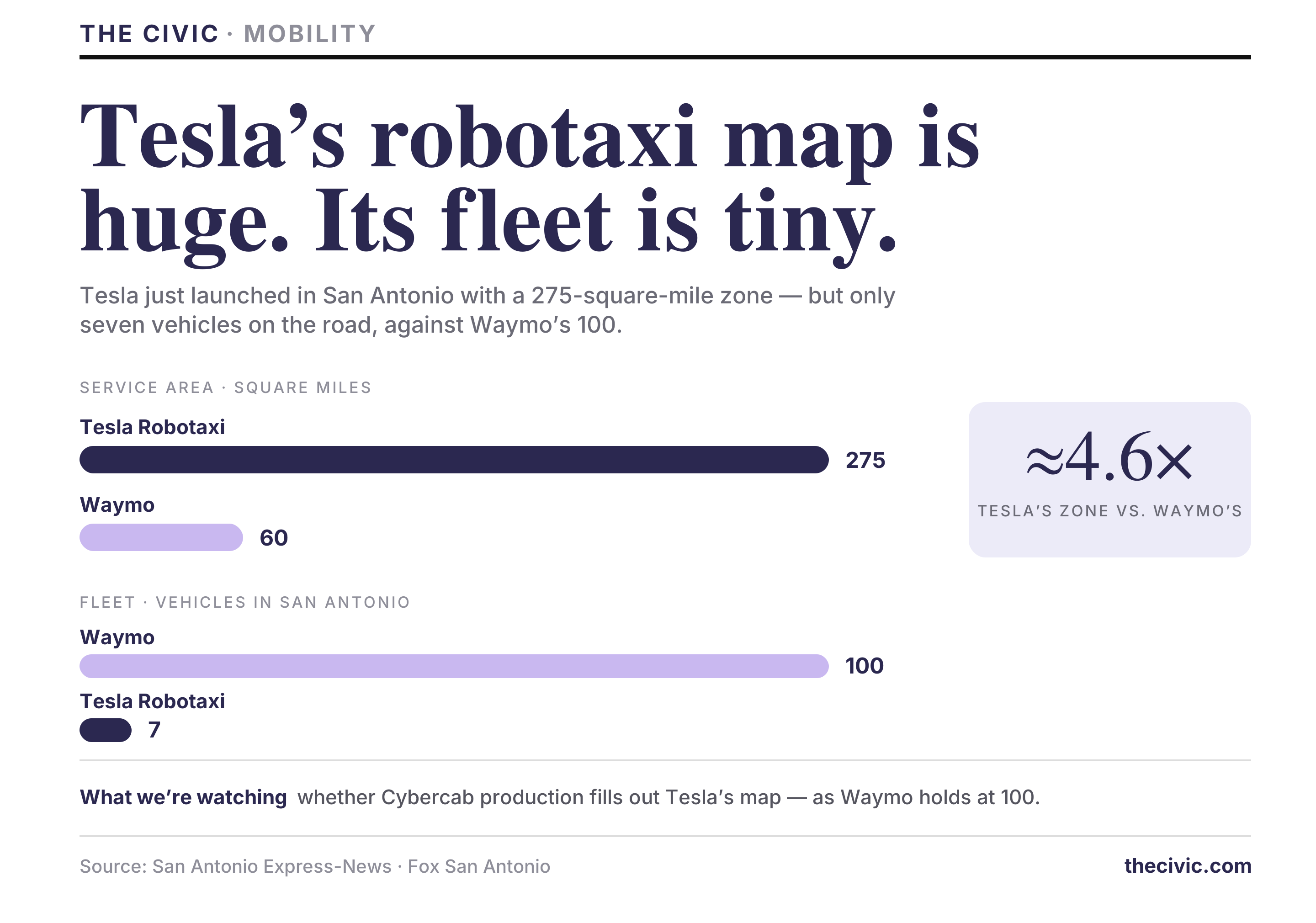
The city is now part of the Texas robotaxi craze. After months of use across the other major Texas metros, Tesla finally brought the robotaxi service to the streets of San Antonio last week. The Express-News reported that the operating area of the autonomous-driving service was 275 square miles, providing a significant increase over Waymo’s operating area of just 60 square miles. While Tesla’s operating area dwarfs that of Waymo, its fleet is significantly smaller. Reports suggest that Tesla is operating a mere seven autonomous vehicles in the city at the moment, but that number is expected to increase rapidly as production of the Cybercab ramps up. Waymo currently operates a fleet of 100 vehicles in San Antonio with no immediate plans for expansion. We’re watching to see if residents choose to embrace Tesla’s small but growing fleet as an alternative to public transportation.
San Antonio’s public school crisis continues. The Express-News reported on Tuesday that SAISD has begun negotiations to sell off the now-closed Wilbur J. Knox Early Childhood Education Center to the San Antonio Housing Trust with plans to convert the former campus into affordable housing. Knox is just one of the 17 facilities that SAISD has closed in just three years, with 15 others facing closure in the future due to poor enrollment. Meanwhile, voters rejected all four propositions on the $600 million SAISD bond that appeared on the November ballot. We’re watching because new leadership in Austin may choose to throw San Antonio’s public schools a lifeline without drastic reform here at home.
The Civic is independent, nonprofit, and nonpartisan. We are supported entirely by our readers and our Charter members. Consider supporting our work.
The Reframe
Photo via the City of San Antonio
With a shakeup in the Texas Capitol, city leaders are looking to put forward a vast slate of social reforms (Report) → Affordability cannot take a backseat in the new legislative agenda.
New leadership has emerged in Austin, and Texas mayors have announced plans to pursue their own ambitious agendas in the Legislature. Those mayors have formed a joint advocacy group, the self-branded Texas Mayors Alliance, in hopes of growing their economies and increasing affordability within their cities while avoiding social issues, according to the San Antonio Report.
Mayor Jones and City Council are set on taking things in a different direction, instead advocating for Medicaid expansion, legalized marijuana, and mandatory paid leave. Other proposals, like the introduction of significant restrictions on data centers, could prove detrimental to the City’s economic development. The economic proposals are vague and intangible, like the proposed locally established minimum wage with no proposed dollar amount or method for determining what it should be or why.
It does seem that many of the policies put forth in the City’s agenda are largely aspirational rather than concrete. Over time, officials may elaborate on their requests to state lawmakers. Until then, it’s difficult to say just how much of a benefit or detriment these policies would be to San Antonio.
Not only do many of these social policy proposals face a Sisyphean battle to get through a Republican-controlled State Senate, but they divert attention away from the issues that allow cities to grow and thrive: economic opportunity, public safety, and affordability. Those rank among the most pressing concerns for San Antonians and will have to be the focus when the inevitable roadblocks of the legislative system appear next session.
The 2028 election will offer voters an opportunity to judge whether or not the new direction was a worthwhile pursuit. For policymakers in either party, the challenge remains the same: translating a political victory into tangible results on those issues for their constituents.
The Pick
Our weekly recommendation for what’s going on in San Antonio

Panda Fest at Civic Park
This weekend, San Antonio will play host to Panda Fest at Civic Park for one of the largest outdoor Asian cuisine festivals in the United States. Visitors will be able to enjoy food from over 100 vendors, cultural performances, and activities for children.
Thanks for joining me for my first week with The Civic. I'm Joe Chalfant, and I was named Executive Director and Editor earlier this week. I couldn't be happier to be part of this amazing project. Like my predecessor, Phil, I have a background in both politics and media. I’ve also had the joy of serving as a Catholic missionary on American college campuses. Since then, I’ve had the pleasure of moving to the San Antonio area to raise my growing family with my wife. I look forward to meeting and hearing from all of our readers and supporters.
Follow us on your platform of choice: X/Twitter, LinkedIn, Instagram, and Facebook. Story tips and reader notes go to our reporter Jarrett Whitener at jarrett@thecivic.com, and my inbox is always open.
Special thanks to our Charter members, whose continued generosity allows us to operate.
Have a great weekend, and I will see you again on Tuesday.
- Joe Chalfant
Executive Director, The Civic
Lots of brainpower over decades have been devoted to reacting to what political actors are saying and doing, hoping that local “economic development” and “growth” can save the day. This old approach isn't going to cut it, sorry to say.
So-called “economic development” has never been practiced; it hasn’t even been defined. Worse, it's always been assumed that it means business development, which is not the case. The folks who talk-the-talk do not come from the E.D. profession; we are not an extension of the Chambers of Commerce or some marketing campaign “to sell” San Antonio to multinational investors. We are not boosters.
San Antonio isn’t the nation's 3rd poorest, impoverished, economically segregated city by accident. We still abide by a narrow, limited, “urban planning” model which no one bothers to examine. On top of that, we had “the nation’s best city Manager” for 14 yrs - why did we slide backwards w/o ANYONE from our “progessive, “community”, “grassroots”, “people of color” or “watchdog press” community saying a word?
As such, SA will continue to rank as amongst the poorest, impoverished, economically segregated cities. We remain a case study in civic failure.