



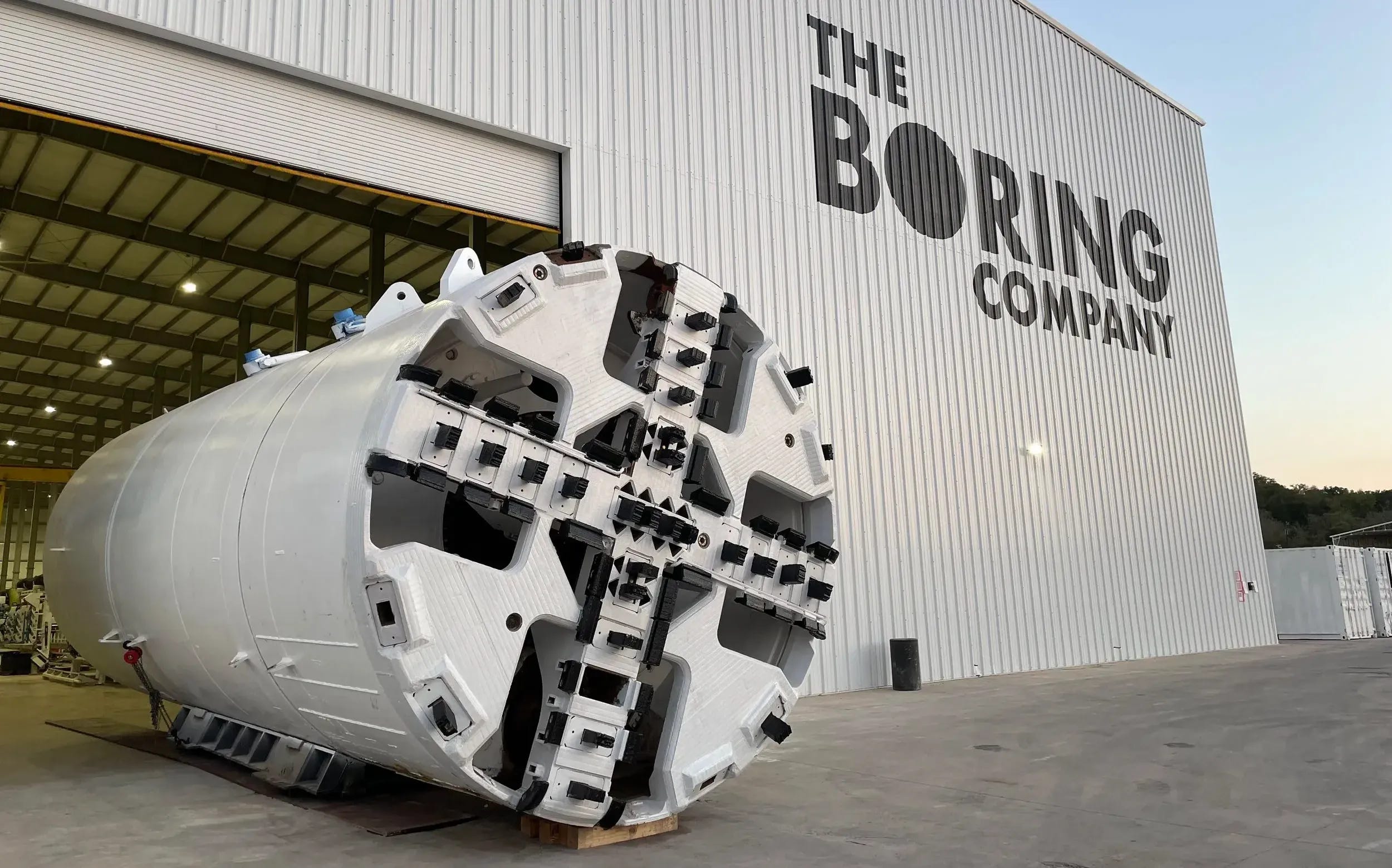
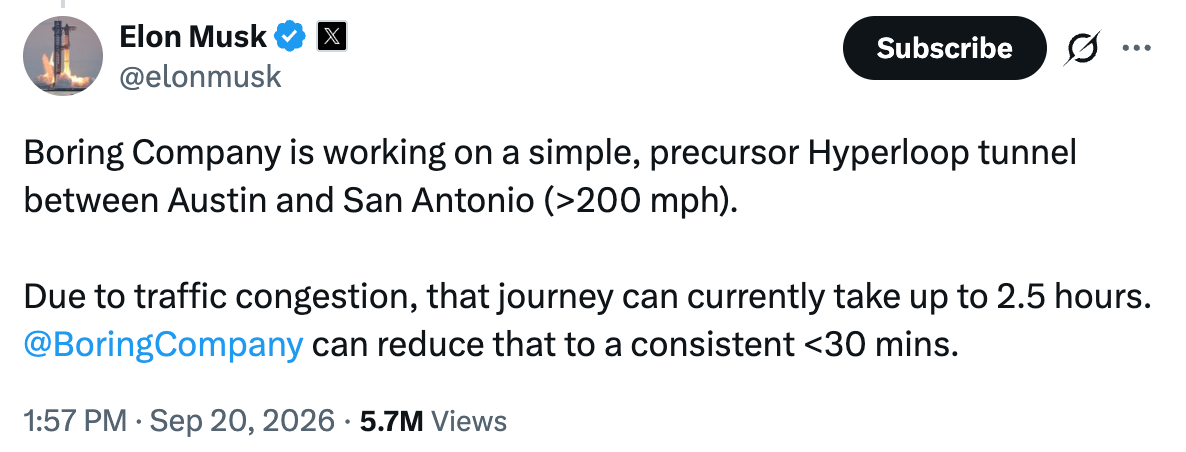
Over the weekend, Elon Musk announced that the Boring Company is “working on a simple, precursor Hyperloop tunnel between Austin and San Antonio.” Reception was optimistic: Sen. Ted Cruz, Joe Lonsdale, Michael Dell, and countless others cheered it on within hours.
A Hyperloop is a transportation idea Musk first unveiled in 2013: a capsule the size of a small bus sealed inside a long vacuum tunnel. With little to no air to slow it down, the capsule could travel between stations at extremely high speed. What exactly this project would look like, Musk didn't say. What he did say: it would travel over 200 mph, going eighty miles in under half an hour.
Meanwhile, the State of Texas is spending $3.2 billion to build a new freeway along twenty miles of I-35 Northeast. Just up the road, another $4.5 billion to rebuild eight miles of I-35 through Austin’s downtown. That’s nearly $8 billion for twenty-eight miles of highway.
When it’s all said and done, the drive between the two cities could still take a couple hours in traffic because the rest of the drive remains congested and limited by the physics of highways.
No one disagrees that more transportation infrastructure is needed. Kyle has grown roughly 1,200 percent since 2000, New Braunfels has tripled, and San Marcos has more than doubled. The combined Austin-San Antonio metro is packed full of over five million people, and it’ll pass eight million by 2050. Leaders in both cities have long said that the two economies should be better connected, but the problem of how to stitch them together remains largely unsolved. This will not get better with time, and we are still building the infrastructure of the past to keep pace with the congestion of the future.
The biggest problem is that every alternative to “build more road” has been fundamentally doomed from the beginning. The commonly proposed solution, an expanded rail connection between Austin and San Antonio or even a new high speed rail line, faces numerous financial and political obstacles.
Building a rail connection to Austin is not impossible to engineer, but it is impossible in nearly every other way. The state constitution dedicates the highway fund to roads and the overwhelming majority of all funding goes to highways, so funding is a challenge. This is a problem when a recent study showed that a new passenger rail line would cost at least $13.5 billion. The finished price tag would undoubtedly be higher. TxDOT’s cheaper option, using existing track, would be too slow to be compelling and only projected a couple thousand daily riders.
And if you can raise the many billions, building above ground still requires securing enough contiguous parcels to put track through the entire corridor. With these constraints, you can study rail projects in Texas all you want—the corridor has been studied two dozen times since 1997—but the money and the political coalition will likely never come.
So don’t wait for a rail solution that Texas will study endlessly but never fund at this scale. Help Boring build a tunnel.
Elon called this project a “precursor,” and there are no details yet as to what the tunnel would actually look like. What we do know is that a Boring project like this one would actually solve a number of problems inherent to connecting Austin and San Antonio by rail.
It doesn’t need the funding that Texas won’t and can’t spend. Boring raised $3 billion this year, its Nashville tunnel is privately funded, and when it bid on a San Antonio airport tunnel in 2022, it offered to pay for the first phase. At the cost the company claims in Nashville, roughly $20 to $30 million per mile, eighty miles would run about $2 billion. But the company’s actual price target is about $10 million a mile, which would put it significantly cheaper than even the cheapest equivalent rail project. And if the Boring pattern holds, much of this could be privately funded.
A dedicated tunnel changes what’s possible. Unlike with highways, there is no weather underground, no wrecks ahead, and no merging traffic to deal with. Unlike an above-ground rail project, there are far fewer political and property puzzles to solve. There is no incumbent rail company to reach an agreement with and the construction cost is far, far lower. Because of this, the Boring Company is probably our only realistic chance to connect the two cities—something leaders in both have said is necessary.
The pieces are almost in place to get started, too. Boring already carries passengers through several miles of tunnel under Las Vegas, is digging in Nashville, and is finishing a test tunnel with its newest machine in Bastrop, thirty miles from Austin. This project would not happen overnight, true, but rail has had four decades and we are no closer to a real solution.
Boring has announced tunnels before that never got built, in Chicago, Los Angeles and elsewhere, even the airport tunnel the Alamo RMA picked in 2022. There are reasons to think this one is different. This has the makings of a flagship program, less than thirty miles from the company's factory, over an achievable distance. Elon has even been talking about this exact idea for years. And if it isn't different, it costs San Antonio nothing. That is the difference between a private bet and a public one.
For decades, we’ve seen creative ideas waste millions and die because they ask Texas to be something it isn’t and never will be: a state that funds massive intercity rail projects. This one doesn’t.
The Boring Company is going to build something like this, somewhere. With $3 billion raised and no shortage of cities asking, it doesn’t need San Antonio’s money. Why not here? When Boring brings a real proposal, San Antonio’s answer should be yes, and how can we help?