




Back in August, the Express-News carried a guest column by the chairs of the San Antonio Ready to Work Advisory Board. Arguing that ambitious investment paired with accountability is paying off with Ready to Work, they cited an economic impact study claiming nearly $12 billion in economic benefits from the program and a staggering 125-to-1 return.
It’s a pattern here and nationally: governments and program sponsors commission economic impact studies that produce large, flashy sums, then present them as objective validation of the spending. Few bother to stress-test the conclusions and the results are often repeated as established fact.
Take AlamoPROMISE. In October 2025, the Express-News reported that the program had “generated $1.1 billion” in economic activity and supported roughly 7,800 jobs. No one, as far as we can find, publicly asked the obvious question: how does a last-dollar scholarship program that had spent roughly $16 million through 2025 produce a billion-dollar impact and nearly 8,000 jobs?
We consulted the report and filed a records request to find out. The District commissioned the study from St. Mary’s University economist Belinda Román and supplied the underlying data. Four days after the agreement was executed, Román asked whether the District still wanted to include “construction improvements ACD (the District) has made during the same timeframe as AlamoPromise,” noting those dollars “will add to the overall economic impact.” Three minutes later, AlamoPROMISE’s chief program officer, Stephanie Vasquez, replied: “Yes.”
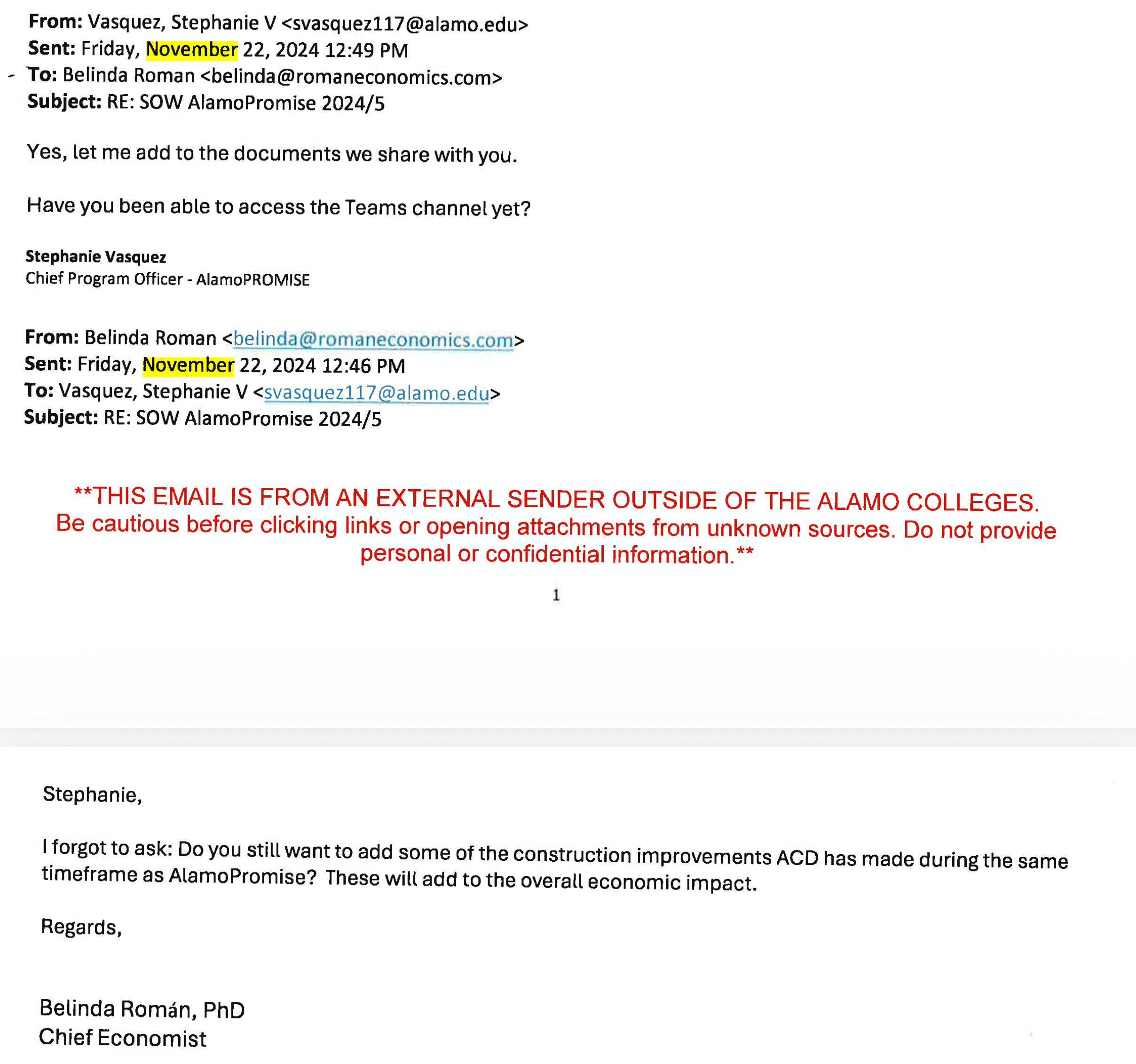
The final report counted bond-financed construction as one of its “two main sources of investments,” spending it says “is derived from the 2017 bond.” It seemingly counted any construction spending that took place during the AlamoPROMISE years, those “included in the 2019–2024 period.” It never says how much construction that added up to, and its executive summary calls the $1.1 billion simply “the overall impact of AlamoPROMISE.” Logically, $16 million in scholarships can account for only a small percent of that. The rest has to come from the construction and other spending counted alongside them.
But Bexar County voters approved the District’s $450 million bond in May 2017, based on its existing enrollment projections, and AlamoPROMISE’s planning didn’t begin until 2018. The construction was approved before there was an AlamoPROMISE to credit it to.
Hmmmm. Not so cut and dry.
The Ready to Work study is a similar product. It projects $7.5 billion in lifetime earnings gains for all graduates and enrollees, then adds $3.8 billion for the economic activity generated when those same earnings are spent, and tacks on roughly $500 million in assumed savings from social programs. Compare that to the program's $94 million cost (a the time of the study) and you get the celebrated 125-to-1 return. What it never does is compare participants with similar people who didn't go through the program, among other decisions, nearly all of which conveniently work to increase the total.
Then, again, in September. As San Antonio’s council cut 39 library positions as part of the budget debate, the Texas Library Association released a statewide study crediting public libraries with $3.8 billion in “economic activity and community value.” And the list goes on and on—UT San Antonio, Microsoft’s data centers, Port San Antonio, the economic impact of immigrants. If there’s a program, business, or cause, there is probably a study designed to produce a big number to make it look essential.
But by the logic of these impact studies, the most “impactful” thing we do is usually whatever we spend the most money on—which is a bad litmus test for what we should support.
Case in point: the San Antonio Police Department is the largest single department in the city budget, with the most recent budget awarding SAPD over $675 million a year. Run that through an IMPLAN model and it would show a tremendous “economic impact” every year. You could even throw in the holistic costs and savings of crime, perception of safety, and other such whimsy, but no one would take that number seriously.
It would be a mistake, though, to treat any impact study as a definitive verdict on whether or not a program deserves the money. Programs will always advocate for themselves, but any engaged citizen (or public official!) presented with one of these figures should know that healthy skepticism is warranted.
And none of this means that these programs are failures. AlamoPROMISE has, at minimum, funneled tens of millions of dollars in federal financial aid into the local community college system, supporting the whole institution. Ready to Work has helped thousands of people, even if we have argued that it wasn’t worth the cost.
San Antonio has real ambitions for its institutions, and a necessary step towards achieving them is understanding what programs actually cause versus what merely happened. So the next time a study announces that a modest investment has produced transformative economic impact, our first question must be: compared to what?