


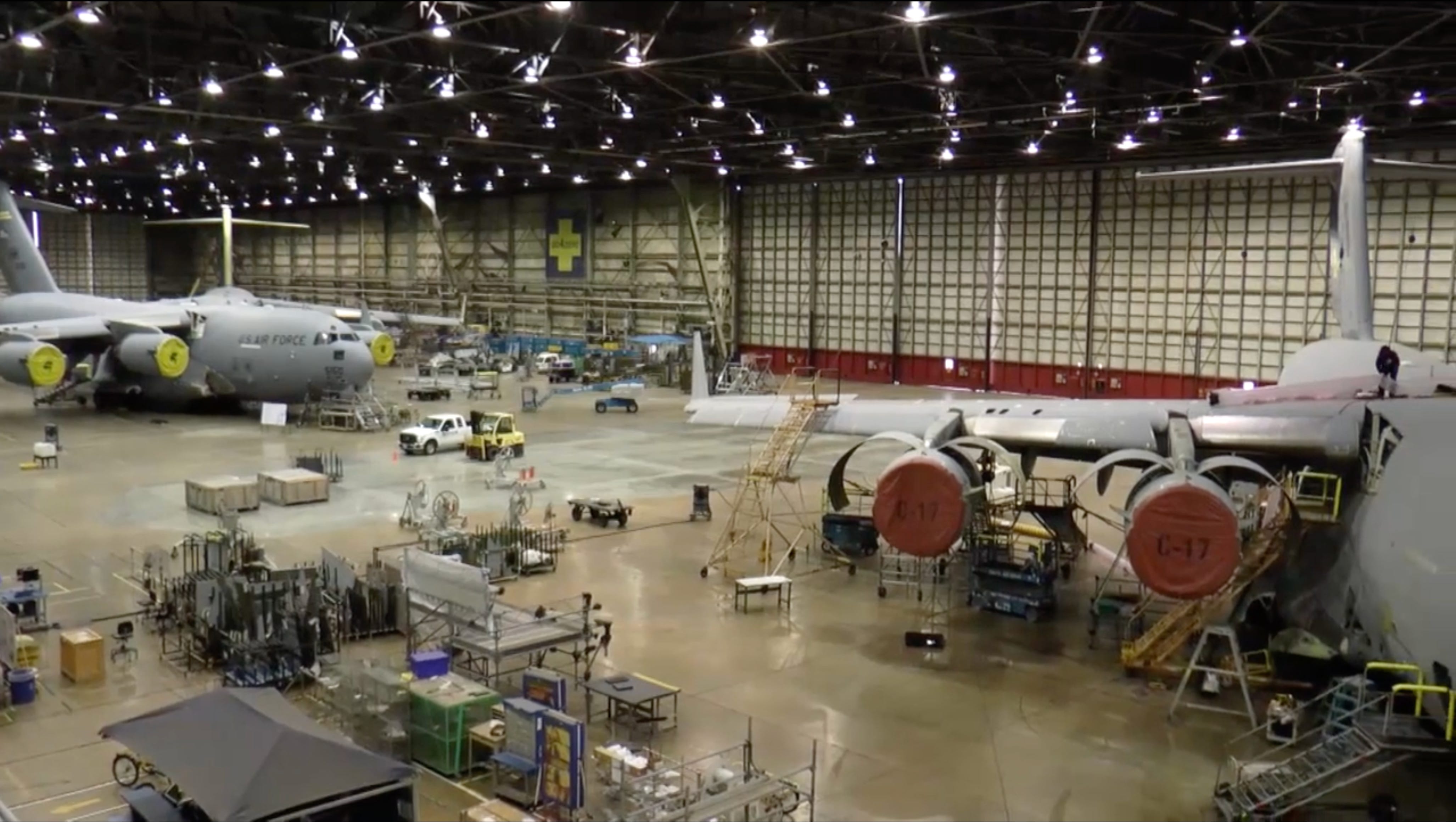
There’s a hangar on the Southwest Side of San Antonio that’s big enough to hold fifteen widebody jets. It is the largest freestanding high-bay aircraft hangar in the world, earning it a Guinness world record.
On any given week it holds C-17 Globemasters, some flown in from Australia, Canada, and the United Kingdom. The enormous airframes move military equipment around the world, but are upgraded here in San Antonio. A single overhaul can run to some 30,000 labor hours, spread across a five-year maintenance cycle. And somewhere in the rotation, since 2014, are the aircraft that carry the President and his cabinet.
Boeing, among the most recognizable companies in America, runs one of its largest maintenance operations at Port San Antonio. Its payroll there tops 3,000, more than 40% of them military veterans. By almost any measure it’s one of the most consequential employers in San Antonio.
But it didn’t happen overnight; Boeing has been quietly building here for decades. When Kelly Air Force Base closed down it left a complicated and open question: what do you do with acres and acres of runway and hangars built for the military once the military is gone? Boeing turned out to be a huge part of the answer.
The first C-17 arrived for work in 1998, back when the base was still preparing for closure and repurposing. Boeing bet on the durable infrastructure left behind: runways, hangars, and the Air Force-trained technicians. Now, every C-17 in the American fleet still comes through here for its deepest maintenance, along with C-17s flown by eight allied operators.
And demand is strong. The sustainment contract behind that work has topped $8 billion, with the Air Force adding another modification this spring, and work on the B-52, under a $2 billion re-engining order that runs to at least 2033, plus the Navy’s F/A-18 Super Hornets and the Air Force’s F-15s, all running into the 2030s. In fact, it has been such a win for Boeing that the company has reinvested more than $240 million in its facilities over the years.
A whole economy took shape around Boeing’s operations. The campus that grew up with it, Port San Antonio, now counts more than 80 employers and nearly 18,000 direct workers. A who’s-who of defense and intelligence companies at the Port includes GDIT, CACI, Booz Allen, L3 Harris, and Leidos.
Widen the lens and the figures look even more impressive. The Texas Comptroller puts the site's total output at $20 billion and ties it to nearly 84,000 jobs across the state. The Port's own commissioned study is more conservative: $5.6 billion in direct output, $9 billion counting broader regional effects, and about 18,000 jobs on the campus itself. Average pay on the campus runs near $111,000, and the after-tax income it sends into Texas households has reached almost $5.7 billion. A veritable aerospace cluster has formed around Boeing, with StandardAero, which overhauls military and commercial jet engines, and a collection of other aerospace firms moving into the Port.
The work is all federal, of course: airlifters, bombers, and even the president’s plane, but Boeing behaves more like a neighbor than a faceless corporation. The company partners with local food banks, lent its name to the Port’s event space, the Boeing Center, and has invested millions of dollars in local STEM education.
And all of that investment culminates in something valuable: A local kid can go to a technical college and find a path to the floor of a hangar that services Air Force One without ever leaving the zip code.
This city spends a lot of its attention on what doesn't work. On the eve of the NBA Finals, with the rest of the world watching, it's worth remembering that some things do—a company as recognizable as Boeing built one of its largest operations here, lent San Antonio its brand, and has grown with us for decades.
It's also worth remembering how. When Kelly closed it was a blow, but the city and Boeing bet on what was already there: durable infrastructure left by the Air Force, and let it compound. If you're looking for what works in San Antonio, this is a good place to start.
Thanks for reading The Civic. This is the first in Growth Engines, a regular look at the parts of San Antonio that work, held to the same standard we bring to the parts that don't. One scheduling note: as I mentioned last week, our weekly briefing has been moved to Fridays so we can respond to the full week of news before it reaches you.
- Philip Reichert
Editor, The Civic.
Nicely done Phillip, thx. As "growth engines" go, so long as these examples of growth are heavily subsidized, we'll see such "success" stories. But what about our organic growth the past 50 yrs, which is not dependent upon heavy subsidies? This is the arena where we need critical analysis; for that, I rely upon the CED (Comm Eco Dec) profession, which focuses upon its socio-economic paradigm to address these "wicked" challenges. I look forward to ur next segments.