



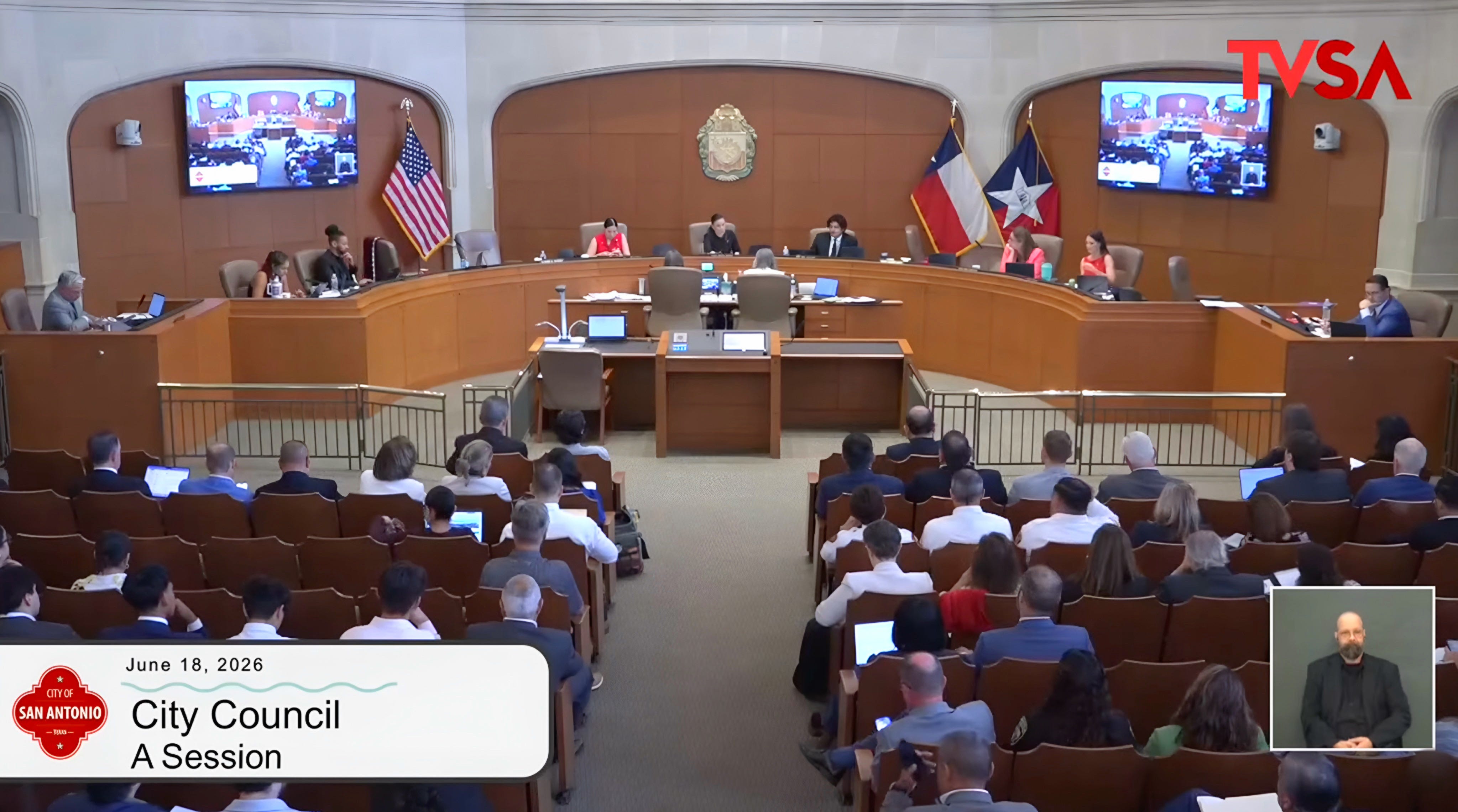
City Council on Thursday received its first detailed look at how San Antonio would close a budget gap that its own forecast projects will grow to $130.7 million by FY2028, presenting a recommendation that leans on a property tax rate increase and new fees rather than substantial reductions.
What is not in dispute is the trajectory. FY2027 itself is expected to be balanced, but a forecast presented in May projected a gap up to $130.7 million in FY2028 and $264 million by FY2031 if nothing changes. Trial budget projections balanced the budget in FY2028, while reducing the FY2031 deficit to $156.9 million.
Rather than absorb the gap primarily through budget cuts, staff recommended raising the property tax rate—the first time in 33 years—and directing every dollar it generates, $53.8 million, to police and fire, whose contract and benefit costs are climbing faster than any other part of the budget.
During the presentation, the consensus from the majority of City Council was to show the impact of departmental cuts before the consideration of a tax rate increase. While each council member brought their own list of priorities, the discussion indicated that an increase will not be supported until City Council and city staff do their due diligence in identifying budget efficiencies.
What the trial budget showed
The trial budget is a checkpoint, not the legally required budget. It incorporated the policy direction council set at a May 22 goal-setting session.
Rather than close the gap with reductions, staff recommended raising the property tax rate and adding new fees, and held cuts to a minimum. Drawing on a program-inventory analysis that classified 72.4 percent of the analyzed budget as state- or charter-mandated, the trial budget protected all mandated services and all council and community priorities, and drew its reductions only from “Other City Services,” the roughly 15 percent of the analyzed budget that is neither. Those reductions totaled $11.7 million in FY2027, amounting to $23.4 million over two years, the minimum staff said was needed to balance. The new fees, $21.9 million over two years, included raising the EMS transport fee from $1,500 to $1,700 among other new fees.
Deeper cuts were highlighted as a path the city recommended against. Balancing without a rate increase, staff showed, would require $137.7 million in reductions over two years and the elimination of 132 filled and 77 vacant positions, including $54.2 million in program service-level cuts, a $36.6 million freeze on civilian raises, and department reorganizations. The slide laying out that option was labeled “Not Recommended.”
How the council reacted
The presentation landed into a council already split along familiar lines.
The fiscal hawks have argued the city should cut before it increases taxes. “Property tax hikes should be absolutely off the table,” Marc Whyte (D10) has said, pressing for a “line-by-line examination” of spending. Against that, Jalen McKee-Rodriguez (D2) has questioned whether scrutiny can reach the scale of the gap: “you can penny-pinch and shake our city departments’ piggy banks and find $100,000 here and $100,000 there... but you’re not going to find $130 million in cuts within departments whose budgets are $10 million.” Phyllis Viagran (D3) has called for “a comprehensive approach” combining reductions with new revenue. Viagran was among the only council members who openly recommended the tax rate increase, raising concern with delaying infrastructure projects or programs that are needed throughout the city.
Whyte identified public safety as his top priority, suggesting that the city start with those funding allocations before moving to other program funding. Whyte continued to advocate for 65 additional police officers added in the next fiscal year but was supportive of cuts identified in the staff presentation.
Whyte highlighted that even with the tax increase, the city was still facing a budget deficit in 2031, meaning City Council and staff would be revisiting funding cut discussions.
“A property tax increase; it is just a bandaid to get us through the next couple of years,” Whyte said. “It doesn’t solve the problem. We have a structural issue here with the way our city government is spending money.”
McKee-Rodriguez took an opposing stance to Whyte’s recommendation, saying a reduction in community programs will lead to an increase in crime. McKee-Rodriguez suggested an independent comprehensive analysis look at the police and fire department budgets to identify areas that could be cut in favor of adding additional officers that Whyte requests.
“Cuts to departments are the bandaid,” he said. McKee-Rodriguez later added, “We will not get better services with lesser resources.”
Misty Spears (D9) identified her priorities as public safety and core city services.
“Every dollar we spend should be measured against whether it is improving the quality of life for the taxpayers who are funding it,” she said.
Teri Castillo (D5) said her priorities are on nutritional and healthcare programs that her constituents utilize regularly. A large push from council members, especially those whose districts are not in Northern San Antonio, was a focus on equity, ensuring that lower income districts did not lose services.
Mayor Jones took a similar stance as City Council, advocating for a deeper look at potential cuts and the impacts they could have on city services.
Ahead of the proposed budget, Jones said she would like to look at programs or services that the city subsidizes for private entities. Using the Botanical Gardens as an example, Jones said entities that have a ticket price should be eliminated from the city budget prior to services focusing on nutrition, health care or other public community services.
“If you charge a ticket fee, we should not be subsidizing your thing,” she said.
What’s next
Thursday was just a checkpoint and the budget will likely see meaningful changes as it is developed throughout the summer. The certified appraisal roll, due around July 25, will revise the figures that underpin both the deficit projections and the rate math; the numbers presented Thursday rest on preliminary appraisal data. The formal Proposed Budget follows in August, with council worksessions and district town halls running from mid-August into September.
Budget Director Freddy Martinez said city staff will work with individual departments throughout the summer to determine the impacts that staffing reductions may have on city services. City Manager Erik Walsh said regardless of the path City Council takes, city staff will look deeper at budget reductions, including moving operating dollars into funding for capital projects.
In the coming weeks, Jones said she is looking forward to seeing an operational analysis of the proposed cuts. “It is hard to commit here to supporting a property tax increase, when we’ve just really done a numbers exercise,” Jones said.
Walsh stated the solution to San Antonio’s budget shortfall is a mixture of generating revenue through tax increases and reducing expenses through necessary cuts.
“Our expenses are growing faster than revenues, so we need to decrease our expenses and increase revenue where we have an opportunity,” Walsh said.